For Aisha and her family, it was cash and much more
This is what UNICEF’s cash plus programme, the Mother and Child Cash Transfer plus programme is achieving in Sudan.

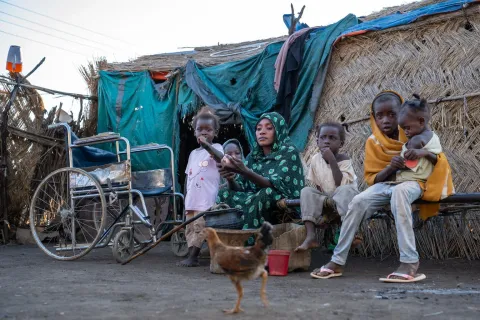
Thirty-year-old Aisha Mohammed Taher sits under a makeshift shelter that also doubles as her house, surrounded by five of her six children. The youngest Miriam is only 11 months. Aisha prepares coffee and a meal for them to eat, it is almost lunch time.
As a stay-home mother, Aisha struggles to provide for her family. The family relies on irregular support from her husband who occasionally earns from odd jobs in the neighborhood.
While her children require regular and nutritious meals to grow and survive, protection and a safe place to stay, Aisha continues to struggle to make this happen without support.
Previously she relied on handouts from neighbours, relatives and sometimes begged from well-wishers in the market to put food on the table.
The roof of her makeshift home leaked during the rainy season while her children lacked education requirements and uniforms.
“Whenever it rained, all of us and our property got wet. During bad storms we sought for shelter from the neighbours.” “Unlike other children, mine never wore uniforms to school. I couldn’t afford,” she reminisces.
These conditions expose her and the children to numerous risks including disease and several deprivations.

Aisha receives cash assistance
In June 2021, Aisha heard about the Mother and Child Cash Transfer Plus programme (MCCT+) from her neighbour. She was pregnant and eligible for enrolment. With the little money available, Aisha sought for the cheapest means of transport to Ahmed Gasim Primary Health Centre in Port Sudan where she was registered. Port Sudan is one of the nine localities in Red Sea state where the MCCT+ programme is rolled out.
“Health care centres are the heart and soul of the MCCT+ programme. Here registered mothers receive cash assistance with essential services in health, nutrition, and protection from health workers,” Louisa Omalara Farinde, UNICEF Social Policy Officer emphasized.
She has so far received a total of 140,000 Sudanese Pounds (240 USD). With the unconditional cash grant, Aisha was able to cater to the pressing and immediate needs of her family including renovation of the shelter, purchase of scholastic materials and uniforms for her children. Today her children are happier because they look no different from their peers while at school.
The smile on her daughter’s face Amna while wearing her uniform complete with a pair of black shoes and a pink backpack says it all.
Importantly, Asha also ensured she saved some money for daily meals.
“I budgeted 500 Sudanese Pounds per day for meals. This was enough for a daily nutritious meal complete with greens and vegetables,” she shared.
Cash assistance and critical health services
A key component of the UNICEF cash plus programme is linking the women to health services during the first 1,000 days of a child’s life – from pregnancy until 2 years.
Aisha benefitted from the plus component of the MCCT programme through antenatal andpost-natal care services as well as health information sessions on nutrition and hygiene. Her child Mariam has also received lifesaving immunizations at the healthcare facility and recently nutrition care.
During her recent visit to the centre, Aisha was encouraged to continue breastfeeding Mariam, sensitized on proper hygiene and sanitation practices and child spacing.
Suad Khalifa Mahgoub, the midwife at Ahmed Gasim PHC who has been at the helm of the UNICEF’s cash plus programme, also known as the 1,000 days programme since its introduction in April 2021 attests to its benefits towards the health of mothers and children. “We have witnessed a spike in pregnant mothers attending antenatal care (ANC) sessions not only in the last trimester as it was before but much earlier in addition to frequent visits,” she shared. “We used to miss out on the pregnant women in the early pregnancy days.”
Among them was Aisha.
“Before she enrolled, Aisha had never visited the health facility, yet she was pregnant. She slowly learnt about the benefits of the ante-natal care visits, and completed five of them before delivery.”
During the visits, mothers are provided with healthcare services, vitamins and folic acid, tetanus vaccinations, and health information for healthy babies.
While the unconditional cash assistance supports families trapped in poverty, when provided together with critical healthcare services, the impact is much bigger.
“Cash and services really go hand in hand,” Omalara Farinde added.
And this is what UNICEF’s cash plus programme, the Mother and Child Cash Transfer plus programme is achieving in Sudan.
Launched in 2020, by UNICEF and partners, the integrated social protection programme provides vulnerable pregnant women and lactating mothers with regular cash assistance combined with knowledge, skills and access to basic health, nutrition, and protection services during the first 1,000 days of life.
As Aisha awaits the next tranche of the cash grant due in January 2023, she already has plans for it.
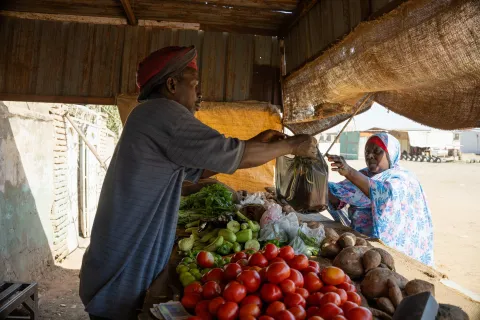
“I wish to buy nutritious food including tomatoes and vegetables for my children,” she shared.