Hunger brings sickness, for the children of South Sudan
Two-year old Lotabo is the latest in a long line of children suffering from hunger.
RIWOTO, South Sudan – The breath is shallow and ragged, as if the intake of air is painful for two-year old Lotabo, his bony ribs sticking out through his ragged top. He was brought in to the clinic in Riwoto, South Sudan, the latest in a long line of children suffering from hunger.
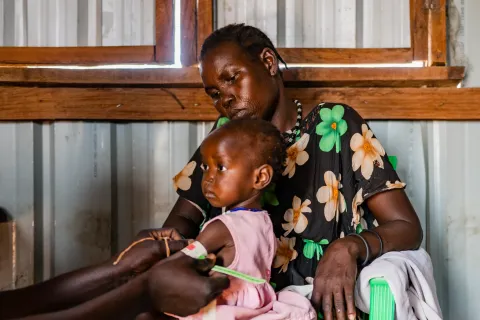
It was Lowerio Loworet that brought Lotabo to the clinic. She took over looking for Lotabo after his mother passed away. Seeing how thin the boy had become, she trekked to the remote clinic to seek help. Already suffering from severe malnutrition, he was also suffering from medical complications; diarrhoea, pneumonia, and a cough.

“We are grateful to come here. I had nothing to feed the baby. There was nothing else.”
The clinic at Riwoto, a simple tin-roof single story building, is run by UNICEF partner, Save the Children. Okello Bosco is the nutrition nurse there. He pulls out a chart of admissions for the clinic, which acts as a “stabilization centre”, providing inpatient care for the worst affected children. They are given a special feeding programme for around two weeks, before they are strong enough to return home. They then return to the clinic for assessments and supplementary feeding.
Medical staff say they fear the food security situation is getting worse. In the past month, 11 cases were admitted, however, previous few months had seen just four or five cases. Areas around Riwoto, a village located north of the town of Kapoeta in Eastern Equatoria, are assessed as being at IPC 4 level for food security. In an international classification scale that runs from 1 to 5, communities assessed at IPC 4 (severe) are considered to be on the brink of famine. Even outside the areas of direct fighting in South Sudan, the impact is felt. Economic problems have seen food prices shoot up and inflation weaken the currency. People are struggling. The harvest was also poor in 2017 after drought and erratic rains.
Back at the clinic, in another bed, mother Nomana Lobore, holds the hand of her daughter Lonyia, aged two. Her other daughter, 12-months-old, is healthy and sleeps next to them.

She brought Lonyia in when her wrists and ankles swelled up – a tell-tale sign of oedema.
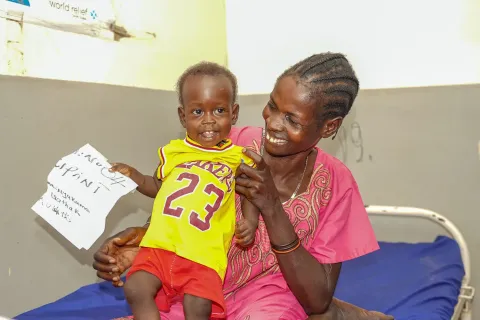
Now the swelling has subsided after two days of feeding a special formulated milk. In time, the child will be moved on to fortified peanut paste supplements.
“I was very worried, but things seem better now.”
While the survival of thousands in South Sudan remains a grave concern and very few parts of the country are escaping the effects of the ongoing food crisis, clinics such as the one at Riwoto are helping to treat the most vulnerable. The admission statistics are also encouraging. Of the children admitted to clinics like Riwoto, almost 90 per cent leave, cured of severe malnutrition.
(Funding for nutrition programming in Eastern Equatoria, as well as other parts of South Sudan, is generously funded by the Swiss National Committee for UNICEF and the Italian Development Cooperation.)