UNICEF Digital Cash Assistance programme, a lifeline for thousands of vulnerable children
Cash transfers help the most vulnerable families with children to cope with the situation and address their very basic needs through local markets
Despite the 2-year crisis, with intense bombardments, mass population displacement and acute malnutrition and famine, the Gaza Strip markets have been functioning with resilience.
On many instances, they have been completely depleted but since August 2025, we have seen more goods available to families and children especially from the private sector – app.30 to 35 trucks every day. Unfortunately, very often at extremely high prices so that families with no or extremely limited income cannot afford it. For example, UNICEF most recent data (UNICEF Gaza market analysis September 2025) shows that diets of children 6-23 months-old children are extremely limited and dominated by grains/roots/bread/tubers, complemented by breast milk, dairy, and to a lower extent legumes/nuts/seeds. These items were accessed both purchased in markets and received in-kind. Dairy was obtained mostly through markets, and vegetables as well as fruits too – but these last two categories are consumed very infrequently.
With its digitally channeled humanitarian cash assistance programme, UNICEF targets the extremely vulnerable families with children including children suffering from severe forms of malnutrition (admitted to treatment), pregnant & breastfeeding women especially those suffering from malnutrition, children and adults with disabilities, prematurely born babies, as well as sick and injured children. It also supports children without parental care, children’s victims of child labor or at risk of exploitation & abuse.
In its response, UNICEF is offering unique integrated services which include Health, WASH, Child Protection, Nutrition and Education, complemented with humanitarian cash transfers. Cash transfers help the most vulnerable families with children to cope with the situation and address their very basic needs through local markets.
Since the beginning of the crisis, UNICEF has reached over 1.1 million unique people with humanitarian cash assistance channeled digitally. On average, 53,000 people (10,000 families) have been supported every month which is too little given the widespread needs and the collapse of local economy.

The digital humanitarian cash assistance is channeled to families via digital e-wallets – an innovative solution with strong risk management. The digital cash payments via e-wallets helps to avoid any conversion to cash, reduce the space for shadow cash market and hence payment of fees. UNICEF humanitarian digital cash programme adheres to the highest standards of neutrality and impartiality. No external party, actor or agency – or even beneficiaries themselves – has a role or any form of influence on the design and implementation of the programme.
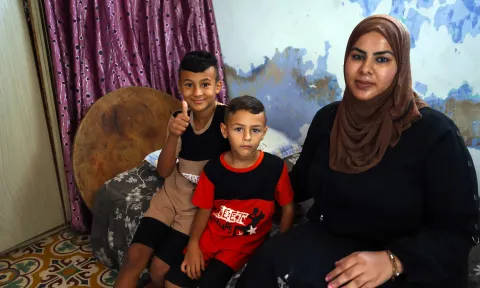
During his first visit to the Gaza Strip, UNICEF Special Representative, Jonathan Veitch met with two of these vulnerable families in Khan Younis and in Al Mawasi. “The families I met with were supported by UNICEF humanitarian multi-purpose cash and nutrition cash top up transfers recently as part of our famine response. One of the family had a child with severe acute malnutrition, a 3-year-old girl whose life was at risk and who has since recovered thanks to UNICEF cash assistance and nutrition services”, said Veitch.

The cash received was used to buy food and medication for the malnourished child among other critical needs for a family of 13 people, including 8 children. The only two males in the family cannot work, as one is critically injured, and the other one is chronically ill, leaving the household headed by women, as very difficult situation in war time. In addition, the families’ needs are very high as winter approaches. As hundreds of thousands of families in Gaza, they need tents for shelter, blankets and winter clothes for children.
The UNICEF digitally channeled humanitarian cash assistance programme - supported by donors including European Union Humanitarian Aid , UK Foreign, Commonwealth and Development Office (FCDO) and the Governments of Canada, Switzerland, Sweden, Croatia and Norway- is a lifeline since it enables families to purchase food items and medical supplies from the formal and informal markets.

The private sector has an irreplaceable role in restoring full market functionality and stabilized prices, which along with adequate humanitarian cash programms are preconditions to avert famine and eradicating malnutrition.
With an additional $7 million every month, and functioning markets UNICEF will be able to support 100,000 people (18,200 families, including more than 50,000 children).