Robotics and Learning Support Bring Together the West Bank’s Most Isolated Children
More than half of the children who attended were girls, and some five per cent of participants had disabilities

- English
- العربية
Cut off and at risk, Palestinian children living in remote West Bank villages enjoy few services.
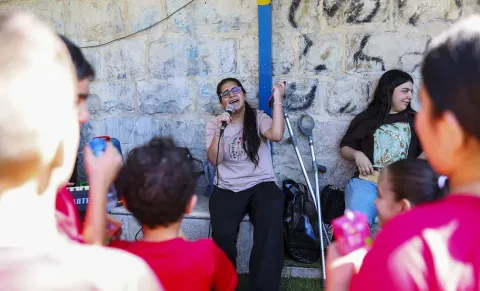
But this summer, 30,000 of these children enjoyed recreation, remedial education, and Social and Emotional Learning programs at UNICEF-led summer activities, breaking the monotony and delighting in a safe, supportive environment.

UNICEF’s summer activities program, funded by Akelius Foundation, created 264 Learning Recovery Schools that offered remedial education along with art and sport and 300 Summer STEM Schools, where children learned to foster innovation in Science, Technology, Engineering, and Mathematics through project-based learning, workshops, and robotics training.

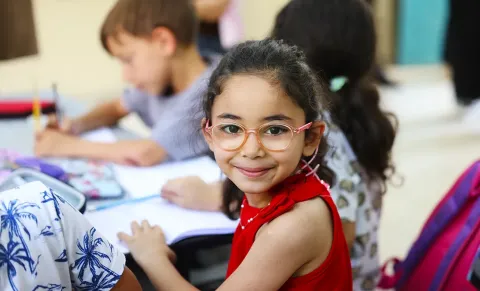
“I like coming to the Learning Recovery School because I understand math and Arabic better now,” said eight-year-old Laila. She attended the program for 15 days at the Kobar village girls' elementary school, north of the city of Ramallah.
“We also play sports and do art, which makes learning fun. I feel happy to learn with my friends every day,” she added.
Escaping Violence and Stress
Since the start of the Gaza War in October 2023, Israel has instituted increasing travel restrictions in the West Bank. In May 2025, there were 849 obstacles to movement, including checkpoints, gates that are most often closed, and various kinds of roadblocks. These measures separate families and make daily life difficult.
Violence has dramatically increased, and between January 2024 and July 2025, 39,847 Palestinians have been displaced.
Villagers living in Area C of the West Bank—remote areas containing Israeli settlements—number an estimated 370,000 Palestinians, including 103,500 school-aged children.

Schools are also impacted. A June 2025 study supported by UNICEF found that 84 schools across the West Bank, including East Jerusalem, are currently subject to demolition orders.
In the face of this heightened violence and risk, children need safe places to play and learn with their friends so that they can develop.
Twelve-year-old Lamia developed a science project—a fire detection sensor— during her time in summer school at the Abu Shkheidem Girls school, also north of Ramallah in the West Bank. “The STEM Summer School made learning so much more exciting,” says Lamia. “It showed me that math and science are not only useful, but also creative and fun.”

More than half of the children who attended were girls, and some five per cent of participants had disabilities.
“Joining the STEM Summer School has been an amazing experience. I loved learning through projects and working with robots—it made science and technology exciting and fun,” said 13-year-old Manal.
“The activities helped me discover new skills and gave me more confidence to think about my future. I’m proud to be part of this program,” she added.