Gaza’s Children Are Seeing Their Schools Destroyed, but UNICEF Has Them Back in Classrooms
As Palestinians in the Gaza Strip continue to endure horrific conditions more than 400 days on, UNICEF is doing everything it can to provide basic supports—including education—to Gaza’s children.
- English
- العربية
As Palestinians in the Gaza Strip continue to endure horrific conditions more than 400 days on, UNICEF is doing everything it can to provide basic supports—including education—to Gaza’s children.
School was supposed to start in September this year, but ongoing displacement and aerial bombardment, with 64 attacks against schools-turned-shelters in October alone, made this impossible. Instead, 57,000 first graders joined the 658,000 children that had already been denied an entire school year of learning. For the first time in decades, a graduating class was not able to complete the requirements to graduate.
To prevent students from losing out entirely, UNICEF and its partners have supports 39 active temporary learning spaces, creating tent classrooms alongside water distribution points and a small support center where families can consult social workers.
"I’ve benefited from school; now I can read and write, says 10-year-old Laith, who was displaced from the northern Gaza Strip. “I remember what lessons mean now, and it reminds me of the days in the north when I went to a clean school, with my bag, notebooks, and books. We were living a good life.”

Laith is studying at the Asdaa Learning Space in the south of the Gaza Strip, where 130 teachers, administrators, and social workers offer services and lessons to about 3,500 students. This wholistic approach also helps by providing a small stipend for the staff, the majority of whom are also displaced and without any other income.

Most of these children have been displaced multiple times and are experiencing a scarcity of food and water that threatens their health and welfare. Poor nutrition and waterborne diseases are causing illness. According to the World Health Organization, nine in 10 children under the age of five is affected by one or more infectious diseases.
The students say they yearn to return to their homes and school and to have some feeling of safety and pride.
“I'm really happy to be back at school and reading again,” says 10-year-old Lana. “My mom started teaching me to help me keep reading and writing so I can express myself better. I used to get an average of 97 per cent in previous school years."

Instead of serving as safe places for learning and development, most of Gaza’s schools have been turned into communal displacement centers; 95 per cent of them have been damaged or destroyed. Attacking a school can be a grave violation of international law.
“Schools should never be on the frontlines of war,” said UNICEF Executive Director, Catherine Russell, “and children should never be indiscriminately attacked while seeking shelter.” She said that children “must be shielded from harm, and their right to education must be upheld, even amidst conflict.”
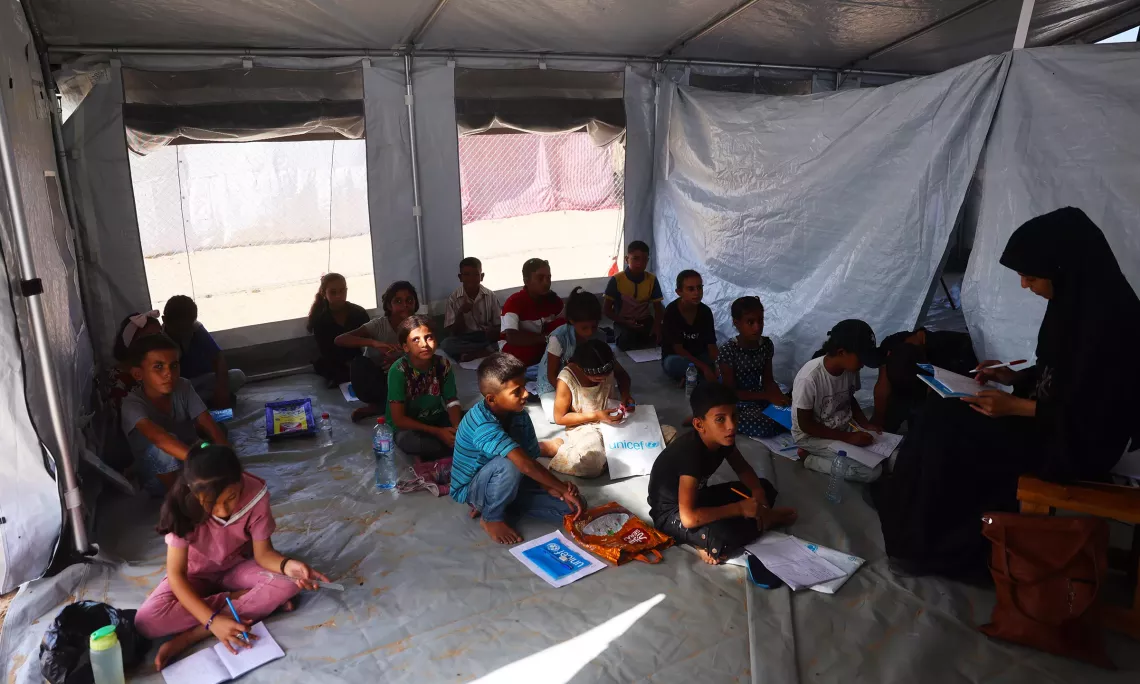
When completed, this phase of the UNICEF program will provide temporary learning spaces and other services for 5,000 children and their families. Supported by Rahmatin Lil Alamin Foundation, an independent charity in Singapore, 8,500 children between the ages of 7–13 years will have regular lessons in math, English, Arabic, and Science to prevent them from learning loss.
The program budget includes the cost of clearing an area, pitching high quality tents, putting up fences and gates to protect the site and establish a known location. UNICEF also trains the staff and volunteers and purchased new teaching and learning equipment, such as furniture for the tents for older students and mats for younger students.
Without schooling, young people face increased risk of exploitation, child labor, early marriage, and other forms of abuse—and are at risk of dropping out of school permanently. Parents report feelings of isolation and frustration in their children as the situation continues without routine and activities to help them develop.
"I’ve benefited from school by learning new words and lessons,” says Tala. “I wish to return to Gaza so we can live freely in our home, go back to school, and be with my friends again."