Giving Every Child a Legal Identity: Somalia’s Progress towards a Birth Registration System
Somalia is rewriting the story of legal identity, one birth at a time

The country is home to an estimated 700,000 to 800,000 births every year (UN Population Division, 2024 est.), yet only a small fraction of these births are ever registered. According to the 2020 Somalia Demographic and Health Survey, only three per cent of children under the age of five have had their births registered, and just 0.3 per cent possess a birth certificate. Birth registration is a rare occurrence, with rates ranging between three and seven per cent in urban areas.
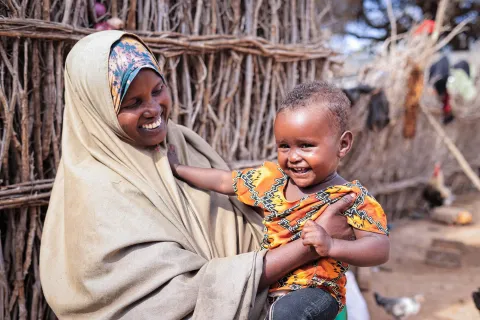
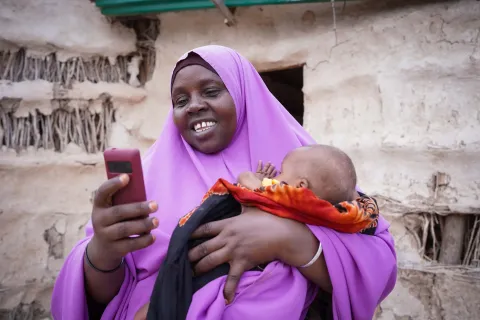
"When my baby was born, there was no way to prove she existed. Now, with a few taps on a tablet, she has a name, a record, a future." - Mother from Diinsoor, Southwest State
Without legal proof of identity, millions of Somali children, particularly those from internally displaced communities, are excluded from essential services such as healthcare, education, and social protection and face higher risks of exploitation and abuse. Somali children’s right to a name and legal identity is hindered by low demand for birth certificates and limited state capacity to deliver birth registration services.
The benefits of having a birth certificate are undeniable. They are critical for proving age, preventing child labour, marriage, trafficking, and ensuring that children in conflict with the law are not prosecuted as adults. As proof of nationality, birth certificates help migrant and refugee children when seeking asylum and maintaining family unity.
Yet amid these challenges, Somalia is rewriting the story of legal identity, one birth at a time. Driven by rising political will as seen through moves to adopt new legislation and bold pilot programmes on digitalization of the birth registration system, the country is taking historic steps to modernize its Civil Registration and Vital Statistics (CRVS) system - creating a clear pathway for every child to be seen, counted, and protected.
Progress and impact
UNICEF and the Ministry of Interior Affairs and Federal Reconciliation, along with various member state governments, have partnered to incubate and promote birth registration services within the larger CRVS framework. The Government of Germany is also a supporter of this work. The following key actions have been taken:
Institutional strengthening
An assessment of gaps in the CRVS system was concluded in 2023, and a Five-Year Strategic Plan was approved, which, among other things, aims to expand the system to 29 new districts. A CRVS Bill is expected to be passed by the end of 2025.
Interoperability of systems
Integrating the CRVS system with the health sector facilitates real-time digital registration of births and deaths. As part of the digital CRVS pilot, 19 districts were equipped with modern registration tools, including tablets, which were distributed to health facilities lacking computers. In addition, the Federal Ministry of Education has committed to mainstreaming CRVS into the school enrolment system, starting with primary-age children who have missed out on registration.
The Child-Sensitive Social Protection Programme, jointly implemented by UNICEF, local governments, and non-governmental organizations, has successfully integrated birth registration into its service delivery model. Operating in Diinsoor, Jariiban, and Odweyne, the system is ensuring that vulnerable pregnant and lactating women and their families on the social cash transfer programme have access to birth registration. The programme aims to reach about 28,000 households by the end of September 2025, of which 70 per cent have been reached so far.

Focus on decentralization
The CRVS has focused on strengthening systems at the district level to deliver birth registration services and capacity building of functionaries, including those from the health services. Public awareness campaigns and innovative folk media and cultural communication practices have been used to generate demand.
Last year, the pilot digital CRVS system was launched in 19 districts covering 158 health facilities. In 2025, the system has been scaled up to 29 additional districts, bringing the total of districts to 48. As a result of these concerted efforts, over 43,000 children in Somalia have been registered in the last two years alone.
Enhanced digitalization
A modern digital CRVS system for birth registration is in full swing, having first been piloted in 19 districts in 2023, with technical support from Open CRVS. The system was deployed with full operational capability, enabling it to be used daily in registering vital events such as births and deaths.
District registrars, health workers, and state-level officials received comprehensive training on system usage, legal processes, and data quality standards. Dedicated technical support teams were mobilized to assist frontline users in resolving digital or procedural challenges. A secure national data repository was established to centrally store the digital records, thereby improving the accuracy, reliability, and accessibility of the data along with robust data protection protocols. In 2024, the system was further enriched with the addition of digital modules for marriage, divorce, guardianship, and residence registration. The digital CRVS system is now operating in 48 districts.
Challenges
While much ground has been laid for a full-fledged CRVS system in Somalia, 70 per cent of recent registrants are aged above five years, proving clearly that there is a huge backlog of unregistered children. Furthermore, not all the regions have a digital CRVS system due to Somalia’s complex political system. And resources for the universalization of civil registration continue to be scarce, even as the legislative framework has been slow. Public awareness and demand for services continue to lag, while integration with other sectors needs greater political will.
Nevertheless, after all is said and done, there is no denying that Somalia’s CRVS reform is well and truly underway. Great strides have been made in just two years, but continued investment will be key to a sustained and successful rollout. The dream to achieve universal, secure, and affordable birth registration depends on political will and the support of donors. Here is what that dream looks like:
- The CRVS system scaled up to the remaining 40-plus districts.
- Digital infrastructure has been rolled out in underserved regions.
- The CRVS Act was passed and provides a legal backbone to the system.
- The CRVS system is linked to and interoperates with other identity systems.
- A fully aware public initiates demand for CRVS services.
The foundations have been laid. The tools are in place. Now is the time to finish what has been started. No child in Somalia should remain invisible - on paper or in life.