National numeracy training empowers over 12,500 primary one teachers in Sierra Leone
Equipping educators with new teaching skills to enhance numeracy in early childhood education

“Now, all of you count five bottle stoppers, take two from that number, give them to your friend and show me how many are left with you,” instructed Catherine as she illustrated her instructions on the blackboard by drawing bottle stopper objects. And in an excited chorus, more than a dozen children simultaneously reciprocated at the top of their voices: “three!”.
Until now, teaching numeracy to children in lower primary school in Sierra Leone has been fraught with challenges due to an absence of children’s workbooks, quality teachers’ guides, and objects used for counting in the classroom. Additionally, most primary school teachers in the country have not had the opportunity to participate in trainings to develop the skills required to deliver their lessons proficiently so children can understand and participate actively in class to enhance their cognitive development. Eight in 10 children lack basic reading and mathematics skills by age 10, and only 3 in 10 primary school teachers have the minimum qualifications required for teaching.

To improve this situation, UNICEF Sierra Leone, supported by the Global Partnership for Education (GPE), and in collaboration with the Ministry of Basic and Senior Secondary Education, Ministry of Technical and Higher Education and Teaching Service Commission, facilitated a one-week training of over 12,500 teachers of primary one children, school quality assurance officers and district officers in every district of the country to effectively deliver and facilitate numeracy lessons. Additionally, national teacher training and development of primary one numeracy materials were also provided through the generous support from the GPE’s “Delivering the Foundations of Learning for All” programme.
Both Catherine and Martha were trained in Freetown before the start of the school year in September.
“Before now, teachers of foundational learning classes delivered numeracy lessons to children without the aid of standardized and updated teachers’ guides to ensure consistency across the board,” said Brima Conteh, master trainer in the programme and who is also a lecturer in Mathematics and Computer Science at the Milton Margai Technical University, one of the teacher training institutions in the country.
“Now, we have worked out the missing link by introducing a standardized teachers’ guide, pupils’ workbook and objects that can be used to help children better understand and appreciate the lessons to improve their numeracy skills.”
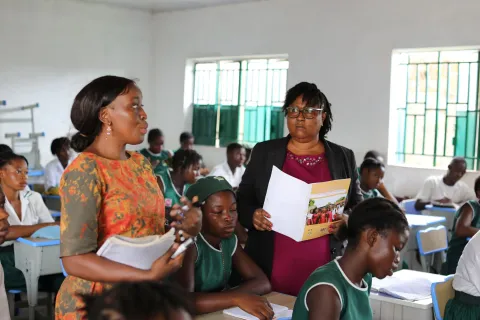
“This is the first time I am receiving this kind of training and before this, we used to write on the blackboard and asked the children to copy without necessarily understanding what they were copying,” said Catherine as she referred to the new Teachers’ Guide that has been developed to help them deliver their lessons efficiently. “Now, we use pictures so that children could understand and relate with the objects and practice them at home.”

“We also learnt how to teach children to identify physical objects for counting so that they could better understand the lessons and feel confident in the classroom,” added Martha as she went through the rows of benches and tables in the classroom to help them identify and count the objects on their desks.
“Both literacy and numeracy are crucial for shaping the foundation of children, enhancing their cognitive development and contributing to critical thinking,” said Aiah Mbayo, UNICEF Sierra Leone Education Specialist. “With thanks to the GPE, we are working with all relevant stakeholders to transform the knowledge base of teachers in foundational learning classes and improve their skills so that children could better understand the lessons, develop more interest in schooling, and kindle their aspirations.”
As Catherine and Martha prepared to go home at the end of a busy school day, with a contagious smile, Catherine said:
“this training has made me to love my job even more, to the point where I now apply the same method to help my granddaughter at home with her homework.”