10th anniversary of the Children’s Rights and Business Principles initiative

- Srpski
- English
Belgrade, 15 December 2022 – UNICEF in Serbia marked the tenth anniversary of the launch of the Children’s Rights and Business Principles initiative, advocated by UNICEF, the United Nations Global Compact and Save the Children. The Principles provide companies with concrete guidance on how to prevent adverse impacts on child rights and how to support their progress in the workplace, the marketplace, the community and in relation to the environment.
In cooperation with partners from the business community in Serbia and representatives of state institutions, the conference participants took stock of the achievements during the first ten years of the implementation of the Children’s Rights and Business Principles in Serbia and discussed the next steps in the upcoming decade, agreeing that the business sector today has an even greater obligation to put the interest of children at the core of its operations.
“In the current challenging economic and business environment there may be some temptation to abandon regulation or economic and business policies and practices framed by responsible conduct – at least temporarily – in the name of cost-cutting, the post-pandemic economic recovery, and the economic challenges the world is facing. But there is ample evidence that responsible business conduct is good for business performance in the long term. And even more importantly, the challenges the world faces highlight the need for much greater commitment, collaboration, public-private partnerships, and consistent action to promote better and more inclusive and productive societies”, said Deyana Kostadinova, UNICEF Representative in Serbia at the conference opening.
The United Nations Global Compact in Serbia, together with UNICEF, participated in discussions on laying the foundations of the principles and worked in previous years on numerous initiatives advocating for responsible business conduct that puts respect for human and child rights at the centre of sustainability of the operation of the business sector in Serbia.
“We know that progress has been made in the implementation of corporate responsibility in our country, including a much more extensive field of action going beyond philanthropic activities, despite the numerous challenges that the business community in Serbia is facing. Investors, employees, consumers and communities are becoming increasingly aware of the unprecedented crises that the world is currently facing and are demanding that companies operate sustainably and respect rights. To make progress, companies will need to adapt to emerging trends and challenges by taking into account the rights of children as key stakeholders”, said Tijana Koprivica, Chair of the Steering Committee of the Global Compact and Chief Business Sustainability Officer at Delta Holding.
The cooperation between the Chamber of Commerce of Serbia and UNICEF made it possible for members of the Chamber to participate in studies related to the implementation of the Children’s Rights and Business Principles, as well as to receive practical instructions on the implementation of the Principles and child-friendly business policies.
“Respecting and supporting child rights within business operations will lead to creating healthy and strong communities, as well as more sustainable and inclusive markets – and both are necessary preconditions for our society to grow and prosper”, said Marija Borota, adviser to the president of the Chamber of Commerce of Serbia.
Nina Glisic, a student at the Faculty of Law and member of UNICEF’s Youth Board, told the participants at the conference what young people expect from the business community. “Young people are better educated now than at any point in the past. However, education in general is not keeping up with market transformations worldwide, and that is why it is important for us that the business community helps to provide young people with internships so they can acquire the skills necessary for the labour market. It takes up to two years for young people in Serbia to get the job they are educated for, while in Europe it takes them five months. We believe that the business sector in Serbia will help young people to shorten this period for us in Serbia as well”, pointed out Nina Glisic.
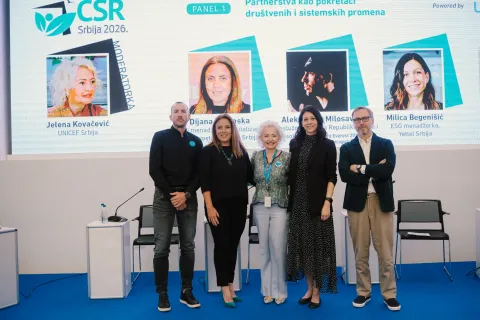
During three panel discussions on the topics of “Workplace: Child- and Family-friendly Business”, “Marketplace: Child-responsible Products and Services” and “Community and Environment: Respecting and Supporting Child Rights”, representatives of the business sector, regulatory bodies and state institutions discussed which spheres of business have the greatest opportunity to improve business with the focus on children and whether the changing legislative, socio-economic and environmental contexts require a stronger commitment of the business sector to child rights.
At the “Workplace” panel, Sanja Rajacic, representative of Banca Intesa and Gorana Antic from Delhaize Serbia, presented their practices, which include developing family-friendly policies and the self-assessment carried out in cooperation with UNICEF, in order to take into account the opinions and suggestions of employees. Comtrade representative, Anja Aleksic, pointed out that family-friendly policies were spontaneously developed and changed according to needs, but that children of employees are a part of the Comtrade family and that special attention is paid to ensure that working parents have a good balance between private life and work. National Coordinator for Serbia at the International Labour Organization, Jovan Protic, pointed out that the decent work of parents is the foundation of corporate responsibility and that we have a lot of work ahead of us in order to meet this requirement in various industries.
At the panel discussion “Marketplace: Child-responsible Products and Services”, Mila Milenkovic from Telekom Serbia, Mihajlo Jovanović Dzaril from Fortuna Esports, Nenad Milic from IAB and Emina Bekovic from the Ministry of Information and Telecommunications – National Contact Centre, discussed how to reduce the adverse effects of excessive consumption of digital content, as well as video games and inappropriate marketing campaigns.
They concluded that their representatives and state institutions should work together to address the issue of the absence of regulatory frameworks in these areas, and that the corporate sector should focus its actions on increasing the knowledge and skills of parents, and that it is necessary to further work on developing digital literacy of both children and parents.
The panel on “Community and Environment” gathered Ana Ivetic from Schneider Electric, Milos Paunovic from Nordeus Foundation, Jovana Lukic, from SBB Foundation and Sanja Bunic from the Chamber of Commerce of Serbia. They discussed how companies and foundations are supporting the government and humanitarian organizations in response to emergencies, as well as how they direct their funds to programmes for the benefit of children. Representatives of Schneider Electric and SBB Foundation pointed out that their companies particularly insist on following the business principle no. 7, which is about respecting children’s rights in relation to the environment. Strategic investment in the exercise of children’s rights in the field of education, health and protection is the focus of the Nordeus and SBB foundations and the Schneider Electric company. Sanja Bunic from the Chamber of Commerce of Serbia pointed out that the annual national award for corporate social responsibility is an additional encouragement for the business sector to integrate human rights through its operations, including the human rights of children, environmental protection and investment in the community.
The Conference ended with the conclusion that investors, employees, consumers and communities are becoming increasingly aware of the unprecedented crises that the world is currently facing and are demanding that companies operate sustainably and respect children’s rights. To make progress, companies will need to adapt to new trends and challenges by integrating child rights into their core strategies and activities. This will enable them to strengthen their existing initiatives for business sustainability while ensuring benefits to their operation, while simultaneously making their contribution to creating a fair world where no one is left behind.
Media contacts
Additional resources

About UNICEF
UNICEF promotes the rights and wellbeing of every child, in everything we do. Together with our partners, we work in 190 countries and territories to translate that commitment into practical action, focusing special effort on reaching the most vulnerable and excluded children, to the benefit of all children, everywhere.
For more information about UNICEF and its work for children, visit www.unicef.org/serbia
Follow UNICEF on Facebook, Twitter, YouTube, Instagram and LinkedIn.