

Nurturing Care for Healthier Futures
Innovating Primary Health Centres` Practice in Caring for Families with Young Children
Authors:
- Dr Jelena Jankovic, Assistant Minister of Health for Public Health, Ministry of Health of the Republic of Serbia
- Dr Danijela Urosevic, Assistant Minister of Health for European Integration and International Relations, Ministry of Health of the Republic of Serbia
- Dr Jelena Zajeganovic Jakovljevic, Health and ECD Specialist, UNICEF Serbia
- Mila Vukovic Jovanovic, ECD Officer, UNICEF Serbia
- Ivana Vojvodic, Social and Behaviour Change Consultant, UNICEF Serbia
Motivation
Nurturing Care for Healthier Futures - The past decade of child health care reform on the primary level in Serbia was marked by national efforts aimed at elevating family-centred, strengths-based care, early stimulation and developmental monitoring, home visiting, and early childhood interventions for the most vulnerable families. The paradigm shift from treatment-oriented care to holistic family-centred care was further underpinned in 2018 with the introduction of the integrated Nurturing Care Framework (NCF) into interventions supporting health, nutrition, safety as well as responsive caregiving and learning through advancement of health care practices with families with young children. By fostering innovated practices of care through essential services at the primary health care level, Serbia is advancing the well-being of parents and its children - a strong foundation for a healthier, more prosperous future. Aligning pre-service education and in-service professional development and daily practice with contemporary evidence demonstrates that access to quality services enhances parental skills and wellbeing, thereby increasing the likelihood that parents can provide adequate care for their children.
National commitment paving the way for innovation of primary health care practices
Serbia joined the global community of countries that recognize optimal development in childhood as a priority of the 21st century, which as such is integrated into the Sustainable Development Goals of the 2030 Agenda.
The crucial role of the health sector was recognized also in the National Programme for ECD adopted by the Serbian Government in March 2016. It recognizes the importance of the health sector in promoting a child`s development and supporting parents and wider environment in creating conditions for optimal child`s development, but also stresses the importance of cross-sectoral coordination between relevant sectors (health, social welfare, education, culture and information, finance) in providing support to families.
The turning point for Serbia was April 2018, when, after strong advocacy by UNICEF, the “Call for action: development for each child and society” was signed by Serbia’s ministers for health, education and social welfare and by the President of the Council for Child Rights. Thus, the Government has positioned ECD at the top of the national agenda.
Soon after, a new impetus set the ground for implementing innovative, strengths-based, family-centred practices of support to families in building their capacities for quality childrearing. The Nurturing Care Framework was launched by the World Health Organization, UNICEF, and the World Bank, in collaboration with the Partnership for Maternal, Newborn & Child Health, the Early Childhood Development Action Network. The Serbian Government started to align its programming with the new integrated evidence-based framework. Serbia was one of the examples of good practice on the launch of the NCF.
Nurturing Care Framework - Serbia showcasing country commitment and success
Five years after the launch of the NCF, in 2023, it was time to take stock of the uptake of the roadmap proposed in the Framework by governments and partners and to reflect on the value it has added to the field of early childhood development. In occasion of the 5th anniversary According to the latest NCF Progress Report 2018-2023, the Nurturing care framework has proven to be an indispensable tool on the journey to create a better future for current and future generations, starting in early childhood. Serbia was one of 51 countries participating in the rapid survey on effects of implementation of the framework carried out in 2023, and one of the country showcasing results at the Global Launch of the Progress report.
|
Serbia is committed to achieving a fairer and healthier start for every child, and the progress made in the implementation of the Nurturing Care Framework is extremely encouraging. Through a comprehensive approach that includes the family, the community, health and educational institutions, financial support for families with children and business policies tailored to the family, Serbia has made significant progress in providing optimal conditions for the growth, development and well-being of every child, former Special Advisor of the Prime Minister of the Republic of Serbia for SDG Agenda, prof. dr Slavica Đjukić Dejanović in occasion of the 5th anniversary of the launch of NCF, July 2023.
NCF introduced the change of paradigm in service provision – from traditionally “child-centred” to “family-centred” approach, putting parents in the focus of our interventions. By equalizing responsive parenting and early learning through play with the well-recognized aspects of nurturing care such as health, nutrition and safety, the framework has influenced completely new dimension of the practice and thus professional development of health workers who are supporting families of young children, Chair of the Ministry of Health Working Group on ECD and ECI, prof dr Milica Pejovic Milovancevic in occasion of the 5th anniversary of the launch of NCF, July 2023 |
In 2020, the COVID-19 pandemic exacerbated poverty, inequality and vulnerability of a large number of families and children, which required a more coordinated approach in programming recognizing the interdependencies between nutrition, health, care and education, social protection especially in the ‘first 1000 days’.
The same year, a National Cross-Sectoral Committee on Early Childhood Development and Parenting Support was formed and the year after the Ministry of Health Working Group on ECD and ECI to pave the way for a more effective coordination in changing and implementing family-centred early childhood development policies and services.
Challenges driving the Nurturing Care agenda forward
While Serbia has made substantial progress over the last decades in improving child health, due mainly to well organized and accessible health-care services, including at the PHC level, many challenges remained. Like other countries in the region, Serbia has wide social and economic disparities.
Children are the most vulnerable age group: In 2020, 10.6% of children in Serbia lived below the country's absolute poverty line and their number is increasing due to the effects of global crises. According to the MICS 2019 Study there are also sharp disparities in child health and development outcomes between the general population and minority groups - young children from poorest quintile lag 8 months behind children from the richest quintiles. Mortality rates among Roma children are significantly higher than the national average. The nutritional status found among children aged under five living in Roma settlements reveals a less favourable situation in respect to the general population — 7% of children are underweight and 17% are stunted. Across Serbia, only 24% of children are exclusively breastfed in the first five months, and only 8% of children in Roma settlements. Physical punishment is used with one third of children age between 2 – 4 years and 60% of preschool-age children grow up without fathers` involvement in play and learning activities.
Estimates from 2019 show that are 60,000 children in Serbia, up to 5 years, which live with developmental delays or disabilities, at risk of social segregation, which makes them vulnerable to stay behind. In addition, according to the in-depth analysis of practices in support services for young children and their families conducted in 2017, Serbia has advanced regulation that promotes social inclusion however it was still faced with persisting gaps and challenges. For the vast majority of these children, the developmental delays used to be recognized too late, parents were often left to find their own way through a maze in which services are fragmented, inaccessible or too expensive. Children with developmental delays and disabilities (CwDD) are particularly vulnerable to stigma and discrimination, from a lack of early detection or diagnosis to exclusion from education and participation in their communities. A tendency to want to ‘fix’ CwDD – rather than changing attitudes and supporting their functioning and participation in society – prevailed. The major focus was on providing medical responses to correct ‘defects’ rather than wider support to help children reach their potential. Services were lacking the new evidence and innovative approaches that put families at the centre of interventions and treatment approaches.
Considering persisting inequalities, professional practice and policy landscape needed to reverse to a more holistic, intersectoral nature reassuring long-term national commitment across different sectors and new investments in advancing primary health care to address these challenges.
Transformative Power of Nurturing Care in Innovating Primary Health Care through essential services
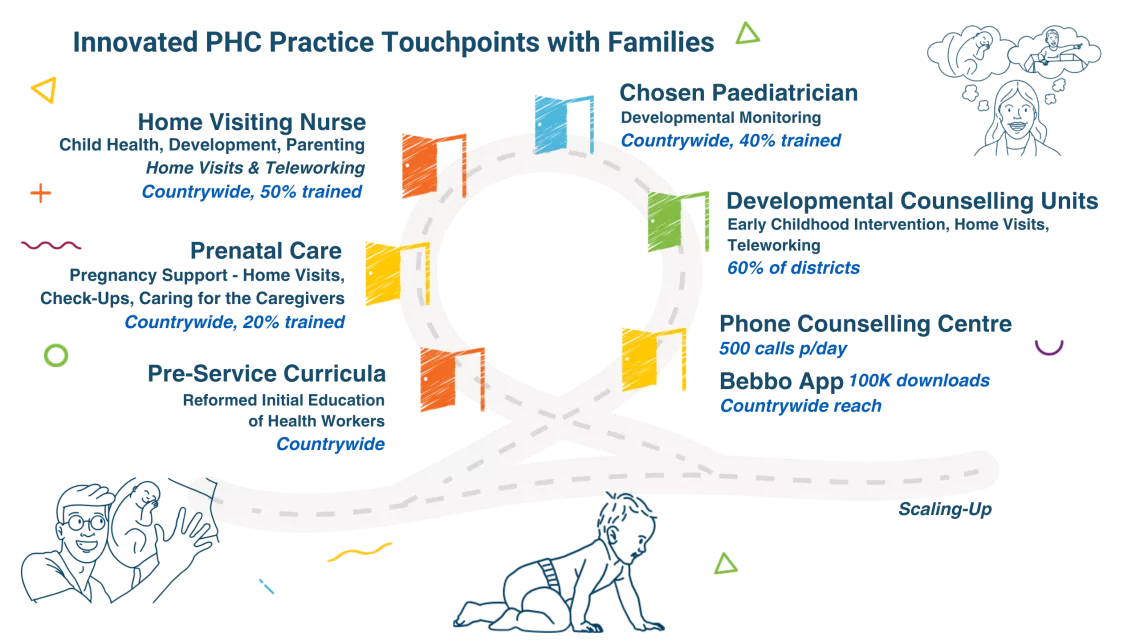
The path of innovation of practice in primary health care yielded significant outcomes. Serbia has improved support, through regular paediatric health care, home visiting nurse services and developmental counselling units, for supporting and monitoring of growth and development, education and counselling of parents in the field of nutrition, health, responsible, gender-balanced parenting, early development and learning through play.
Serbia started to Introduce a new paradigm in the child-care model through primary health care – family-centred and strength-based care, in which capacities of parents and parental mental health and wellbeing are equally important for outcomes of the child. These are key elements in promoting holistic health. The innovation of practice at the primary health care level incorporates the pyramid of support from universal to progressive and targeted support to the most vulnerable families and builds on existing essential services which are widespread in the country (the basic health package foresees 10 or more preventive visits to a paediatrician and ten home visits by a patronage nurse during the first 5 years as well as developmental counselling units established in each of the districts).
The systemic interventions included institutionalisation of nurturing care and developmental monitoring through national guidelines for paediatricians and home visiting nurses. In partnership with the National Chamber of Nurses, the guidance has been promoted in several occasions. Hard copies have been widely promoted and disseminated to all of 158 PHC centres in the country.
The health information system for quality assurance of Maternal, Newborn, and Child Health services at primary health was advanced by introducing nurturing care and early childhood development in the by-laws regulating scope and quality of paediatric and home visiting services. The regulation about documentation was changed for home visiting nurses and the new digitalized solutions that integrate developmental monitoring prepared for paediatricians. In addition, methodology and digitalized platform for Registry of children with disabilities were developed based on the functional assessment of child development and International Classification of Functioning, Disability and Health. All these efforts were vital in ensuring true integration of the focus on developmental aspects into the routine health care services and consequent monitoring of progress.

Although initiated during COVID-19 through specific Guidance for the work of the visiting nurse service during the COVID-19 pandemic, the continuity and efficiency of maternal, newborn, and child health services was fostered through newly introduced tele-counselling services for home visiting nurses and for early intervention practitioners of DCUs.
In more than 50 municipalities (30% of all), inter-sectorial collaboration was strengthened to support improved health and developmental outcomes and wellbeing of all and particularly marginalized children and their families. Local inter-sectorial bodies for parental support were formed, protocols of cooperation developed, new measures introduced across municipal plans and local budgets allocated to support health and other systems provide optimal support for early childhood parenting.Professional development is core for advancing PHC services
New professional development programmes were developed for primary health care professionals. Capacity building packages introduced digital solutions and blended learning (online and face-to-face). The most important for expanding effectiveness and quality of care were steps to introduce supportive supervision and on-the-job training for health professionals.
Through accredited capacity-building programme, focused on developmental screening and monitoring, 40% of paediatricians have improved their skills for early detection of risks, delays and disabilities and quality development monitoring by using standardized developmental screening tools such as Ages and Stages . The growth and development related milestones monitored during paediatric check-ups are being introduced in the digital information system. This process is underpinned by introduction of developmental paediatrics initiated in 2016 through elective courses for medical students and a revised paediatric syllabus, with a parallel process being introduced in nursing schools.


Home visiting nurses, as part of primary health care in Serbia, through universal and progressive visits (app. 10 in the first 1000 days), provide all aspects of day-to-day counselling of parents in the area of nutrition, health, responsive parenting, safety, early development and learning through play, as well as family wellbeing. So far, half of the home visiting nurses in Serbia are empowered through innovated evidence-based comprehensive capacity building programs fully aligned with the NCF. Professional change of home visiting nurse practices is not reflected only in the content and what they do, but particularly in the way how they deliver services.
The focus is switched to caring for those who care for children and promoting caregivers' mental health and emotional well-being, addressing barriers by encouraging self-care, stress relief strategies, gender equity in parenting, strengthening parental alliance, family engagement and resources.
“Everything changed for me as a parent when I got reassured by a comforting health worker’s word ~You are not alone in this, let’s face the challenge together” ~ (Mother from Novi Sad)
Frontline workers felt that the Program Caring for the Caregiver shifted their priorities. One frontline worker said: "Attention to the feelings such as worries, fear, exhaustions in parents have been included into the priority list"
The biggest value the CFC Program is bringing to families is that it leads them, with the support of the Front-line workers, through self-care and coping practices. The key message is that sometimes is just enough for caregivers to have a warm and supportive person next to them who listens. On the other hand, this program is totally applicable on us – professionals – too. Kristina Nedeljkovic, home visiting nurse and head of the home visiting nurse service of the Health Center of Novi Sad.
These practices are part of the legislation that defines the scope and content of their work, they are core components of the professional guideline for HVNs, accredited by National Health Council for continuous medical education, and are currently being included in the pre-service training for home visiting nurses.
Prenatal maternal care now emphasizes care for emotional well-being of families with pregnant women and preparedness for parental role. Serbia is one of 13 countries implementing the Caring for the Caregivers (CFC) program[i]. PHC Home Visiting Nurses working with families and children play an essential role in this regard, especially if we consider that many barriers caregivers might face (lack of the physical, psychological, and social capacity to care for their child, jeopardized mental health for instance). Health workers are therefore being equipped with adequate skills for building trustful relationships with families and for supporting caregiver`s needs through existing maternal and child health programs/services. PHC health workers visits to families in the prenatal period dominantly focus on building mutual trust and connection.
Since 2016, to better support the most vulnerable families and complement the work of home visiting nurses, the Ministry of Health and UNICEF continuously supported the capacity building for health mediators for Roma population on different components of nurturing care. In 2022, 12% of health mediators have been trained for providing support to emotional well-being and mental health of parents and caregivers from Roma families with young children.
PHC-led early detection and family-centered early intervention for CwDD are changing reality of families and children
For the most at-risk children with developmental risks, difficulties and disabilities, family-oriented Early Childhood Intervention services have been modelled in Serbia to bring together primary health centres, pre-schools, and social welfare services. According to the model developed, ECI Services are being coordinated by Developmental Counselling Units in Primary Health Centres. Aligned with European standards, the early intervention components start with early identification, followed by in-depth developmental assessment, determination of eligibility, and provision of family-centred support in the child’s natural environment with activities integrated into her or his daily routines. Parents and caregivers are seen as equal partners in planning and delivering early childhood intervention.

Limited knowledge on disability rights, prejudices, and insecurity resulting from self-perceived lack of preparation and adequate resources for inclusive and family oriented ECI, affects professional self-confidence and readiness to provide quality care to families. Thus, capacity building interventions in Serbia appeared to be crucial in increasing professional`s self-efficacy in working with families with children with disabilities. So far more than 300 professionals from the sector of health care, social welfare, preschool education have been trained and have increased confidence in providing integrated ECI services.
Changing beliefs, attitudes, and practices of professionals at developmental counselling units, pre-schools and social welfare services has proven key to move into transdisciplinary support for the families and consequently improve access and quality of services.
The ECI model has recognized the need to support strengths of caregivers of children with developmental delays or disabilities as they report more frequently experiencing feelings of inadequacy and poor self-confidence. Therefore, caregivers skills group training introduced in 2018 becomes essential in adopting strategies to engage children in communication, play, and home routines and promote adaptive behaviours and learning. This has led to increased parental satisfaction with family-centred and integrated approaches in PHCs and the level of participation in planning intervention tailored to the child` and family`s needs.
“This support programme is especially important for us parents because this is the first time someone asks us how we feel, how we as parents cope with the whole situation of raising a child with disabilities. It is such a valuable program because only now we see how many important moments we missed for the work and inclusion of our children in everyday life activities child can benefit from, which we parents can do ourselves, on the other hand we have invested so much in taking children to different therapists”, feedback from the Interview session with parents during the Caregiver Skills Training.
In the process of scaling-up integrated ECI model, 60% of districts in Serbia have been reached with a tendence of spreading countrywide.
Essential Public Health Care Services can rely on innovation and digital tools
Digital world has widened opportunities for reaching out and engaging with parents. We can proudly say that teleworking such as high-quality video counselling is an important pillar complementing the work of home visiting nurses and ECI teams in Serbia.

The new regional mobile application for parents - Bebbo app (that was originally developed in Serbia) improved uptake of trustworthy and relevant information related to parenting, child development and nurturing care reaching more than 820,000 users across our region of which 100,000 in Serbia. According to latest Bebbo app (regional) user survey analysis, 80% of respondents agree or strongly agree that Bebbo helps them better support their children’s development, better understand their needs and helps them feel more confident as a parent.
Playing, reading, managing difficult behaviors, caring about own mental health, tracking child development and vaccination are among the areas for which the respondents report perceived change in behavior upon using the app. In Serbia, the Bebbo app is an extended hand of the telephone counselling service for parents (available 24/7), established by the City Institute of Public Health of Belgrade in 2002 with support from UNICEF, which today has the capacity to answer more than 500 calls per day from parents across Serbia.
These possibilities need to expand, with the caveat that nothing can replace face-to-face interaction of professionals and parents.
Resources for parents and caregivers aimed to increase parental skills for nurturing care and responsive, playful parenting are growing through ante- and postnatal services, maternity units, and preschools, including digital innovations such as Bebbo application.
Increased satisfaction and improved practices of parents
Parental well-being is more and more in the focus of everyday practice of health care workers, and benefits of a father’s involvement in child rearing is more systematically fostered by health professionals. These efforts are mirrored in the improvement of parent-child interaction, involvement of both mothers and fathers of young children for early stimulation through play and talk. The fathers’ engagement increased by 20% in the targeted localities compared to baseline (national average).
According to the findings of the Implementation Research from the Scaling-Up Playful Parenting Program PHC health workers are highly trusted sources of information and emotional support during early childhood (for vulnerable families very often the only source) and are perceived as “empathetic, supportive, they show appreciation and understanding, respond to needs“.

LOOKING FORWARD AND REFELECTING ON THE IMPLEMENTATION SUCCESS FACTORS
The Ministry of Health remains committed to strengthening ECD support to children and their families across the country in a sustainable manner through cross sectoral coordination between health, education, and social sectors, particularly to meet the needs of the most vulnerable families. Continuous evidence generation feeds the programming and supports aligning legal framework with innovated practices. One of success factors is active role of academia for sustainable pre-and in-service professional development. New guidelines and capacity-building programmes for visiting nurses, paediatricians, and other health professionals, together with the mobilization of local intersectoral teams, will help ensure that all children and their families have timely access to guidance and support for nurturing care. Supportive supervision of the work of professionals is a direct investment in the strengths, quality, and fidelity of service provision and workforce retention. In addition, expanding nurturing care programmes for parents and participation of caregivers in programming remains a priority for the years to come.
To achieve this, continuous multipronged approach is applied in:
- fostering cross-sectoral coordination and referral mechanisms at national and local level for universal and intensive support to families with young children
- operationalising the National Program for ECD with costed plan of actions across sectors
- enabling continuous professional development which include mechanisms for horizontal exchange and helps aligning pre-service education with innovation in the in-service practice
- fostering innovation of paediatric, home visiting services, developmental counselling units with special attention on the lack of human resources
- supporting digitalisation in health
- ensuring developmental screening is part of everyday work of every PHC paediatrician in the country
- supporting institutionalisation of the work of health mediators with Roma families
- exploring opportunities for re-converting existing resources and services, e.g. expanding the way of working with families and providing “distance” and community-based support

Acknowledgements
Special acknowledgment to all PHC centres, their managers, health professionals and associates from DCU teams that have been pioneers in introducing innovations in their day-to-day practice. Special thanks goes to all our partners that has jointly with Ministry of Health and UNICEF been upfront in developing and supporting health system strengthening components such as Institute of Public Health of Serbia, Paediatric Association of Serbia, Belgrade City Institute of Public Health, Institute for Mental Health, Belgrade Psychological Centre, NGO Harmonija, Standing Conference of Towns and Municipalities, Association for Public Health of Serbia, Association of Health Mediators, Association of Home Visiting Nurses, Roma NGO Bibija, NGO Autism Serbia. In addition, extraordinary cooperation with the ministries of education, family care and social welfare, as well as engagement of respective institutions in the mandate of these sectors ensured a comprehensive and intersectoral coordinated action in mainstreaming NCF.
USEFUL RESOURCES /Real Stories from Real Lives:
- Empowering Families: The Transformative Impact of Visiting Nurses
- Innovative support provided at the right time
- Kosta, mom and dad – three superheroes - Breastfeeding during the COVID-19 pandemic
- Matej is a winner
- Bebbo - A Reliable Parenting Guide
- Animation Step-by-step through parenting in the first 1000 days
Quotes:
[1] SERBIA: Capitalizing on strengths (nurturing-care.org)
[2] https://nurturing-care.org/events/launch-of-the-nurturing-care-framework-progress-report/
[3] Nurturing care framework progress report 2018-2023: reflections and looking forward. Geneva: World Health Organization and the United Nations Children’s Fund (UNICEF), 2023. Licence: CC BY-NC-SA 3.0 IGO
[4] Jakovljevic J., Jankovic Mladenovic S., Knjeginjic V. - Serbia - Capitalizing on the health system’s strengths to build a new approach to nurturing care, Case Study: https://nurturing-care.org/resources/nurturing-care-case-study-serbia.pdf
[5] Development of Poverty Projections Based on the Potential Impact of Conflict in Ukraine on The Most Vulnerable Groups in Serbia, with a Particular Focus on Children, UNICEF Serbia, 2023
[6] Serbia Multiple Indicator Cluster Survey 2019 and Serbia – Roma Settlements Multiple Indicator Cluster Survey - Statistical Office of the Republic of Serbia and UNICEF. 2020. Serbia Multiple Indicator Cluster Survey and Serbia Roma Settlements Multiple Indicator Cluster Survey, 2019, Survey Findings Report. Belgrade, Serbia: Statistical Office of the Republic of Serbia and UNICEF
[7] Open Society Foundations, Institute of Psychology and Pediatric Association of Serbia, ‘Standardization of the Instrument “Ages and Stages of Development” as a Part of a Project Piloting Early Intervention System in Serbia’ (Unpublished), 2019.
[8] Open Society Foundations and UNICEF Serbia, ‘Report on the In-depth Analysis of the Current Practice of Support Services for Young Children and Their Families’ (Unpublished), 2017
[9] Including the prenatal visit of the home visiting nurse to a family with pregnant woman
[10] Registry of children with disabilities: Registar dece sa smetnjama u razvoju full.pdf (unicef.org)
[11] Issued by the National Institute for Public Health of Serbia ~Dr Milan Jovanovic Batut~
[12] Technical Guidance has been developed on the implementation of the Ages and Stages Questionnaire standardized according to the Serbian context in pediatric practice
[13] Supporting Families for Nurturing Care: Resource Modules for Home Visitors: https://www.issa.nl/modules_home_visitor
[14] Rochat T.J. Redinger S. Rozentals-Thresher R. Yousafzia A. Stein A. (2019). Caring for the Caregiver. UNICEF, New York. (The Caring for the Caregiver is a training module which aims to build frontline workers’ skills in strengths-based counselling to increase caregivers’ confidence and help them develop stress management, self-care and conflict-resolution skills to support their emotional well-being.)
[15] Roma Health Mediators are extended arm of the health system towards the most vulnerable Roma families. They work within patronage nurse services in the PHCs and are employed to assist Roma families obtain right to health and other entitlements. Since 2009, MoH has employed 85 of them throughout Serbia.
[16] Case Study, Family-Centred Services for Early Childhood Intervention: Highlighting Initiatives in Croatia and Serbia, UNICEF ECARO, 2022
[17] Applying Social and Behavior Change Approaches to Support Inclusion of Children with Disabilities – Case studies from Europe and Central Asia, United Nations Children’s Fund (UNICEF), February 2022
[18] Developmental Counselling Units are established within Primary Health Centers
[19] Applying Social and Behavior Change Approaches to Support Inclusion of Children with Disabilities – Case studies from Europe and Central Asia, United Nations Children’s Fund (UNICEF), February 2022
[20] The Bebbo mobile app was launched by the UNICEF Regional Office for Eastern Europe and Central Asia in 2021, based on a prototype developed in Serbia and then rolled out in 14 countries in 19 language variants. It is a free parenting support app that provides caregivers with expert advice on a range of child health and development issues, from nutrition and breastfeeding to early learning and the value of play, responsive parenting, protection and safety. Some of its features include games for caregivers and children, ideas on engaging in playful interaction with children through these games stimulating learning and development, tracking children’s milestones, and assisting caregivers in supporting development through play.
[21] Applying Social and Behavior Change Approaches to Support Inclusion of Children with Disabilities – Case studies from Europe and Central Asia, United Nations Children’s Fund (UNICEF), February 2022