Papua New Guinea: A back-to-school campaign gathers momentum
2020 was a challenging year for both educators and students in Papua New Guinea.
2020 was a challenging year for both educators and students in Papua New Guinea. Even before the pandemic, Papua New Guinea’s education sector faced many challenges. Development partners such as UNICEF have worked over the years with the government to overcome these challenges, which will require greater investments to improve education outcomes.
Papua New Guinea’s geography, its socio-economic fabric and weak capacities add to the complexity. Approximately 80% of the population live in rural and remote areas and many rely on subsistence agriculture. Social protection mechanisms are few and most assistance is delivered through family and community networks. Rates of gender, family and sexual violence are amongst the highest in the world, while the health system has been assessed by WHO as among 10 worst in the world.
Addressing the impact of the pandemic on education
Attendance and student retention rates have been low for the past years across the country, due to range of intersecting factors, including the stresses caused by poverty, illness, tribal fighting, child labor, natural disasters and family, domestic and sexual violence. The impact of COVID-19 has further disrupted school attendance across the sector.
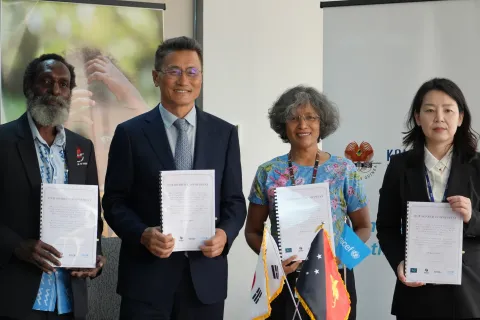
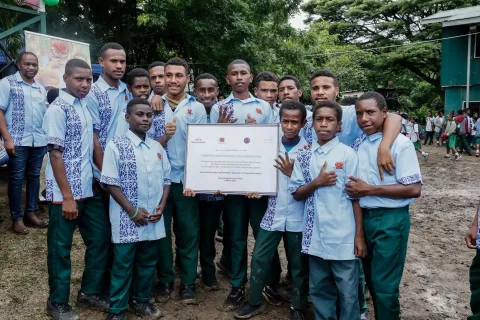
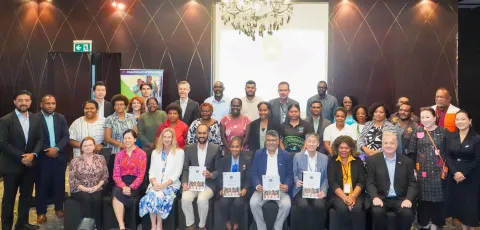
As part of Papua New Guinea’s national COVID-19 response efforts under the Niupela Pasin (the ‘new normal’) and in an effort to build forward better, the National Department of Education is leading an initiative to encourage students back into the classroom with development partners, including UNICEF, Child Fund, World Vision and Save the Children, and funding from the Global Partnership for Education.
Key to these initiatives is raising public awareness on COVID-safety measures. These include efforts to improve hygiene, adhering to physical distancing protocols and regularly checking student welfare. This initiative also targets teachers, parents and caregivers, and community leaders, all of whom are critical to ensuring the success of the initiative.
Sending messages to communities on prevention and returning to school
The challenging contexts within which this initiative is being delivered have required a focus on social messaging that is cultural appropriate and accessible to a wide variety of people. Despite being a culturally heterogenous country, communities across Papua New Guinea uniformly share oral tradition.
In an effort to maximize impact, communication has drawn on traditional media such as radio, television and print media in addition to social media, while development partners focus on distributing education materials through community networks, grassroots institutions and faith-based organizations.

Key messages for teachers, students and parents include:
- Education is a foundation for people to better contribute to their families, communities and country.
- PNG schools are back to ‘learning under the new normal’ following a disrupted 2020.
- All children deserve the opportunity to access education and fulfill their potential.
- Regular attendance is key to every student’s ability to learn.
About the author: Judith Reen is an Education Specialist who is providing technical support to the National Department of Education in coordinating the Papua New Guinea COVID-19 Education In Emergencies Response and Recovery Plan (EERRP) funded by the Australian High Commission and the Global Partnership for Education. She has extensive experience in providing technical support in the education sector covering emergency response, teacher capacity building as well as refugee and gender programs in countries such as Afghanistan, Maldives, Nauru and Chile. More recently she administered a portfolio of 19 education and domestic violence services for remote Aboriginal communities in Australia including managing COVID-19 preparedness, response and recovery.