Delivering hope to children in remote corners of Western Province
A young father’s passionate mission to ensure lifesaving vaccines reach all children

When 31-year-old father of three, Akelos Tabua, accepted a job as the Provincial Cold Chain and Logistics Officer for the Western Provincial Health Authority in 2021, he knew he had an immense task ahead of him.
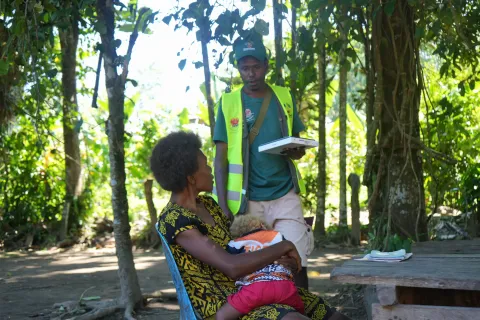
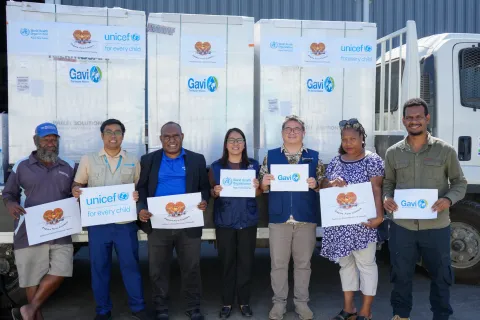
Between 2022 and 2023, Akelos and his team navigated challenging landscapes in the North Fly and Delta districts of Western Province installing 13 electric and solar powered fridges so that essential lifesaving vaccines could reach far flung communities. Reliable refrigeration is crucial for maintaining the cold chain that ensures vaccines remain effective at preventing life-threatening diseases in children.
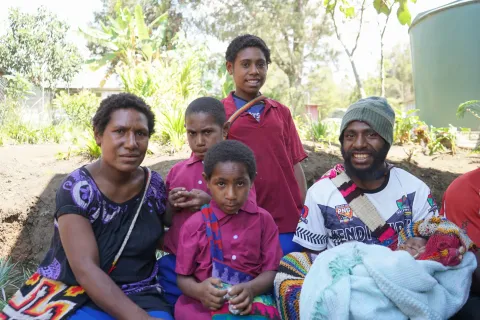
“I’ve always had a heart for children,” Akelos says with a warm smile. “All my kids, I have three who are 9, 5 and 4, were immunized in Port Moresby, and I think about the children here who don’t have the same opportunities. If they can’t get to town where these services are provided, then we need to bring the vaccines to them.


Western Province presents some of the most overwhelming logistical challenges in PNG. It is the country’s largest province by area that occupies 99,300 square kilometres and has several large river systems, the mighty Fly River and its tributaries - the Strictland and Ok Tedi Rivers - running through it. These vast waterways combined with a harsh geographical terrain and remote communities scattered across four districts, make transportation of any kind an arduous undertaking.
The journey to reach these communities was not easy. Boats with outboard motors were used to navigate swamps and rivers to get to health facilities in Delta Fly while in North Fly, the lack of a proper road network meant all supplies were flown in by helicopters and light aircrafts.
UNICEF has also provided the Artek device, a long-term vaccine storage container, which can hold vaccines at the recommended temperature for 35 days. This means vaccines can be safely stored and transported for days while travelling to remote communities and vaccination sties. This device helps health workers conduct resource intensive outreaches effectively.
“I think about what will happen to these children if they don’t get vaccinated. It’s heartbreaking,” Akelos says. “If the cold chain is there, we’ll be just fine. We’ll have a healthy population there. So, when I install these refrigerators, I know it’s making a difference and I am satisfied,” Akelos adds.
But it’s not just the technical side of his work that defines Akelos. Recently, the introduction of tools like the mSupply - a mobile application that runs on a tablet to streamline vaccine ordering and stock management - is helping to transform the way he does his job.
Before mSupply, Akelos relied on manual systems to track inventory, place orders and manage stock. This was a slow process often prone to errors.
“When mSupply was introduced, it has made my job so much easier when it comes to ordering. Thanks to UNICEF, I like it. I did a two-day on-the-job training for mSupply in December 2024 and I’ve been using mSupply since then for all our stock takes and orders,” Akelos explains.”


Through generous support provided by the Government of Japan and Gavi, the vaccine alliance, UNICEF is working with the Government of Papua New Guinea to roll out mSupply in selected provinces. With technical support provided by UNICEF, 115 health workers from 21 Provincial Stores, seven district vaccine stores and 45 health facilities across the country have been trained and are using mSupply to manage their vaccine stock.
The mSupply tablets in provinces are linked to big screens in the National Department of Health, Central Medical Store in Port Moresby and the UNICEF office, where monthly stock-take inputs, inventory updates and quarterly order details are viewed live and monitored. For Daru, like the majority of provinces in the country, an order can take about three weeks from the time it is placed to the time the stock arrives in Daru as the only transportation available is by air.
All these support - solar-powered refrigerators, long-term vaccine storage containers, and the mSupply system - is helping the critical workforce of the immunization program, like Akelos, to perform their tasks effectively and efficiently and is also ensuring quality vaccines are readily available for vaccination activities.