Their Second Chance at Education
Learners in Mamasapano find alternative pathways to rebuild their dreams, disrupted by armed conflict

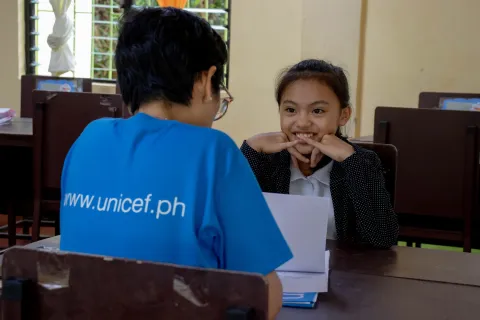
COTABATO CITY, 10 October 2024 - Mamasapano, located 64 kilometers from Cotabato City, has faced years of armed conflict and economic instability. Though schools are often considered ‘zones of peace,’ they are still affected, with children and adolescents in the area turning to Alternative Learning System (ALS) for a chance at education. ALS is a parallel learning system that’s more flexible and non-formal. It allows youth and adults, who had been out of school for at least 3 years, to continue their studies.
Through targeted programmes, UNICEF and the Korean International Cooperation Agency (KOICA) and their three decades of partnership with the Philippines, have ensured that children and adolescents in Mamasapano have the opportunity to pursue education, despite the challenges. UNICEF and KOICA have trained ALS educators, provided much-needed learning materials, and ensured the creation of safe spaces where students can focus on their studies.

For their children’s sake
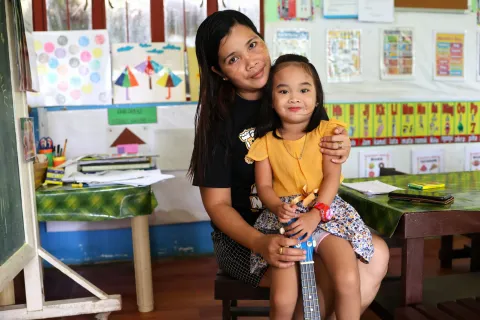
Surainie Samama, 23, like many women in Mamasapano, faces unique challenges as she juggles education and family responsibilities. Now a mother of two, her kids attend school while she attends her ALS classes. “100 pesos per day,” she says, referring to the amount she spends on fare and food for her and her two children. For many, 100 pesos may seem small, but for Surainie, whose family rely on farming to make a living, it’s a significant amount as they only earn money once every three months. On top of her own needs, Surainie must also ensure that her children have the supplies they need for school.
The cost is steep but she insists on attending ALS as it has equipped her to be a better parent: “It’s for them. I need to finish my education because I need to teach my kids. It is hard to teach when you don’t know what you’re teaching.”
Halima Sugadol, 24, faces the same challenges but compounded by her commute, especially during bad weather. “When it floods, the fare goes up,” she says. Every morning, she sells food to support her family, then heads to school in the afternoon, bringing her child along with her. “I struggle with my budget but I need to make do,” she says with a determined smile. “I want to finish school for my children.”

For both women, education is more than just a personal achievement. It is a means of lifting their families out of the cycle of poverty and keeping the children from engaging/getting recruited in armed conflict – two issues that have long held them back.
Jawaher Majid, 13, who is soon to graduate from the ALS programme, also struggles to make do with her 20 pesos per day allowance but she perseveres because education is important to her. She admits she feels embarrassed about her current standing.
“I’m still in Grade 5 when I should be in high school by now,” she says quietly. The eldest of five siblings, she had to step in to help her mother with household chores, forcing her to put education on hold.
All three have faced disruptions from armed conflict and the COVID-19 pandemic and are now just getting back on track.
Education as a tool for peace
Warda Unos, 39 has seen firsthand how education can help reduce conflict. “Before, there was so much fighting,” she recalls. “But now, with more people going to school, there are fewer clan feuds and less violence.” Warda, who is also a peer, dreams of becoming a social worker, a role that would allow her to help her community in a more direct way.
Surainie sees education as a tool for peace. “We need to educate people, so they would not join armed groups,” she says. Her dream is to become a teacher, not just to educate children but to guide parents as well.
Rahma Baguamama, 29, too, dreams of becoming a teacher. With 11 siblings, she knows the importance of education in breaking the cycle of poverty and violence. “I want to share what I’ve learned,” she says. “Everything I have learned from ALS, I want to pass on to the children I will teach.”
ALS as their lifeline
For the ALS learners of Mamasapano, the programme has been a lifeline. Warda, who had forgotten much of what she learned in her early school years, found ALS to be her second chance. “I didn’t think I could ever go back to school,” she says. “But ALS gave me hope. It helped me remember what I had learned before and gave me the confidence to keep going.”

For Halima, ALS was a turning point. “I regained my confidence,” she says. “I didn’t think I could finish school, but now I know I can.”
The dreams of ALS learners are deeply tied to their communities. They see education as not only a means to fulfill their personal aspirations but also as a means to help others and contribute to peace, not just in Mamasapano but throughout the entire Bangsamoro region.