Tawi-Tawi schools need better water, hygiene and sanitation facilities
Every child’s right to safe and clean water everywhere they go

Bongao, Tawi-Tawi, 09 May 2024 – Every morning, before Ashraf Kasawali leaves for school, he fills his tumbler with water. “I want to make sure that the water I drink is clean,” says the 11-year-old learner. His house has running water from Bongao Water District, while in his school, the water is drawn from the ground by an electric pump and then stored in a tank.

Bongao, Tawi-Tawi, lies in the southernmost province of the Philippines. It is about 1,500 kilometers southwest of the capital Manila.
“We don’t have enough budget for water service connection,” says Zenaida Talipan, principal of Pagasinan Elementary School, where Ashraf is in grade 6. “The pump is cheaper, but we are not sure if the water is clean since it has been years since we had it tested.”
Talipan also says that the school buys drinking water from a refilling station. “Each classroom has a container. The school—not the teacher or the learners—pays for the water.” For a school with 594 learners and scant resources, the system does not always work. “It’s better to have your own water so that you could drink whenever you need to,” says Ashraf.
Access to fresh water is a perennial challenge in Tawi-Tawi, a province comprising 107 islands. “Many of our schools still rely on rainwater,” says Christine Sangkula, the health program coordinator of the Bangsamoro Autonomous Region in Muslim Mindanao, Ministry of Basic, Higher and Technical Education - Division of Tawi-Tawi.
“We can ask the children to bring their own water to school, but that’s not the best solution to the problem because even in their homes, many families do not have easy access to fresh water,” Sangkula adds.

Poor ratings
Of the more than 200 elementary and secondary schools in Tawi-Tawi, none has met the national standards for water, sanitation and hygiene (WASH). Under the Department of Education’s WASH in Schools (WinS) program, a school may receive a rating of one star to three stars based on facilities and practices, with three stars signifying that the school has met national standards.
For drinking water, a school is awarded with three stars if the water is provided for free to all learners at all times and if the quality of water is tested more than once every calendar year.
“About 17 percent only of our schools have earned one or two stars,” says Sangkula. “About 83 percent are considered zero stars. It’s difficult for us to implement WinS because the program does not have a budget of its own. Some WinS-related activities are only pushed through because we conduct them with the more established, funded activities of the division office.”
Sangkula shares that monitoring the schools is another challenge. She can travel by land in Bongao, the capital of the province, and in adjacent municipalities. “For the schools in other islands, I just communicate with the district or school nurses through phone or online applications.”
More toilets needed
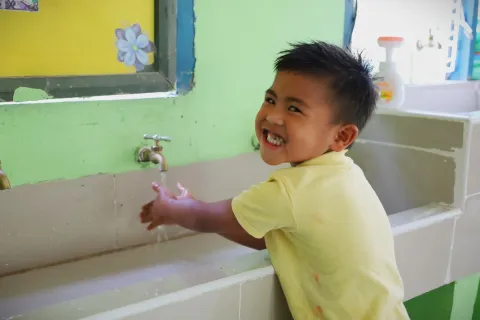
For handwashing, Pagasinan Elementary School has adequate facilities, including two small rooms and two pipes outdoors. Each room has more than 20 faucets, and each pipe has just one lever but has ten holes, allowing ten students to wash their hands simultaneously. The outdoor pipes, however, are not connected to the water tank, so a teacher or a learner has to fetch water from the tank using a container and then attach the container to the pipe.

Near the classrooms, the school has a stand-alone structure for three toilets, supposedly for females, for males, and for children with disabilities, but the toilet for females is no longer functional and one toilet has to be reserved for teachers, so all the learners have to share one toilet. To meet the national standards, the school has to have gender-segregated toilets with one toilet seat for every 50 learners or less.
Due to the number of users, keeping the toilets clean is difficult. “We need to hire another utility worker who would focus only on the comfort rooms, but we cannot afford it,” says Talipan. “Sometimes, mothers who are waiting for their children take it upon themselves to clean the comfort rooms.”
“I only use the toilet in school when I need to urinate,” says Ashraf. “It’s not comfortable to use. Sometimes it’s dirty. Sometimes it’s difficult to flush. And you can’t stay in it for long because other kids also need to use it. If I need to defecate, I wait until I get home.”
With support and funding from the Spanish Agency for International Development Cooperation (AECID), UNICEF Philippines continues to work with the Ministry of Health, the Integrated Provincial Health Office and the local government units to ensure access to safe water in schools and achieve zero open defecation.