Strengthening protection: For every child and woman survivor, a new hope and life
Survivors of abuse are given care, education, skills and a chance to find safety and hope
This is a good news story of hope.
In 2024, the municipality of Datu Odin Sinsuat tallied 27 child protection cases: 10 cases of gender-based violence, 12 Children at Risk, and seven Children in Conflict with the Law (CICL). “That’s an increase of six from the 23 cases in 2023,” said Bai Sittie Druz-Ali Adam, Municipal Social Welfare Officer of Datu Odin Sinsuat. And as of June 2025, they have already monitored more than 10 cases.
This does not mean abuse cases are on the rise. It means the community’s awareness on the importance of reporting such cases is increasing, according to Bai Sittie. But she is also aware that there are cases that happen but are still not reported.
Despite the situation, the Ministry of Social Services and Development remains committed to the welfare of the survivors by helping them get back up on their feet.
The Ministry is playing a vital role in recovery and integration. The broader goal is to build a community where children are protected at home, in school, and in society. With trained teams and empowered social workers, Datu Odin Sinsuat is moving closer to that vision.
Bae Sittie is on the front line to provide case management, coordinate education and protection services and determine the best path forward in the best interest of children.

“What we really want is for them [survivors] to be with their family. But if there are no other family members available to care for them, we have no choice but to bring them [to this centre at our office].”
The survivors undergo an intake process performed by the Centre’s house parents. While the survivor is residing at the centre, the Municipal Social Welfare Officer and the facility’s head discuss each case. One important development when they can return to their extended families, communities or foster parents.
Daily life is structured to impart important life skills to the survivors. They do household chores and learn arts and crafts to help them get ready to go back out into their respective communities. Their house parents, who they call their “mommies,” guide them through these activities.
They learn to make things like bracelets, earrings, banana chips, and balms, which they can later sell. “I sometimes ask our clients [survivors]: ‘When you get out of here, do you know anything that you can do [for a living]?’ What if you need money?” said Rosario Quitoras, Social Welfare Officer II and the facility’s head. “They said: ‘Mommy, I can cook something, and I can sell it.’.”
Children are also able to continue their studies, with some doing it through the Alternative Learning System of the Ministry of Basic and Higher Technical Education.
In some cases, children and young people are also given seed capital to start their own business when they go back out into the community. One such case is Ben*, a Child at Risk who, at 16, was caught selling illegal drugs.

Ben was a particularly tough case, according to Bai Sittie. “These kids, they’re hardened by the streets,” she said. Her approach towards Ben was a mix of care and discipline: soft enough that she is approachable, but strong enough that she still commands his respect. Like many of the facility’s clients, Ben grew up away from her mother, who started working abroad when he was young. His dad had already passed away, and he was left in the care of his grandparents.
Ben learned new skills such as cooking and continued his studies. “Our house parents treated us well,” he said.
Now he’s back with his grandparents.
He expressed his desire to go back to school. “I want to become a policeman,” said Ben.
Bai Sittie’s job is not easy, but definitely an important one. Thanks to the generous support of the Korean Government through the Korea International Cooperation Agency (KOICA), UNICEF Philippines is able to provide critical assistance that empowers Bai Sittie and other social workers in Maguindanao del Norte, Sur, and Cotabato City. This support enhances their skills and competencies in managing child protection cases effectively.
She is a valued member of the Multidisciplinary Team, which includes representatives from the Philippine National Police - Women and Children Protection Desk, Rural Health Units of the Ministry of Health, and the City/Municipal Social Welfare Development Office.
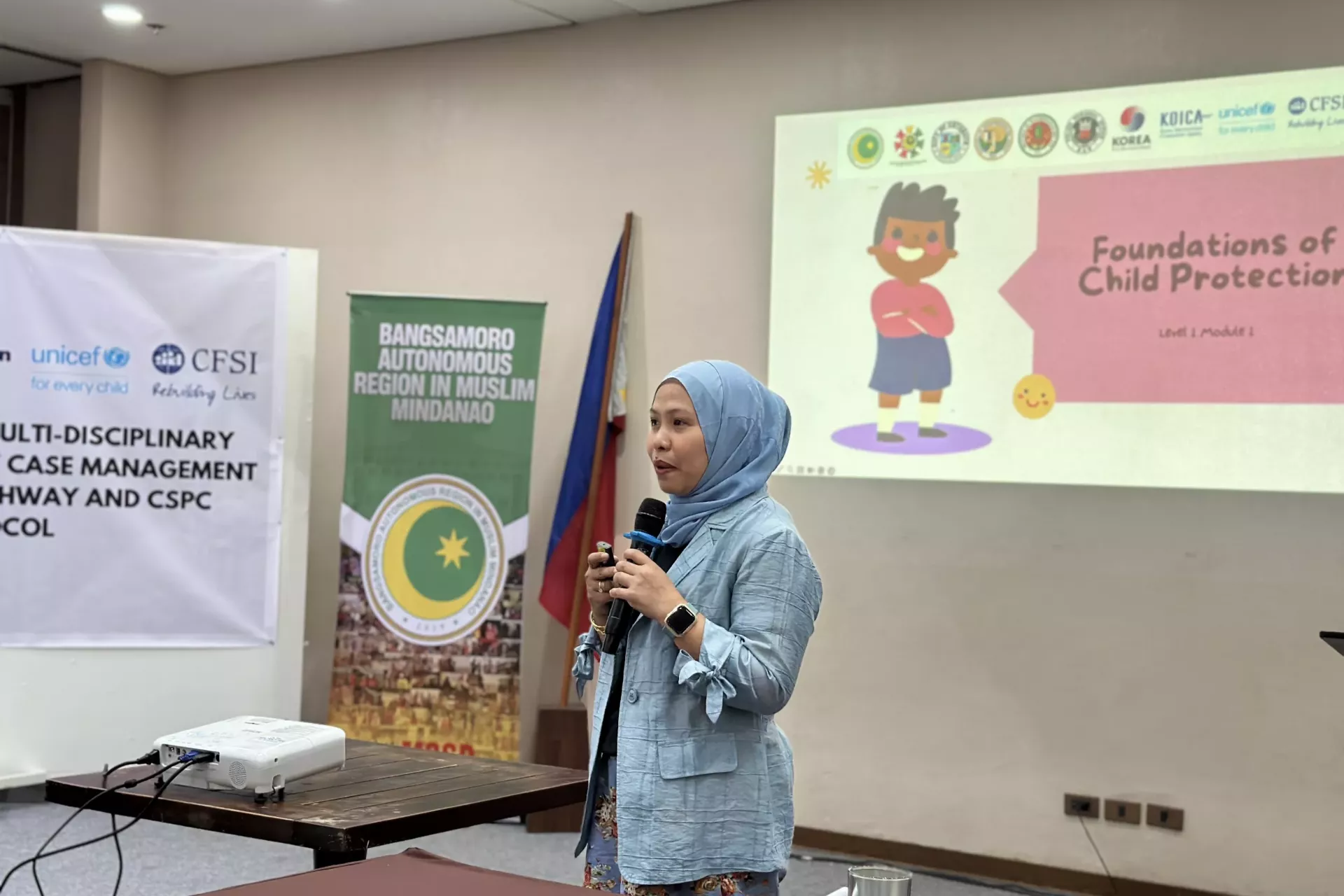
Through KOICA-backed training, the Team members were equipped with expertise in child protection and gender-based violence case management. Bai Sittie has taken the lead in cascading this training down to barangay-level officials, and strengthening child protection efforts at the community level to reach every child.

“It’s good that the MDT had this training, because now we’re all on the same page,” said Bai Sittie. Coordination is important especially to avoid having the survivor tell their story repeatedly to different agencies, forcing them to relive their trauma over and over again. “We should wait and conduct the interview as a group,” Bai Sittie added. “No matter the entry point of the case, there’s a need to notify the others because the services needed by our clients cannot be provided by one agency alone. They need to have the mindset to be ready to give the services needed by the client on their end.”
With properly trained multidisciplinary teams, and a community educated on child protection, Datu Odin Sinsuat is a big step closer to a society that keeps children safe at home, in school and within communities.
*name changed to protect identity