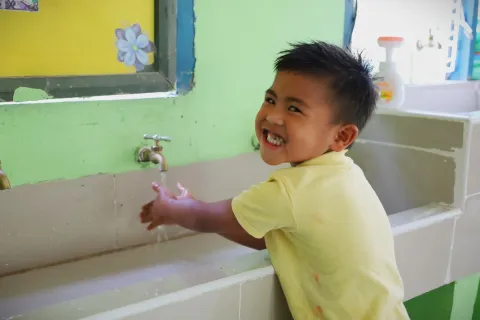
Hygiene amid crisis
UNICEF implements WASH in Datu Saudi Ampatuan evacuation center

To go to the toilet, 21-year-old Sohairah Abdulbadi had to walk for about 200 meters and wait in line. She’s staying in the evacuation center beside the public market of Datu Saudi Ampatuan town in Maguindanao province, and the nearest convenient toilet was at Masjid Dimaukom, also known as the Pink Mosque.
“It was difficult for me because of my condition,” says Abdulbadi, putting her hand on her belly. She’s pregnant with her first child. Even if she is wearing loose garments from head to toe, her pregnancy is obvious because she’s about to give birth any day.
“The line was always long,” Abdulbadi adds. “So many people were using the toilet.” At the peak of the recent armed conflict in Maguindanao, the evacuation center sheltered 669 families. “I’m glad that it’s more comfortable now because there are latrines nearby.”
In response to the needs of the evacuees, UNICEF, together with its implementing partner, Mindanao Organization for Social and Economic Progress (MOSEP), built six latrines in the evacuation center.
From the makeshift house where Abdulbadi is staying, the nearest latrine is about thirty meters away, and she doesn’t have to fall in line, especially on days when the armed conflict subsides and some evacuees return to their homes temporarily.

Fleeing the conflict
On March 18 this year, fighting broke out between government soldiers and members of the Bangsamoro Islamic Freedom Fighters (BIFF). Abdulbadi and her family had to leave their home in Kitango village, about three kilometers away from the municipal hall of Datu Saudi Ampatuan.
“We heard gunfire in the wee hours of the morning,” says Abdulbadi. “It sounded so near. We were afraid that the bullets would hit our house, so we left in a hurry. We were not able to pack the things that we needed.”
Her 21-year-old husband, Salahuddin Mobin, notes that their situation is ironic. “We were living on our own in Cotabato City, and we decided to move to her parents’ house so that she would be safer during delivery, but here we are, in an evacuation center.”
The couple share the makeshift house with six other members of Abdulbadi’s family. The oldest is her grandmother, and the youngest is her 9-year-old brother.
“We are thankful to UNICEF for giving us some of our urgent needs,” says Abdulbadi. UNICEF provided each family a hygiene and dignity kit, which included a pail, a dipper, soap, shampoo, toothbrush, toothpaste, sanitary pads, and other household items.
Rohanna Salik, the head of the Municipal Disaster Risk Reduction Management Office, praises UNICEF for the quick response. “The evacuees arrived here on March 18,” she says. “UNICEF validated the information on March 19, and then partner organizations including the BARMM MSSD and the local government distributed the hygiene and dignity kits on March 20.”
“We heard gunfire in the wee hours of the morning. It sounded so near. We were afraid that the bullets would hit our house, so we left in a hurry. We were not able to pack the things that we needed.”

Zero open defecation
Under its Water, Sanitation and Hygiene (WASH) program, UNICEF had been working with MOSEP in Maguindanao even before the recent armed conflict. “We’ve been supporting the zero open defecation program of the province,” says Rasul Abdullah, UNICEF’s WASH officer. “We provided trainings to all rural sanitary inspectors in the province of Maguindanao, and each month, we provide honorarium for 10 of them and mobilization support for 26 others so that they can reach even remote villages.”
The construction of latrines in the evacuation center augmented the zero open defecation program. “When the evacuees flocked here, the lack of toilets was a serious problem,” says Musib Gulo, the rural sanitary inspector of Datu Saudi Ampatuan. “Some evacuees were forced to use plastic bags, so their excrement was not disposed of properly. The latrines are a big help.”
“The latrines are emergency-type,” explains Abdullah. “So they are made of light materials.” The six squatting pit latrines are built in pairs, one for men and one for women, and distributed in the evacuation center.
“We’ve been supporting the zero open defecation program of the province. We provided trainings to all rural sanitary inspectors in the province of Maguindanao, and each month, we provide honorarium for 10 of them and mobilization support for 26 others so that they can reach even remote villages.”

Access to clean water
UNICEF and MOSEP also ensure that the drinking water of the evacuees is clean and safe. “We gave them jerrycans and water purification tablets,” says Zalave Dinas, MOSEP’s WASH technical expert. “The water is rationed by the municipal government every morning. It looks clean, but it’s not treated, and some of the evacuees got sick.”
To ensure that the evacuees use the tablets properly, MOSEP once gathered the women in the municipal gymnasium and gave a demonstration. “We have also deployed 11 hygiene promoters,” adds Dinas. “They go tent to tent and teach the families how to use the tablets. They also teach hygiene practices, such as proper garbage disposal and handwashing.”
MOSEP staff regularly monitor the quality of the water, both in the tents and at the source. “We’re in the third round now of taking samples,” says Dinas. “We bring the samples to Cotabato City and check them for E. coli, which can cause diarrhea.”
“We have also deployed 11 hygiene promoters. They go tent to tent and teach the families how to use the tablets. They also teach hygiene practices, such as proper garbage disposal and handwashing.”

A new life
Abdulbadi and Mobin are preparing for the birth of their baby, who will likely be born while the couple is staying in the evacuation center. “I feel pain in my thighs every now and then,” says Abdulbadi.
Mobin, a teacher in a madrassa, lost his job when the armed conflict broke out, but recently, he went back to Kitango with Abdulbadi’s family to harvest the watermelon that they had planted. “We get by even if it’s difficult,” says Mobin.
“We’re thankful that the local government, along with non-governmental organizations, is helping us,” says Abdulbadi.
###