Strengthening Primary Health Care for Flood-Affected Children and Women in Sindh
Thanks to support from France, UNICEF strengthens crucial health and immunization services in flood-affected districts in Sindh.

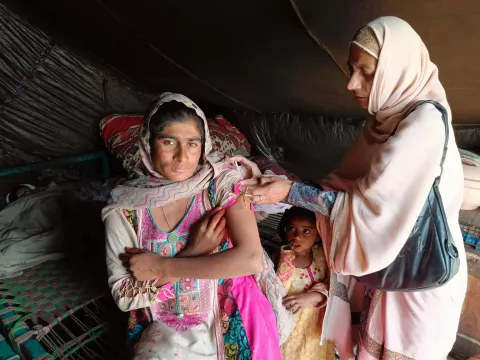
“I am really happy that my child is vaccinated against measles, I hope he won’t get sick with this dangerous disease now,” says Gulzadi, a mother of eight children in Jacobabad.
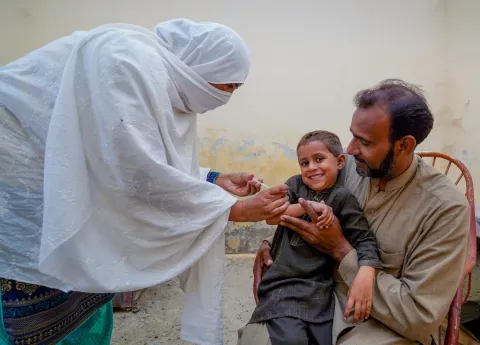
Gulzadi has brought her youngest son Muhammed Rafiq (18 months) for a measles booster vaccination to the Tehsil Headquarter (THQ) Hospital Thul in Jacobabad, Sindh, having completed his routine immunization at the centre.
“This hospital is close to our home. I bring my children here for vaccination and medical check-ups. The vaccinators are kind and friendly towards children. They put children at ease and make the vaccination less stressful for them. As a mother, this is what I want for my child” adds Gulzadi.
Jacobabad is an impoverished district with low routine immunization coverage putting children at risk of deadly vaccine preventable diseases.
During the devastating 2022 floods, Gulzadi’s village was inundated with flood water, damaging her house. The floods damaged and destroyed roads and health facilities, compromising health and immunization services for children and women.
With generous funding from France, UNICEF supported the Government of Sindh to strengthen primary health care with a focus on maternal, newborn, child and adolescent health services for flood-affected communities in five districts in Sindh.

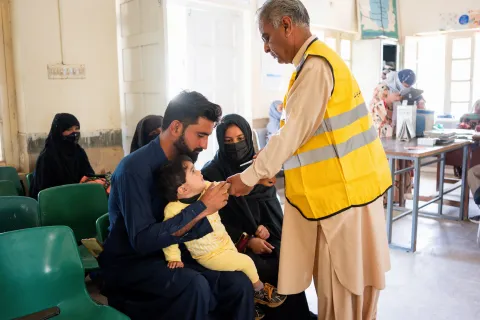
Through Health and Immunization Flood Response project, a 12-day training was organised for Expanded Programme on Immunization (EPI) vaccinators from five districts to enhance their knowledge and skills. Bashir Ahmed Shah is one of 380 vaccinators who received the training.
“Although I am working as an EPI vaccinator since 2005, I found that the training was a great learning experience. I learned about planning vaccination outreach sessions, interpersonal communication and counselling of caregivers,” says Bashir Ahmed Shah.
Convincing parents and guardians to allow their children to be vaccinated, is one of the biggest challenges faced by vaccinators during community outreach sessions. Sometimes caregivers do not complete the routine immunization schedule of their children, opting out halfway through.
“During the training, I learned how to find children who defaulted on their EPI vaccination. This is the most critical issue because the communities affected by floods have competing priorities and we have to make them realize how important it is to immunize their children.”
Vaccinating young children is a sensitive job and mothers want their children to be comfortably immunized.
“Children fear vaccination. We are trained to take care of them and make the vaccination less traumatic for them. I know, for young kids it’s not something to enjoy but at least I make sure that they are not scared away as immunization is important to protect them.”

THQ hospital is the main health service provider in Tehsil Thul serving a population of more than 500,000 people.
With support from France, the Maternal, Newborn and Child Health services were also strengthened in the hospital.
Asiya BB is a mother from Muhammad Qasim Burio village in Thul. She received Antenatal Care services during her pregnancy in THQ hospital.
“When I was sick, I came to the hospital. The doctor examined me and conducted tests and advised me about medicines and my diet. The staff were helpful and friendly. My baby was delivered here. Here they have good facilities. I am happy to have a healthy baby boy,” says Asiya BB.
Muhammed, Asiya’s son, is now three months old and in good health. She has been regularly visiting the hospital for post-natal examination and care since the child’s birth.
“We cannot afford to go to a private hospital. This is a government hospital with all the facilities, that’s why I came here. Otherwise, it would have been very difficult for me, adds Asiya BB.
Over 555,000 people, including 420,000 children and 130,000 women, accessed health services thanks to support from the Government of France, UNICEF and implementing partners Medical Emergency Resilience Foundation and the Aga Khan University.
“People here are poor with limited access to health and immunization services. The 2022 floods deteriorated the situation. This project was a big help in strengthening health and immunization services for the most vulnerable and marginalised communities,” says, Dr. Wajid Hussain Bhutto Acting District Health Officer, Jacobabad, Sindh.