Five years on, life progresses for Shahnaz
The EU-funded BES II programme is helping children develop life skills alongside learning at UNICEF-supported ALP centres in Balochistan.

It was 2021 when ten-year-old Shahnaz joined the Alternative Learning Programme (ALP) centre, established by UNICEF in Hazarganji, on the outskirts of Quetta, the capital of Balochistan province.
The centre was initially only for boys. However, giving in to his daughter’s desire to learn, Shahnaz’s father, Mira Khan, who was the teacher at the centre, enrolled her while she disguised herself as a boy named Mohammad Saleem.
A few months later, a separate classroom for girls was added to the ALP, and Shahnaz no longer had to pretend to be a boy.
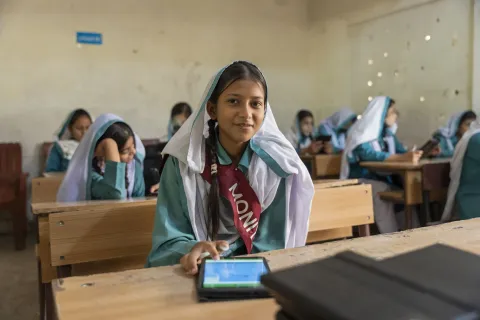
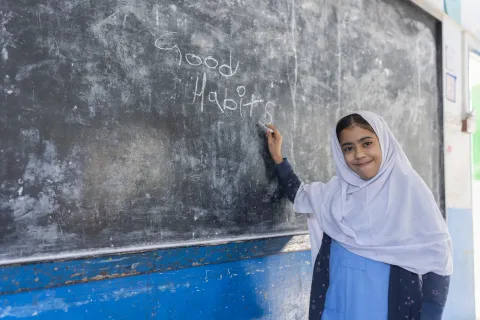
Five years later, Shahnaz (15) is a grade 8 student at the same ALP centre, which operates under the Balochistan Education Support (BES) II Programme (2021 – 2025), a comprehensive initiative to provide accelerated learning opportunities to boys and girls who had never enrolled in school or had dropped out at some stage.
Shahnaz’s family belongs to a conservative community, where girls’ education is a taboo. Even very few men are educated. When the ALP centre in Hazarganji started, Mira Khan was the only man in his village who could read and write. He was chosen to be the teacher at the centre.
“People in this area are generally poor," says Mira Khan. “Their children start working from a young age to earn some money for the family. After their class at the ALP is over, the boys run down to the nearby market to do odd jobs. However, girls are not allowed to do so. They must return home.”
Over the years, things have changed, and the interest in learning, in both boys and girls, even in conservative communities, has grown.
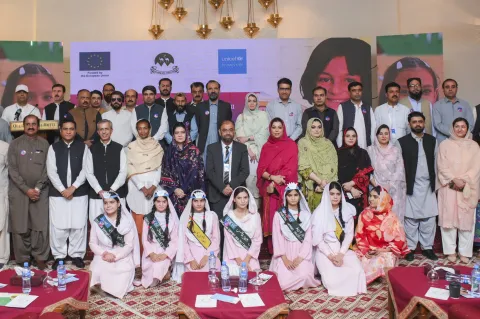
Generously funded by the European Union, supported by UNICEF, and implemented through the School Education Department and its associated entities in the Government of Balochistan, BES II is changing the education landscape in the province.
Under BES II, a total of 210 ALP centres have been established in 16 districts of the province. The plan includes constructing more ALP centres in the remaining six districts. Once all centres are completed, more than 20,000 children will be enrolled.
To help students continue to learn beyond the primary level, 23 ALP centres have been expanded to cover middle-level education (grades 6-8) through an accelerated curriculum that spans over 18 months.
To further enrich the educational experience and prepare students for vocational opportunities, the National Vocational and Training Commission, Balochistan, developed a technical and vocational trade curriculum specifically tailored for the middle-level ALP students.

All the middle-level ALP centres now provide employable skills to enrolled boys and girls. Currently, six different kinds of vocational training are being offered. These include motorcycle repair, information technology, a beautician course, poultry farming, art and craft, and dressmaking.
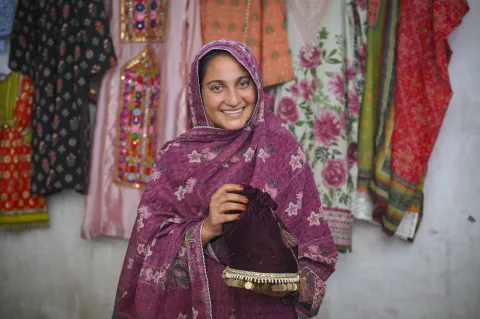
At the ALP centre in Hazarganji, girls enrolled in the middle level are being trained in dressmaking. A trained instructor teaches them to design, cut, and sew.
“I am a trained instructor at the Balochistan Small Industries Wing and have been tasked to conduct dressmaking classes at this centre twice a week, on Fridays and Saturdays,” says Hasina Bano, the cutting and sewing instructor at ALP Hazarganji.

“Initially, girls at this centre had no idea about cutting and sewing. This was something very new for them. Once I told them that by learning this skill, they could not only make dresses for themselves and their family members but also make dresses to sell in the market and make money for their families, they all got very interested.”
Girls are trained to cut and sew in a step-by-step manner. They first learn how to use a measuring tape, then draw a pattern on the whiteboard, then draw it on paper and cut it, and finally draw it on the cloth before cutting and sewing on a hand or electric sewing machine. Eight hand sewing machines, four electric machines, and one overlocking machine have been provided to the ALP centre in Hazarganji. From cloth to scissors, all materials are also provided by the project.
“I have 16 girls enrolled in the dressmaking class,” says Hasina Bano. “Though the vocational class is for the middle-level girls, some primary-level girls have also joined the class out of their own interest.”

“This vocational class has been going on for ten months, and most of the girls, particularly Shahnaz, have become well-versed in all aspects of dressmaking. Last Eid, the girls were overjoyed as they managed to sell some of their dresses by displaying them at a shop in the local market.”
The motivation to learn a skill that can help them earn money is so strong that some of the girls enrolled in the dressmaking class have convinced their families to buy their own sewing machines. What they learn in the ALP centre, they practice at home to enhance their skills and become productive members of their families.
“Many years ago, I overcame my fear of being the only girl sitting in the room and pretended to be a boy so I could study,” says Shahnaz. “My father was my biggest support then, and so is he even now. If I ever wanted to learn something, he would never say no.”
“We eagerly wait for Friday and Saturday for the dressmaking class. Our teacher knows a lot, and she has taught us well.”

“I can now read, write, do maths, and even stitch clothes for myself, my mother, and my sisters,” says Shahnaz with a sense of achievement.”
The facility for vocational training in the ALP centres has added new vigour among girls and boys to learn. While they continue to learn, a skill that can help them earn for themselves and their families has added a new dimension to their progress in life.