A better life begins with safe water
Access to safe and sustainable water and sanitation is transforming lives in rural Balochistan.

Note: Due to security concerns, the names of the individuals mentioned in this story have been changed.
Loralai District, Balochistan: At the edge of north-eastern Balochistan, among barren hills and vast open plains, lies a remote village home to around 500 registered Afghan refugees and members of the host community. Rows of mud-brick homes, built close together, form a settlement that feels both fragile and enduring. There are no paved streets, only worn pathways, little vegetation, and no visible source of water. With minimal infrastructure, life here has long required families to adapt to scarcity, especially when it comes to something as basic as water.
“Until a few years ago, every day soon after sunrise, I would accompany my brothers to fetch water from wherever it could be found,” says Abeera, a 13-year-old from the village. “People fighting over water was a common sight.”
Before 2023, access to water in this community depended on a traditional karez system, a centuries old underground irrigation channel that carried water from upstream areas. The flow was unpredictable and often insufficient. What little water reached the settlement was frequently contaminated, having passed through other communities where it was used for washing clothes and bathing. With no alternative sources nearby, Abeera and others from her community would walk miles to fetch water from distant villages.

“If we were lucky, we would get some water,” Abeera recalls. “But carrying heavy containers back home was exhausting. Many times, we would walk all the way to those villages, only to be sent back empty-handed.”
A decade ago, the village was home to thousands of registered Afghan refugees and members of the host community. Prolonged water shortages forced many families to leave, and recent government repatriation policies have reduced the population even further.
With water scarce and often contaminated, waterborne diseases and sanitation related illnesses were prevalent. With the nearest hospital located nearly 50 km away, for most families, medical care meant relying on home remedies and waiting for illnesses to pass.
Recognizing the scale of the hardship, the Commissionerate for Afghan Refugees, Government of Balochistan, with support from UNICEF, stepped in to address the community’s water crisis.
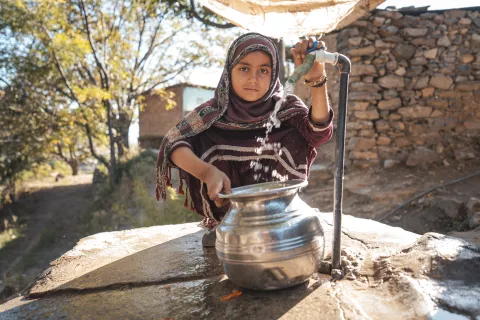
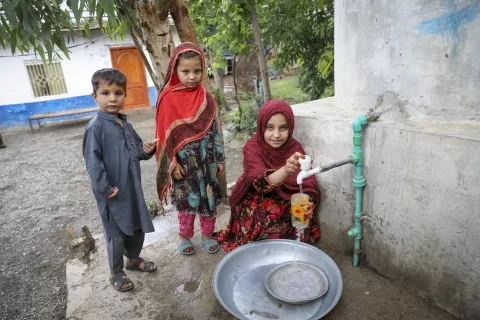
With funding from the Kingdom of the Netherlands, a solar-powered water supply scheme was established in the village in 2023. The system draws groundwater through a tube well powered by solar energy and delivers it to the community through a network of pipelines. In addition to household connections, a community water tank was installed at the centre of the settlement.
“I can now open the tap and drink water whenever we want,” says Abeera, with a wide smile. “We don’t need to go out in search of water anymore. We can wash dishes every day and have no fear of falling ill from contaminated water.

Alongside improved water access, hygiene and sanitation emerged as another critical need. Open defecation was common in the village, and there was little awareness of the health risks it posed. As part of the same project, social mobilization teams worked with families to raise awareness about hygiene and sanitation. Households were provided with materials to construct latrines, which they built themselves. For many families, it was the first time they had ever used one at home.
“Our relatives from Quetta would never visit us because we did not have toilets,” Abeera adds, “Once they came for a funeral, but they stayed in Loralai city instead.”
To ensure the scheme runs sustainably, the community manages it themselves. A trained local operator oversees the tube well and daily water supply, while the village Water, Sanitation and Hygiene (WASH) Committee manages maintenance and finances through household contributions for repairs and upkeep. The committee also helps families build latrines.
Rehmat Khan, president of the village WASH Committee, oversees contributions, bookkeeping and maintenance. A labourer in nearby Loralai and a lifelong resident of the village, he has seen firsthand how access to safe water has changed daily life.

“Providing water, sanitation and hygiene services in remote areas of Balochistan remains a key priority for UNICEF,” states Falak Naz, UNICEF WASH Officer. “With funding from the Netherlands, we established two water supply schemes in refugee camps in Loralai District, and one each in Pishin and Chaghi Districts through our partners, benefiting more than 8,000 people.”
Even as the village changed, access to safe drinking water has brought stability to the families that remained.
“A water supply scheme like this needs constant supervision,” Rehmat explains. “It can develop a fault at any time, so we must be prepared to fix it immediately. Safe drinking water is essential for our community’s well-being, and I see it as my responsibility to make sure this system keeps running.”
For the families still living here, that means something they did not always have: safe water close to home.