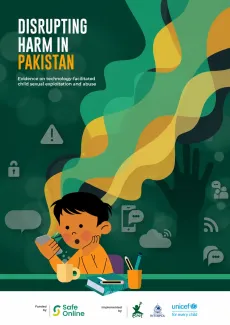
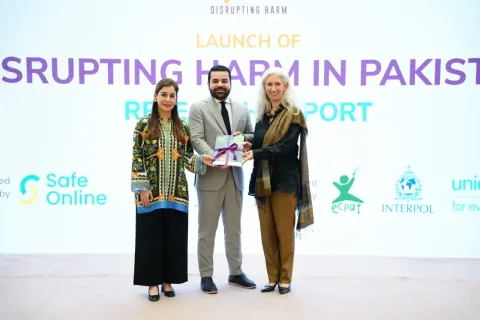
DISRUPTING HARM IN PAKISTAN
Evidence on technology-facilitated child sexual exploitation and abuse.
Highlights
Nearly 1 in 16 internet-using children aged 12–17 in Pakistan experienced at least one form of technology-facilitated sexual exploitation and abuse in a single year - equivalent to approximately 1.5 million children - according to new research from UNICEF Office of Strategy and Evidence – Innocenti, ECPAT International, and INTERPOL, funded by Safe Online.
This study is the most comprehensive evidence gathered to date on this issue in Pakistan. It examines not only the scale and nature of these crimes, but the barriers children face in disclosure, reporting, and access to justice, and the gaps in our legal framework that allow perpetrators to act with impunity.
Key findings
- Nearly 6 per cent of internet-using children in Pakistan aged 12–17 were subjected to at least one form of tech-facilitated sexual exploitation and abuse the past year – approximately 1.5 million children.
- Sexual extortion, blackmail and artificial intelligence-generated abuse reflect evolving risks.
- Children face major barriers in accessing support services including fear, stigma and family repercussions limit engagement with support.
- Perpetrators were found to exploit power imbalances, economic vulnerability, stigma and children’s fear of blame or exposure to coerce compliance and maintain silence.
- Pakistani legislation does not require forensic interviews of children to be systematically conducted by specially trained professionals, increasing the risk of secondary victimization from insensitive or inappropriate questioning.
- The Prevention of Electronic Crimes Act still uses the term ‘child pornography’ to refer to child sexual abuse material. This outdated terminology can imply that such images or recordings are a form of pornography, thereby
This report ends with a set of data-driven recommendations based on its key findings. They include action to be taken by key actors across government, law enforcement, justice and social services sectors, by communities, schools and families, and by digital platforms and service providers.