When Water Stops, Learning Stops
Voices from Motufoua Secondary School

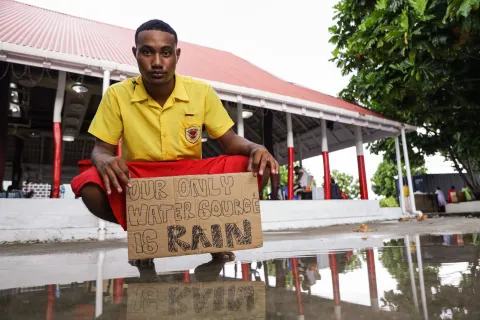
At Motufoua Secondary School in Tuvalu’s remote Vaitupu island, more than 500 boarding students live, study, and dream together. But behind the vibrant assemblies and laughter in dormitories lies a stark reality: the uncertainty of water. For these students, every day begins with a question that determines whether learning can happen—“Is there water today?”
When taps run dry, the rhythm of school life collapses. Students cannot wash, prepare for class, or use toilets. Many arrive late; some miss school entirely. As one student put it, “If there’s no water in the morning, the day cannot start.”
The issue goes beyond inconvenience. It affects dignity, health, and education. Broken taps, blocked sinks, and long walks to the nearest functional station have become routine. During Tuvalu’s long dry season, scarcity worsens everything, leaving students and teachers struggling to maintain basic hygiene.

Seventeen-year-old Vilosa Vaipuna knows this struggle well. “When there’s no water, I sometimes miss lessons because I cannot wash or use the toilets. It makes me feel frustrated and left behind.” Her friend Tafaoata Pene echoed the sentiment: “I feel stressed, even depressed, when I cannot keep clean. It affects how I feel about school and about myself.”
For girls, the challenge is even harder. Without private spaces to manage menstrual hygiene, girls manage their periods with discomfort and anxiety. “Sometimes I feel too ashamed to go to class when there’s no water,” one student shared quietly. The lack of facilities undermines confidence and attendance, creating barriers to learning that no child should face.
For Naman, the challenge disrupts learning. “There’s only one handwashing station in the girls’ dormitory. There are no toilets or taps near classrooms, so we have to run back during lessons. Sometimes students do not come back at all.” Tyra added the health dimension: “Most of the time the toilets cannot be used because they’re not clean. Broken taps and non-flushing toilets make it hard to stay healthy. Lack of clean water makes students sick and affects our attendance. It feels unfair.”
Teachers see the impact daily. Mathematics and Computer Science teacher Ms. Meri Gavidi explained, “Late arrivals and absenteeism often come down to one reason. There is no water for students to get ready.” Her colleague, Ms. Inimere, added, “If children want to wash their hands, they run through the rain back to the dormitory. With limited cleaning supplies and no working toilets in the school blocks, many students leave during class and don’t return. It shouldn’t be that hard.”

Beyond infrastructure, there is a gap in knowledge. Only one WASH training session has been held in recent years, leaving students and teachers without the skills to maintain safe hygiene practices.
“We want to learn," said one student softly. "But we want to feel clean when we learn.”
Despite these challenges, hope remains. “When WASH improves, everything improves—attendance, health, attitudes,” said Mercy. UNICEF, with funding support from the Government of India under UN South-South cooperation, is working with Tuvalu’s Department of Education and Public Works Department to upgrade water and sanitation systems. A new 100,000-litre water tank is being constructed at Motufoua to boost storage and ensure reliable access to clean water.
For students like Vilosa, Tafaoata, Naman, and Tyra, these improvements mean more than convenience—they are the foundation for safety, confidence, and educational success. At Motufoua Secondary School, the message is clear: clean water is essential for dignity, health, and learning. When water stops, learning stops. But when safe water flows, every child can thrive—clean, confident, and ready to learn.