A decade of dedication
Championing inclusive education in the Solomon Islands

“I felt isolated and lost. I felt I am not included in this group.”
Catherine is participating in a training on inclusive education, together with her colleagues from different divisions from the Ministry of Education and Human Resources Development (MEHRD) in the Solomon Islands. The main objective of this training was to build the participants’ knowledge, skills, and confidence in inclusive education as expert coaches to support the continuous professional development of teachers across the country.
The 5-day training targeted for master trainers, included role-plays, visits to a school, and experiential activities so that participants could link the theory they learn, which is the ‘ideal’ scenario in the classroom to the reality and practices on the ground, as well as practice coaching skills to support teachers to adapt inclusive teaching methods in their classrooms.

During the experiential activities, participants had to role play Year 3 children and develop a story together. However, one had to be blindfolded, another had to clasp their hands on their ears, and another had to hold both of their hands behind their backs.
Catherine held her hands on her ears to experience how it feels to not hear well. She shared her thoughts on how she felt excluded in the group discussions.
“It was difficult to make myself understood and eventually, I gave up.”

Other participants also shared their reflections from this activity, and they eventually arrived at a strong and clear question:
“How can we really support learning for these children?”
It was a moment where a renewed and strong commitment to inclusion was made amongst the participants, who shared a drive to answer that question and ensure that all children’s learning needs are supported.
In the Solomon Islands, an estimated 7 per cent of children aged 5 to 17 years old have a disability, and the prevalence of disability is higher among younger children; 9 per cent of 5- to 9-year-olds have a disability compared to 6 per cent of 10- to 19-year-olds (Solomon Islands National Statistics Office, 2019). Per the most recent data available (PWDSI, 2015), less than 2 per cent of children with disabilities attend primary school, a striking minority of such children.
Of the children in school, teachers estimate that 33 per cent have behavioral difficulties and 38 per cent have difficulties in focusing attention and concentrating (PILNA, 2021). This shows the importance of creating conducive learning environments in schools, as well as equipping teachers to support learners based on their individual needs.
“It took almost 10 years to raise awareness on the importance of inclusive education,” said Catherine. She explained that when she joined the Ministry in 2014, she had to start from scratch. “I really struggled because there was no plan on inclusive education and not many understood what it is.”
This training was a refresher for the master trainers, following an initial training provided during 2021 and 2022. At that time, 220 teachers from 78 schools across 4 provinces were trained for the first time on practical inclusive practices to promote positive learning environments.
Monitoring after the first training showed positive changes in the attitudes of teachers to ensure all learners were included in learning activities. However, it also highlighted the need for more hands-on activities for teachers to practice adjusting and differentiating their lesson plans to meet the needs of all learners. Another finding was a lack of ongoing and continuous hands-on support to teachers in managing the day-to-day opportunities and challenges of achieving a vision of inclusion in their classrooms.
These lessons were reflected in this training. This time, the training took a whole-school and whole-community approach. The master trainers had practical sessions to gain skills on expert coaching and feedback to teachers, hands-on activities to differentiate lessons including setting specific learning outcomes as well as develop plans on how to ensure comprehensive support is provided to teachers.
The newly upskilled master trainers will roll out this training to 7 out of the 9 provinces in the country and will reach approximately 800 teachers to provide inclusive learning environments for all children.
This work is backed by strong commitment by the government, including the ratification in June 2023 of the UN Convention on the Rights of Persons with Disabilities. In January 2024, the Education Act was passed, with inclusion as one of the core pillars in the Act.
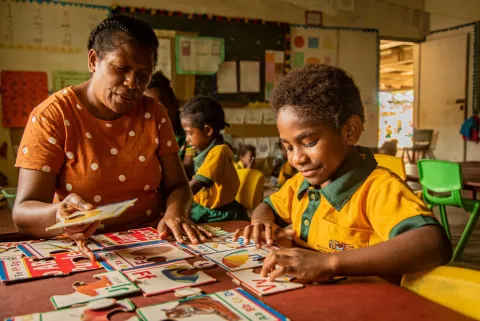
This progress was much needed. Most children with disabilities are out of school for fear of being bullied or discriminated against by teachers and peers. Training the school principals and teachers to adopt inclusive teaching methods, create a warm and welcoming environment in the classrooms which values diversity and engage with parents, is one step for children with disabilities to feel safe to go to school.
Participants learnt in the training that one practical skill that teachers can learn is breaking down the tasks into small steps and appreciating each milestone. This principle can be equally applied to the journey that Solomon Islands is taking on inclusion.
“I didn’t give up because I wanted change,” says Catherine.
A decade of dedication to inclusive education has made some significant changes and she and her team are committed to providing continuous support to all children in the Solomon Islands.
UNICEF provided technical and financial support for the development and roll-out of this refresher training, which was led by the Ministry of Education and Human Resources Development in the Solomon Islands and supported through the New Zealand Ministry of Foreign Affairs and Trade and Australian Department of Foreign Affairs and Trade. The inclusive education training is expected to reach teachers nationwide by 2029 through the integration of the modules into the professional development curriculum for more than 11,000 teachers in the country, which will benefit more than 100,000 children.