Children’s exposure to intimate partner violence against their mothers pervasive worldwide – UNICEF
First-ever regional analysis shows that over half of children in Oceania are victims of violence in the home

NEW YORK/SUVA, 28 November 2025 – Children in Oceania, along with Sub-Saharan Africa, and Central and Southern Asia, are most likely to live with a mother who has experienced physical, emotional, or sexual abuse by a partner in the past year. This reflects pervasive inequalities and global patterns of abuse faced by women, according to new UNICEF data.
The data brief was released following updated global estimates on violence against women published by WHO, on behalf of the UN Violence Against Women Inter-Agency Working Group on Estimation and Data. According to the interagency estimates, over 1 in 10 adolescent girls and women (aged 15 and older) have been subjected to physical or sexual violence by an intimate partner in the past 12 months.
UNICEF’s findings underscore how this violence extends to children globally, with 1 in 4 children – around 610 million – living with mothers who are experiencing intimate partner violence.
“Today, millions of women and children are living in homes where violence is a part of regular life,” said UNICEF Executive Director, Catherine Russell. “Women’s safety and autonomy are paramount to children’s well-being.”
For the first time, regional data reveals where women and children are most at risk, showing that children’s exposure largely mirrors geographical patterns of partner violence among adolescent girls and women.
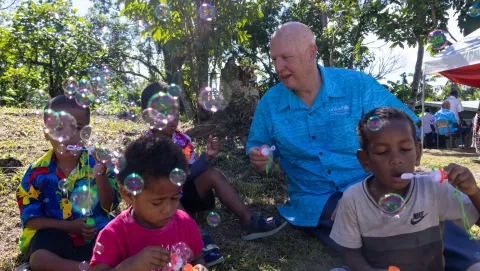
According to the analysis, Oceania* has the highest prevalence, with just over 3 million children living with a mother who has recently experienced intimate partner violence. This is approximately half of all children in the Pacific region. Sub-Saharan Africa has the second highest prevalence at 32 per cent, affecting 187 million children. Central and Southern Asia, where 29 per cent of children in the region are exposed, accounts for the largest share of the global burden, totaling 201 million children.
“Behind every statistic is a child whose sense of safety and hope has been shattered by violence,” said UNICEF Pacific Representative, Hamish Young. “These numbers are a wake-up call for our region. We cannot accept a reality where homes that are meant to be places of comfort are instead places of fear. It is time for governments, communities, and every one of us to stand together and invest in proven solutions, so that every child and every woman in Oceania can live free from violence and thrive.”
Studies show that violence not only harms the health and well-being of women, but also significantly impacts their children’s sense of safety, health, and learning. According to the analysis, which also includes data on violent discipline, children growing up in households where women are experiencing violence are also significantly more likely to be subjected to physical or psychological aggression themselves. Such exposure heightens their risk of carrying violence into adulthood, either as victims or perpetrators.
UNICEF calls on governments and partners to invest in proven solutions to end violence against women and violence against children by:
- Coordinating and expanding strategies that simultaneously reduce violence against women and violence against children, including supporting women and girl-led organizations.
- Expanding survivor-centred services so women and children can access safety and care.
- Investing in prevention, including parenting support and school-based programmes that promote gender equality and non-violence.
- Tackling harmful social norms that underlie inequality and violence, and amplifying the voices of survivors and young people.
###
Notes to Editors
*Does not include Australia and New Zealand but includes Papua New Guinea.
UNICEF’s new publication, Data Brief on Violence Against Children in the Home, includes updated global figures and the first-ever regional breakdowns.
The UN interagency report, Violence Against Women, 2023 estimates, provides the most comprehensive and latest data on intimate partner violence and non-partner sexual violence.
Read UNICEF’s guidance on how to address violence against women and children in coordination, and an infographic showing the overlaps between intimate partner violence against women and violence against children.
Access UNICEF global databases and data publications on violence against children.
Media contacts
About UNICEF
UNICEF promotes the rights and wellbeing of every child, in everything we do. Together with our partners, we work in 190 countries and territories to translate that commitment into practical action, focusing special effort on reaching the most vulnerable and excluded children, to the benefit of all children, everywhere.
For more information about UNICEF and its work for children, visit https://www.unicef.org/pacificislands/