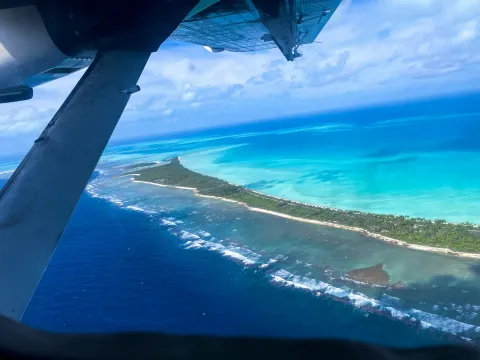
The remote Eastern islands of Fiji are hard to get to and remain exposed to climate hazards. With only one flight a week, the Lau islands communities rely on boats to transport what they need. One major issue is the scarcity of reliable water sources. The isolation of the Lau Islands makes it difficult to transport essential supplies, including supplies to construct resilient clean water supply systems, especially during extreme weather events like cyclones and droughts, which are becoming more and more frequent.
To overcome this challenge, UNICEF Pacific is supporting the Ministry of Health with a drought-proofing project led by the Divisional Health Inspector Eastern. The goal is to ensure water supply in healthcare facilities, regardless of the season.
This project focuses on enhancing water, sanitation and hygiene (WASH) facilities in 14 healthcare centres across the Lau Islands. A key part of this initiative is installing water tanks to augment their water source and provide a reliable water supply tailored to the unique needs of these islands.
At midnight, on May 29th 2024, a dedicated team of 30 labourers, construction workers and health officials, set off on their 16-day mission to create an impact in these communities.
The main boat, loaded with construction supplies, water tanks and fittings, set off from the capital, Suva, cutting through the waves as the team headed towards the remote islands.


At their first stop, Nasoki Nursing Station in Moala Island, the team faced challenging terrain, forcing them to offload materials at an improvised location and transport them via smaller fiberglass boats. Despite significant delays and low tide conditions, they worked tirelessly to achieve this goal.
The next day, at 2:00 AM, they set sail to Matuku Island, where they were met by three boats from the village with people who came to help. The team efficiently unloaded everything from the ship onto the smaller fiberglass boats, ensuring a smooth transfer despite the challenging conditions.


But when they reached the shore, the real challenge began. With no proper landing area, the team had to carry the heavy tanks and other materials on their backs. The shore was slippery from the rain, and the team endured strong winds on their way to the project site. Despite their fatigue from working late the previous evening, they refused to give up.
On their way to the Vatoa Nursing Station, the weather turned, and strong winds whipped across the water. The fiber boats swayed precariously, with one boat nearly capsizing due to strong waves. Adrenaline surged through the team as they fought to keep the boat steady, but they pressed on.

The Power of Collaboration
Community involvement was crucial to the project’s success. Despite the exhaustion and challenging conditions, a sense of determination kept the team going as they carried materials over hills and across far distances towards the village.
In some instances, the tide was so low that the boats could not reach the shore. The team had to wade through the shallow waters, pushing the boats towards land for almost an hour. The warm water against their legs and the immense effort required to move the boats highlighted the solidarity among the team as they encouraged each other to keep going.
In Lomaloma, the extensive work required two days of effort, with the community addressing significant water issues by installing two 10,000-litre tanks and repairing the village dam. This collaborative effort between the team and the community ensured the project’s success, highlighting the power of community collaboration in overcoming challenges and achieving common goals.
Impact of the Project
The immediate benefits of the drought-proofing project are already making a difference. With the installation of water tanks, healthcare centres now have a reliable water supply, which is crucial for maintaining hygiene and sanitation standards. This project has also strengthened the climate resilience of these communities, ensuring that even the most remote areas have access to clean and safe water during droughts and other extreme weather events.
But the impact goes beyond just water security. By improving WASH facilities, the project has significantly contributed to better health outcomes for these communities. For instance, the installation of water tanks and the repair of the village dam in Lomaloma have resolved some major water issues, ensuring a sustainable water supply for the future.


In total, the project successfully delivered and installed 24 tanks, 23 new tank bases, and fittings, including materials for standpipes and dam improvements. The team also repaired two existing tank bases and a number of gutter systems. These efforts have not only addressed immediate water needs but have also strengthened the climate resilience of these remote communities, ensuring they are better equipped to face future challenges.
This incredible support for the 14 health facilities was made possible thanks to contributions from the Governments of Japan and New Zealand.
Constructing water and sanitation facilities in remote islands across vast Pacific Island countries and territories is not only a logistical challenge but a test of resilience and endurance. Transporting construction supplies like cement, pipes, fittings, and water tanks on small 40-60 horsepower boats through treacherous high waves and choppy waters is an immense struggle. Commercial shipping schedules are infrequent to many remote islands, with shipments arriving only once every 3-4 months. A single missed procurement and delivery can delay progress for months, leaving communities vulnerable to the harsh realities of climate hazards without the necessities such as clean water they urgently need.
Despite these daunting challenges, the UNICEF Pacific WASH programme with support from our partners and dedicated field staff are constructing climate-resilient WASH facilities for children and families across these hard-to-reach islands. From Christmas Island, and the Gilbert Islands in Kiribati to Micronesia, Samoa, the Solomon Islands, and Vanuatu. Beyond simply delivering water tanks alone, UNICEF Pacific is working closely with the communities to build WASH services and systems which are resilient to climate risks.
UNICEF Pacific WASH programme is funded by the Governments of Australia, New Zealand, Japan, Republic of Korea, United States and the European Union.