Towards Services Without Barriers: New Analysis of Services for Children with Disabilities

- English
- Македонски
- Shqip
Skopje, 17 December 2025 – A new Analysis of Services for Children with Disabilities calls for renewed commitment to accessible, high-quality, and adequately funded services to ensure children with disabilities receive the support they need to participate in society and fulfil their potential.
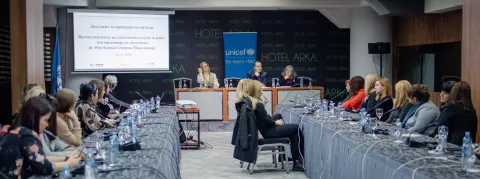
These were the conclusions of an event where stakeholders from government institutions, service providers, organizations of persons with disabilities, and parents discussed the findings of the new analysis.
“As a Ministry, we are aware that supporting children with disabilities is a complex and multi-sectoral process. Therefore, we want to jointly identify the challenges and opportunities, and through harmonization of practices, clear policies, strengthened capacities and improved coordination, to provide quality, timely and sustainable solutions.” said Fatmir Limani, Minister of Social Policy, Demographics and Youth.
The analysis was conducted by the Association of Special Educators and Rehabilitators in cooperation with UNICEF and the Service for Functional Assessment of Children and Youth at the Health Center Skopje.
“The approach was unique and comprehensive. We examined if recommended services identified during individual disability assessments were provided effectively and the extent to which they improved children’s participation in daily life and connections with the community”, said Goran Petrushev, President of the Association of Special Educators and Rehabilitators. Nearly two-thirds of parents expressed satisfaction with the services their children received.”
“The analysis highlights promising results to build on and do more to ensure that every child receives the support they need. UNICEF remains committed to continuing this journey with local stakeholders - ensuring that every child is included, valued, and empowered to reach their full potential,” said Lesley Miller, UNICEF Representative.
“As a Government, and I personally, we take responsibility to create conditions for the recommendations to be translated into concrete policies and measures.“ said Fatmir Limani, Minister of Social Policy, Demographics and Youth.
The analysis reviewed over 1,700 functional assessments. It found significant progress in supporting children with disabilities, including the establishment of new services and the development of strong partnerships. However, persistent challenges remain, including a lack of specialized staff, unequal access to services across regions, funding shortages, and gaps in intersectoral coordination.
More specifically, the analysis highlights that while most children are in regular classes with individual education plans and curriculum support, few have access to assistive technologies and there is a shortage of speech therapists. Furthermore, while financial assistance is generally available, less than half receive needed personal assistance and counselling, and early intervention services are limited.
To address some of the barriers, during the event partners discussed priority actions including the need to:
- Expand and decentralize services to underserved regions, so families in smaller towns and rural areas do not face unaffordable travel and access costs.
- Address staffing shortages of specialized service providers, including special educators, speech therapists, and child psychiatrists.
- Continue to make schools and kindergartens inclusive and accessible and expand the availability of assistive technologies.
- Provide systematic, tailored training for all professionals working with children with disabilities, including on early intervention and inclusive education practices.
- Strengthen cross sectoral‑ coordination and monitoring, aligning health, education, social and child protection systems around child and ‑family centered pathways.
- Guarantee timely delivery of all services recommended by functional assessment teams, without delay or discrimination.
The analysis builds on the International Classification of Functioning, Disability and Health (ICF), which was first piloted in disability assessments in the country with the support of UNICEF in 2019. Today there are nine regional assessment teams that serve as single entry points for children and youth to access support services and cash benefits.
Media contacts
Additional resources

About UNICEF
UNICEF, the United Nations agency for children, works to protect the rights of every child, everywhere, especially the most disadvantaged children and in the toughest places to reach. Across more than 190 countries and territories, we do whatever it takes to help children survive, thrive, and fulfil their potential.