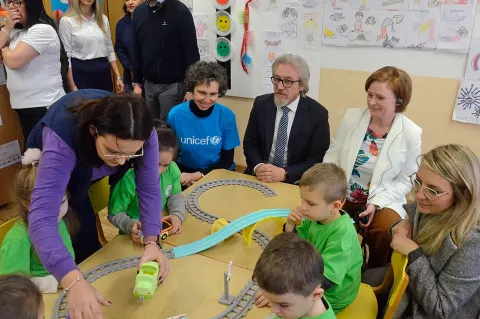
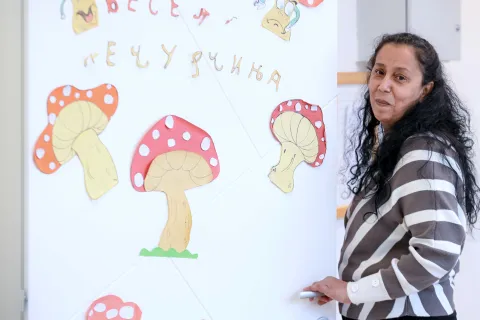
Public–private partnerships and vouchers for children from vulnerable families among the models to expand kindergarten enrolment
- English
- Македонски
- Shqip
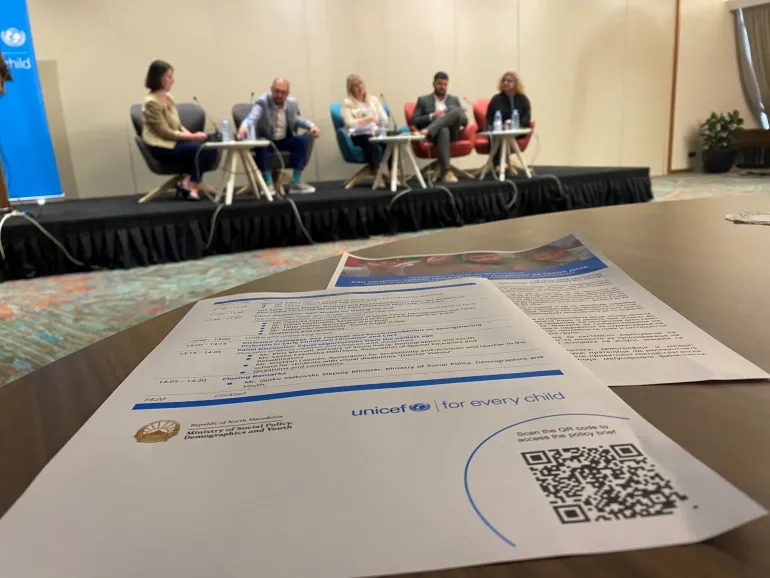
Skopje, 18 June 2026: The Minister of Social Policy, Demography and Youth, Fatmir Limani, the Deputy Minister Gjoko Velkovski, and UNICEF Representative, Lesley Miller, presented key findings to strengthening the early childhood education and care system and expanding enrolment in preschool education.
At the conference titled “Early Start, Lasting Benefits – Kindergarten for Every Child!” - the findings and recommendations from an analysis on innovative financing models for early childhood education and care were presented.
North Macedonia can accelerate access to kindergartens by combining public investment with support to private providers and employers, while also ensuring services are affordable and inclusive, according to the new UNICEF-supported analysis.
The findings highlight both the urgency and the opportunity: more than 79,000 children aged 0–6 are not enrolled in any form of early childhood education and care, and reaching the national target of 65 per cent enrolment by 2032 will require around 19,000 additional places.
Demand already exceeds supply, with nearly 5,000 children on waiting lists in 2025. Coverage by municipality varies sharply, from high enrolment in some areas to below 10 per cent, or none, in others. Children from the most vulnerable groups including Roma children, children with disabilities and those living in poverty remain least likely to benefit.
The Minister of Social Policy, Demography and Youth, Fatmir Limani, emphasized that the Ministry is working to expand capacities through construction and reconstruction, as well as through alternative childcare models such as group-based childcare in various settings and early childhood development centres. These efforts also aim to increase access to preschool education and support private service providers.
“In cooperation with the World Bank’s social services improvement project and UNICEF, we will propose a voucher model that would enable children from vulnerable families and those on waiting lists to enrol in private kindergartens. If this approach proves effective in practice, it could become a permanent policy, contributing to a faster expansion of enrolment coverage,” said Minister Limani.
“Early childhood education and care is one of the most important investments in child development, school readiness and long-term human capital. Increasing the number of places is essential, but it will only deliver results if access is equitable, inclusive, affordable and of good quality,” said Lesley Miller, UNICEF Representative. “If we do not design the system to reach the most vulnerable children, we risk widening the very inequalities we are trying to reduce. The goal is not simply more places, but better opportunities for every child, in every community.”
The analysis shows that the current system, which is largely reliant on public provision, cannot meet demand fast enough. Private providers account for just 7 per cent of enrolment, while employer-based services are very rare. Expanding public infrastructure alone would take decades and require investment of more than €100 million, alongside significant workforce expansion.
A more effective approach to increasing coverage is to combine the expansion of public infrastructure with the introduction of co-financing for private kindergartens and employers. The analysis proposes creating approximately 13,500 new places through private provision and 5,300 public places by 2032, supported by a co-financing model to ensure services are affordable for families, including those who are most vulnerable.
To ensure equitable access, the analysis recommends measures such as fee waivers, variable fees based on parents’ income, transport support and proactive outreach, so that new places translate into real opportunities for all children including those at risk of exclusion. Furthermore, additional resources for children with disabilities would include practical measures such as accessibility upgrades, and introduction of earmarked funding to municipalities to enable full participation of children with disabilities in quality early learning.
Participants at the event agreed that expanding early childhood education and care is not only an infrastructure challenge, but a broader system transformation. Stronger coordination between central and local government, providers and employers, combined with sustained investment in quality, workforce and inclusion, will be essential to ensure every child gets the best possible start in life.
Deputy Minister Velkovski concluded the event with the following message:
“Demand for kindergarten places is growing, and it is our responsibility to respond with concrete solutions. That is why we are investing in new capacities that will provide care for an additional 3,515 children across the country. However, real success will not be measured solely by the number of new places, but by how effectively we ensure access for every child, especially those who have been excluded from the system the longest.”
For more information, please contact
Suzie Pappas Capovska | Tel: (02) 3231-244 | [email protected]
Media contacts
About UNICEF
UNICEF, the United Nations agency for children, works to protect the rights of every child, everywhere, especially the most disadvantaged children and in the toughest places to reach. Across more than 190 countries and territories, we do whatever it takes to help children survive, thrive, and fulfil their potential.