European Child Guarantee - a pathway to reduce child poverty in the country

- English
- Македонски
- Shqip
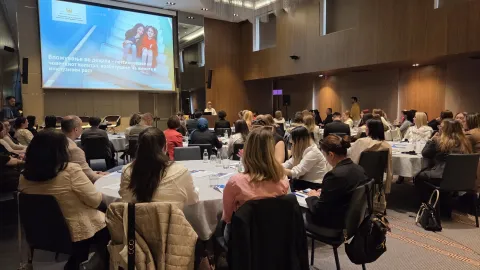
Skopje, 14 March 2024: At a panel discussion on multidimensional child poverty, stakeholders from the Government, development partners, academia and civil society agreed on a need for cross-sectoral and long-term approach to tackle multidimensional child poverty in North Macedonia. Introducing the European Child Guarantee in the country was pointed out as an intervention with the greatest promise to reach the most vulnerable children and secure systemic access to social services.
Child poverty is not contingent only on family income but also arises due to deprivations in care, goods and services provided by the parents and by the public authorities. In the country every third child lives below the poverty line – this is considerably higher than that of the overall population. Furthermore, a UNICEF-supported analysis has shown that deprivations in education, early childhood development, nutrition, safety, and love and care are among the top five contributors to multidimensional child poverty.
“Child poverty is not a problem of one Government or one political party. Child poverty requires a sustained and systematic response at both national and local level. The high child poverty rate is a challenge that has persisted in the country for many years,” said Patrizia DiGiovanni, UNICEF Representative. “As we are approaching the Parliamentary and Presidential elections, we should remember that child poverty is not inevitable; ending it is a policy choice.”
"As part of its mission to reduce poverty, share prosperity and preserve the planet, the World Bank, together with its partners in the country, collaborates on topics and issues related to the well-being of children in North Macedonia, especially those from the most vulnerable category and through improving the scope and quality of services in the sphere of education, social and health," said Bojana Natseva, senior education specialist at the World Bank, during the panel debate.
The discussion summarized the results from a series of sector consultations focusing on education, health, nutrition and social protection aspects of child poverty.
The panelists agreed on the following action points:
- Need to make children living in poverty visible, through monitoring, measurement and acting on the evidence.
- Increase access to social services and care to address child poverty, promote family-centered support and child protection interventions to reach the most vulnerable.
- Provide direct financial relief for families through cash transfers.
- Continue the trend of expanding access to early childhood education, given its significance to future life outcomes.
- Address educational deprivations that contribute to child poverty through programmes for reduction of student dropout and support for the inclusion of children who are outside the educational process, and children with disabilities, can go a long way in addressing.
- Ensure access to healthcare for every child by improving the coverage of the health insurance for children, as well as strengthening the home visit services and immunization systems.
In the quest to tackle child poverty in North Macedonia, the country is using experiences from the European Union including the European Child Guarantee - a mechanism aiming to prevent and combat social exclusion of children by guaranteeing access to a set of key basic social services and financial assistance.
There is an ongoing work led by the Ministry of Labour and Social Policy in close collaboration with Ministry of Health, Ministry of Education and Science and UNICEF to pave the way for implementation of the European Child Guarantee in the country.
The results of today’s discussion and previous policy dialogues on multidimensional child poverty will feed into the National Action Plan on Child Rights and the plan for implementation of the European Child Guarantee in the country.
Media contacts
About UNICEF
UNICEF promotes the rights and wellbeing of every child, in everything we do. Together with our partners, we work in 190 countries and territories to translate that commitment into practical action, focusing special effort on reaching the most vulnerable and excluded children, to the benefit of all children, everywhere.
For more information about UNICEF and its work for children, visit www.unicef.mk.
Follow UNICEF on Twitter, Facebook, Instagram and YouTube.