Three Children, One Decision: Protect Them All
In Jakusko, a community in northeast Nigeria, a woman affected by conflict ensures that all her children are vaccinated against vaccine preventable diseases.

In Jakusko, a conflict-affected community in northeast Nigeria, vaccination is not optional. It is a family commitment.
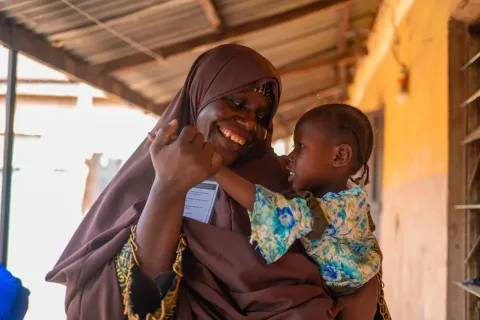
For Harira Lawan, a 28-year-old mother of three, protecting her children from vaccine-preventable diseases begins with showing up. Early one bright October morning, she stepped out of her home in Jakusko, Yobe State, with her children close by, walking briskly toward a nearby vaccination post.
“I have seen what happens when children are not vaccinated,” she said, gently setting down her three-year-old daughter, Khadijah, as health workers prepared to take her records. “That is why I have vaccinated my children since the day they were born. It is a priority for me because I understand its value.”

By the time Harira arrived, the vaccination post was already busy. Under the wide shade of a giant tree, health workers moved from child to child, administering vaccines and updating records, while caregivers waited patiently, watching closely. The air carried a quiet sense of purpose.
Standing behind her children, Yusuf, Rahamah and Khadijah, Harira waited her turn. She had come to take advantage of the nationwide integrated vaccination campaign organized by the Government to protect children against multiple vaccine-preventable diseases.
In northeast Nigeria, where years of conflict have weakened health systems and disrupted access to routine services, such campaigns are critical. Many communities struggle with shortages of trained health workers, damaged infrastructure, and long distances to health facilities, all of which limit routine immunization coverage.
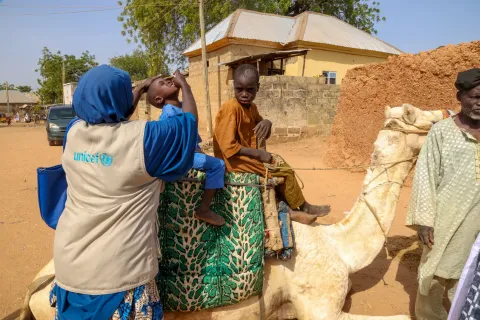
To bridge these gaps, UNICEF, working with government and partners, supports the recruitment and training of health workers, the procurement of vaccines, and the logistics needed to reach children in both urban centres and hard-to-reach communities.
According to Dr. Marie Marcos, UNICEF Health Manager in Maiduguri, the measles and rubella integrated vaccination campaign provided a rare opportunity to deliver multiple life-saving interventions at once. Led by the Government and supported by partners including Gavi, the Government of Germany through KfW (BMZ), and the United Nations Central Emergency Response Fund, the campaign served as a one-stop platform for children to receive vaccines against measles, rubella, polio, malaria, diphtheria, tetanus, and human papillomavirus, among others.
Harira’s confidence in immunization comes from personal experience.
“I understood the importance of vaccines when I had my first child, Yusuf, nine years ago in Damaturu,” she recalled. “He was rarely sick, and when he did fall ill, it was mild. That opened my eyes. Since then, I have never taken vaccination lightly.”

Her commitment reflects a growing shift among women affected by conflict across Nigeria’s northeast. Years of sustained advocacy and investment in routine immunization have helped build trust, though challenges remain, particularly around access and persistent myths about vaccines.
During the campaign, vaccination services were delivered through fixed and mobile posts, health facilities, schools, and places of worship. These efforts were backed by weeks of community engagement, including outreach to traditional and religious leaders and local influencers, ensuring families were informed and encouraged to participate.
For Harira, the choice was simple.
“I left everything else behind and brought my children here,” she said, watching as her youngest received her vaccine. “Prevention is always better than looking for a cure.”