A Mother’s Second Chance
In northeast Nigeria, a vocational programme is transforming the lives of conflict-affected Fatsuma and her children.

In the 10 years that Fatsuma Mohammed Ibrahim and her children fled armed conflict in Kukawa, a community in Borno State to Damagum, her hometown in neighbouring Yobe State in northeast Nigeria, she has faced many life battles, including the death of two children.
I met and married my husband over 22 years ago in Kukawa. We had six children together and though we were not well off, he managed to provide our basic needs. I was selling local perfumes in Kukawa, and my husband was a patent medicine vendor. We were able to get by until 15 years ago when armed conflict claimed his life. He was ambushed and killed while dispensing drugs to customers. I had no choice to run for my life with my children, she said.
However, life in Damagum was equally not a bed of roses. “We left everything behind in Kukawa and I did not have sufficient capital to continue my perfume business here. The business is also a kind of luxury. Only comfortable people will think of investing in fragrance. The economy in Damagum was poorer than before I left,’’ she added.
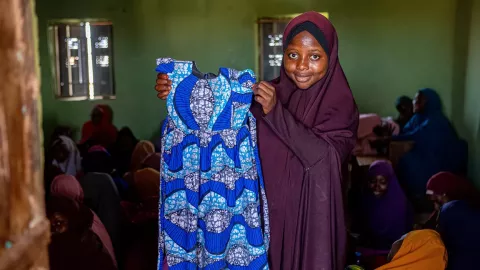
Fatsuma, 43, was one of the beneficiaries of a UNICEF-supported vocational training programme implemented in collaboration with the Yobe State Government to improve the resilience of people affected by conflict in northeast Nigeria. Funded by the Government of Germany (BMZ) through KfW Development Bank, over 50,000 adolescents and women have graduated from the programme since inception.

With an array of vocational skills such as tailoring and the production of soap, paint and accessories, UNICEF is supporting the capacity of households to earn an income and invest in their wellbeing, including education services.
Through the Resilience Integrated Education Programming for Children in Northeast Nigeria, UNICEF is building the resilience of households to respond to the shocks of protracted conflict. By promoting self-reliance and industry, the programme has also enabled governments in the region to foster peace in various communities.
For Fatsuma, the training has not only provided an alternative economic source to fend for her family. It has also helped to enroll her two youngest children in school.

However, the challenge remains access to capital for business expansion. According to Fatsuma, the major challenge of the body cream business is capital.
I have no problem with marketing and sales, but I will do better with access to more capital. My customers love my products because I make sure that the fragrance of the body cream is pleasant and that no harsh chemical is added. I earn around N48,000 in profit monthly. Sometimes it can be more and sometimes it can be less, she said.
My biggest achievement is that all my children are enrolled and can stay in school. At least, we have hope with education. Unlike before, it is not so challenging to buy writing materials and pay for medications when the children fall ill. One of my children had typhoid and we had to go as far as Damaturu, the state capital for his treatment. I was able to fund his treatment through my business, she added.