Increasing Vaccine Voices
Reducing the Number of Zero Dose Children in Borno

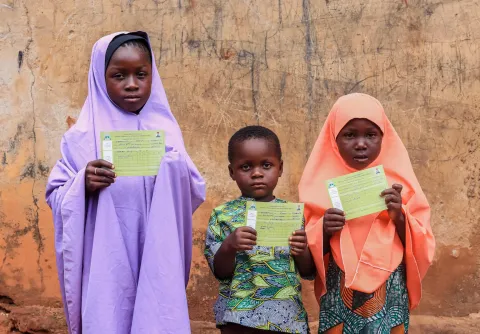
They walked up quietly, almost shy, barely believing their names had been called. Saadatu Galadima, Joy Mamza and Aminu Dahiru stood on that stage in Mohammed Indimi Hall in Maiduguri, dazed, looking at one another as if waiting for someone to say it was all a mistake. Then the realisation burst through, they bent over in excitement, hugged tightly and let the joy sweep over them. Against all odds, they had just won the Adopt A PHC Naija Challenge, a youth powered campaign to improve vaccination rates in some of Borno’s most densely populated communities.
At their adopted Mala Kachallah Primary Healthcare Centre, the team increased the number of zero dose children vaccinated by more than 50 per cent. That single achievement was powerful enough to place them ahead of nine other teams, each out there trying to lift the same burden, the same silent weight carried by thousands of unvaccinated children across northeast Nigeria.
Their victory speech carried the kind of humility that comes from knowing the scale of the problem. A small step for their team, but a meaningful contribution to a national effort to reduce the number of zero dose children in Nigeria. “This is all a collaborative effort,” Joy said, still catching her breath. “We visited the community three times a week, meeting caregivers wherever we could find them. We did not miss any opportunity. The other teams are equally strong, so winning this is huge for us''

The Challenge, created by the Foundation for Alternative Learning in Underserved Communities in collaboration with the Borno State Primary Healthcare Development Board, brought together thirty young people. They split themselves into ten teams, each adopting one primary healthcare centre in a zero dose community in Maiduguri. Their role was simple but powerful, to use their creativity to counter vaccine myths, speak with caregivers, win trust and align communities with lifesaving immunisation services.
Supported by UNICEF with funding from the Government of Canada, the Challenge was designed as a fresh, youthful push to tackle one of Nigeria’s toughest public health challenges. Nigeria still has over two million unvaccinated children, the highest global burden of zero-dose children. A zero-dose child is one who has not received even the first routine immunization vaccine, usually the Penta vaccine. In places affected by conflict, that lack of protection becomes a direct threat to child survival.
Communities across northern Nigeria face multiple barriers, insecurity, poverty, vaccine stockouts, misconceptions, and years of low trust in the formal health system. The northeast carries 27 per cent of the country’s unvaccinated children, according to the latest national surveys. Borno alone has eight zero dose LGAs while neighbouring Yobe has two. For families living at the edge of conflict, every missed vaccination is another risk they can hardly afford.
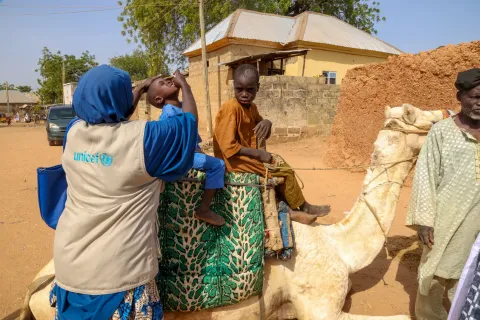
This is why UNICEF and government partners have spent years strengthening routine immunisation systems, training healthcare workers, maintaining vaccine availability and expanding vaccination points. They have even deployed ‘flying midwives,’ midwives who travel across difficult terrain to deliver vaccines and basic health services in remote communities, a scheme that has since been fully taken over by the Borno State Government.

Within this broader landscape, the Adopt A PHC Naija Challenge stood out as a new spark, a youth first approach that not only raised vaccination rates but built a generation of young advocates who can carry these messages far beyond the project itself. Alongside the winning Vaccine Voices team, Naija Nexus and Healing Line took second and third place. Others like Guidance of Growth, Lafiya, Immunization Panthers, Mind Lifters, Bluebird, Pathfinders and Haske played critical roles in reaching communities that often sit at the margins of public health systems.
Before stepping into the field, each team received training support from UNICEF and guidance from experienced community mobilisers. They learned how to explain vaccination schedules, how to demystify childhood diseases and how to speak in local languages in a way that resonates deeply.
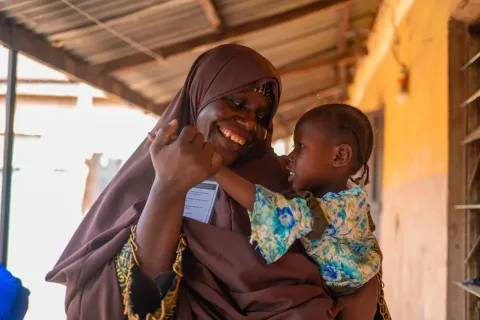
For Aminu Dahiru, the only male member of Vaccine Voices, the journey was transformational. “I learned how to speak to people, how to persuade them, how to understand their fears. We worked closely with trusted community voices,” he said. He also remembers the moments that showed the heart of the communities. “One day in Shuwari, rain started suddenly. People ran for cover, caregivers rushed home. But one woman stopped and asked us to come inside her house so we would not get drenched. That kindness stays with you.”
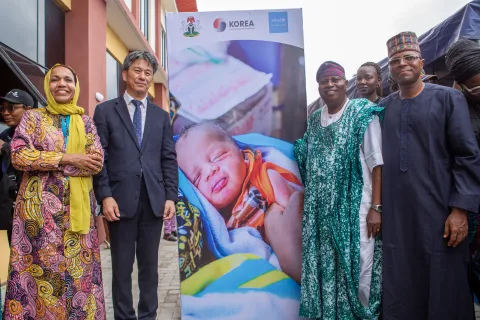
At the award ceremony, the Executive Secretary of the Borno State Primary Healthcare Development Board, Professor Muhammad Arab Alhaji, summed up the achievement simply. This, he said, is what happens when young people take ownership. Represented by the Director of Disease Control and Immunization, Hajia Fati Ali, he praised the advocates for reaching more than nine hundred thousand people through door to door mobilization, radio broadcasts and digital storytelling.
Over 11,900 caregivers were personally engaged, and routine immunisation uptake increased by 44 per cent, almost doubling the project’s target. “These are not just statistics,” he said. “They represent real children, protected.”