Enabling teachers, educating children
Innovative teacher professional development model seeks to address Nigeria’s learning crises

The Challenge
Nigeria faces a severe learning crisis, with over 70% of children lacking foundational literacy and numeracy (FLN) skills. Among other factors, weak teacher capacity – exacerbated by insufficient standardized teacher professional development (STPD) opportunities – has posed an acute challenge to better educational outcomes for children.
Pre-service teacher training programmes often fail to effectively bridge the gap between theory and practical classroom application, while training through in-service models leads to a dilution of essential knowledge across subsequent levels of training. This results in:
- Limited teacher engagement
- Insufficient feedback
- Lack of contextualized learning
- Poor educational quality for children
These issues, combined with inadequate teaching resources, are leaving millions of Nigerian children without the educational foundations necessary to survive and thrive.
The Solution
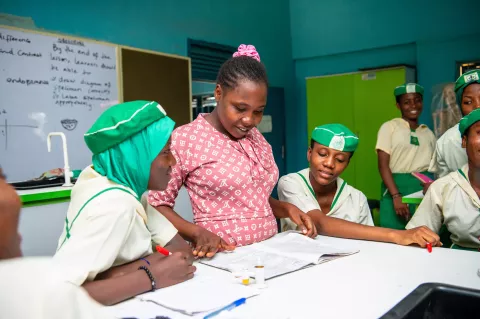
During July 2022-August 2023, UNICEF Nigeria collaborated with government partners to pilot an innovative school-based STPD model known as the Learning Lab. This initiative was rolled out in 12 schools across three states—Borno, Kaduna, and Lagos—engaging 12 teachers and 719 learners.
The STPD-Learning Lab model proposes a shift away from the cascade approach, offering:
- A more contextualized and needs-based teacher development programme
- Instructional Leadership Teams providing ongoing, in-school support
- Mentoring and collaborative learning opportunities through "cycles of inquiry"
- Focus on identifying classroom challenges and co-constructing solutions
- Digital platforms support including Kobo Collect for data recording
The approach seeks to empower teachers by giving them greater ownership of their development while fostering collaborative learning environments that improve both teaching effectiveness and student learning outcomes.
The Impact
The STPD-Learning Lab model has demonstrated measurable improvements in both teacher efficacy and student learning outcomes through its innovative, school-based approach.
By the end of the pilot, the model successfully created a safe, in-school space for teachers and trainers to deepen their understanding of teaching and training. Teachers showed significant progress in FLN skills, while surveys reported enhanced pedagogical knowledge, attitudes, confidence, and collaboration. Instructional teams helped transform schools into hubs of continuous learning and reflection, creating an environment where teachers co-designed lesson plans, received real-time feedback, and experimented with new strategies.
The model leveraged existing expertise from various educational bodies, including the State Universal Basic Education Board (SUBEB) and Local Government Education Authorities (LGEAs), to create communities of practice focused on innovative teacher development. This move was deemed invaluable for trainers and for increasing teacher-learner engagement, demonstrating the model's potential to catalyze positive changes in the educational system.
The implementation yielded several valuable lessons. Instructional leadership is crucial to pedagogical improvement, with the formation of ILTs within schools playing a vital role in enhancing teacher capacity through real-time, classroom-based learning. The experience also emphasized the importance of adapting models to specific contexts and reducing complexity when introducing new concepts to increase effectiveness. These adaptations were successfully demonstrated in Lagos, where the model was adjusted to include an investigation of scripted lessons used by teachers.
Looking ahead, the first iteration of the STPD-Learning Lab presents a clear pathway for improving teacher professional development in Nigeria. The pilot offers several recommendations that will inform scale-up and implementation in other states in 2024-2025, including Zamfara, Sokoto, Kano and Jigawa. Through this expansion, the model continues its mission to transform teacher development through school-based, needs-driven learning experiences.