Media Leaders and Other Stakeholders Call for Collective Action to Improve the Lives and Future of Nigeria’s Children
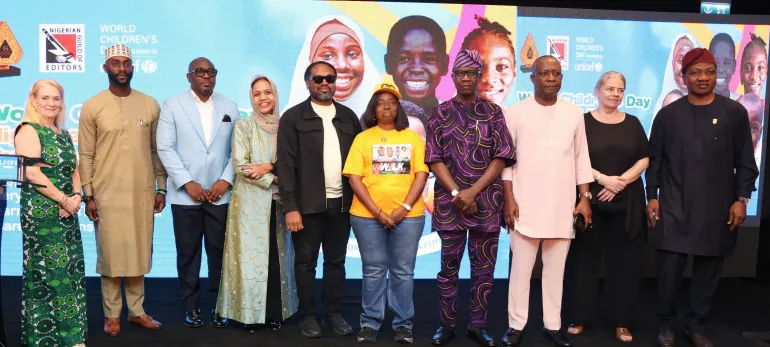
LAGOS, 26 November 2026 – Media leaders, government officials, development partners, private sector representatives, and children today called for stronger collective action to give every Nigerian child the best start in life and the opportunity to remain in school, to learn, and be protected.
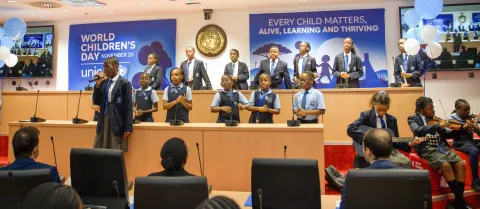
The call came at the 2026 World Children’s Day High-Level Media Symposium in Lagos, convened by UNICEF Nigeria with the Nigerian Guild of Editors (NGE) and the Diamond Awards for Media Excellence (DAME). Under the theme "Every Child Alive, Thriving and Learning: A Shared Responsibility,” the event brought evidence and children’s voices into direct conversation with those who shape policy, investment, and public opinion.
The discussions connected two defining stages in a child’s life. The care, nutrition, and protection received from pregnancy to age two are critical for survival, brain development, and future learning. Children brought these issues to life through a drama that highlighted the importance of child survival, and the support children need to survive, thrive, and be protected, as well as the barriers that prevent many children from accessing education.
As children grow, poverty, insecurity, displacement, harmful social norms, disability barriers, and weak learning conditions continue to keep many out of school or in classrooms without the quality education they need.
In her keynote address, Her Excellency Dr. Claudiana Ibijoke Sanwo-Olu, First Lady of Lagos State, said supporting mothers and investing early in children are essential to building a healthier and better-educated generation.
“The Babajide Sanwo-Olu-led administration demonstrates an unwavering commitment to inclusive child development and gender-responsive governance. This singular decision goes beyond policy. It is a profound statement that every child matters and that true gender equality is achieved not by competing interests but by ensuring that every child, girl or boy, is given the opportunity to realise his or her God-given potential. It is a defining moment in the evolution of child development and protection in Lagos State."
“As we undertake the review of the Child’s Rights Law 2015, we have before us a unique opportunity to strengthen our legal and institutional framework in ways that respond to emerging realities while safeguarding the best interests of every child,” said Dr. Sanwo-Olu.
UNICEF Representative in Nigeria, Wafaa Saeed, called for sustained investment in children, stressing that the earliest years of life cannot wait for economic conditions to improve and that the media has an important role in keeping children’s issues in the national conversation.
“You cannot pause a baby’s brain development while waiting for economic recovery. From conception to age two, 80 percent of human brain growth occurs, making investment in the first 1,000 days critical to a child’s survival, development and future,” said Saeed.
She also urged the media to look beyond the figures and consistently connect evidence with the experiences of children and families.
“Statistics only matter when they move us to protect the child behind the number. We need the media to humanize the numbers, keep children in the headlines year-round and spotlight the solutions that are working across Nigeria,” she said.
Children helped move the conversation beyond statistics. They questioned decision-makers on what government, families, communities, businesses, and partners would do to ensure that a child’s location, family circumstances, gender, or disability does not determine whether that child survives, thrives, learns or is protected.
The exchange highlighted practical priorities: stronger maternal and child health and nutrition services; support for breastfeeding and appropriate complementary feeding; immunization, clean water, birth registration, and early stimulation; better financing and frontline delivery; and workplaces and communities that support parents and caregivers. On education, attention is centered on removing the pressures that stop children from enrolling or staying in school, improving safety and inclusion, strengthening teachers and learning quality, and expanding flexible options for children in underserved and conflict-affected communities.
President of the Nigerian Guild of Editors, Eze Anaba, said the media must keep children’s rights at the centre of national and editorial conversations, beyond commemorative days or the release of new statistics.
“The media must go beyond reporting figures and ask what they mean for real children, what government and other stakeholders have committed to do, and whether those commitments are being fulfilled. Through sustained, ethical, and solutions-focused journalism, we can keep children visible, influence public policy, and strengthen accountability for lasting progress,” said Anaba.
DAME Trustee Lanre Idowu said the symposium reflected the continuing joint work of UNICEF, NGE, and DAME under their Memorandum of Understanding to advance children’s rights through stronger journalism and public accountability.
“Through training, access to credible evidence, field visits, editorial engagement, and recognition of excellent reporting, this partnership is helping to deepen the quality and consistency of child-rights journalism. Our shared commitment is to move beyond awareness to informed public conversation, policy influence, accountability, and action for children,” said Idowu.
Goodwill messages from the government, donors, the private sector, and UNICEF Champions reinforced the same call for shared responsibility and sustained investment. Children’s performances, including “The First 1,000 Days of Life” and “I am Nigerian Child,” further brought the evidence to life and reminded participants that decisions about children must include their voices.
In his goodwill message, Adefemi Adeniran, Director of Corporate Communications and CSR at Airtel Nigeria, stressed that a child’s circumstances should not determine their prospects in life.
“Neither the economic circumstances of a child’s parent, background nor their developmental differences should determine a child’s prospects in life. Keeping them alive is our fundamental obligation. Enabling them to learn is our collective responsibility. Creating conditions for them to thrive must be our shared ambition. The Nigeria we aspire to be tomorrow will be a reflection of the choices we make for our children today,” said Adeniran.
UNICEF Nigeria Goodwill Ambassador and musician Cobhams Asuquo, who spoke about the “First 1,000 Days of Life” song he produced, highlighted the power of music as a tool to make important messages about children simple, memorable and able to connect with people.
“Music is a powerful tool. It can take an important message beyond the statistics and help people connect with the real lives and experiences behind it. With the First 1,000 Days of Life song, we wanted families and communities to understand that what we do for a child from the very beginning, the nutrition, care and support we provide, can shape that child’s future,” said Asuquo.
One of the highlights of the event was a special presentation by Asuquo with schoolchildren of “I Am a Nigerian Child,” bringing children’s voices to the centre of the symposium and its call for every Nigerian child to survive, thrive, learn, and be protected.
The symposium also came as UNICEF marks 80 years of working for and with children globally. The anniversary offers an opportunity to reflect on progress while renewing the choices and partnerships needed to protect those gains and secure a better future for every child.
Participants concluded that no single institution can deliver that future alone. Government leadership and financing, family and community action, private sector engagement, development partnerships, sustained media attention, and children’s participation are all essential to improve the lives and future of Nigeria’s children.
About the UNICEF, NGE, and DAME Partnership
UNICEF Nigeria, the Nigerian Guild of Editors (NGE), and the Diamond Awards for Media Excellence (DAME) are partnering to strengthen the media’s role in advancing children’s rights in Nigeria. By bringing media leaders and journalists closer to issues affecting children, the partnership keeps children at the centre of public debate and encourages greater attention and action. It harnesses the media’s influence to help build a Nigeria where every child can survive, thrive, learn and develop, grow up healthy and protected, and reach their full potential.
Media contacts
About UNICEF
UNICEF promotes the rights and wellbeing of every child, in everything we do. Together with our partners, we work in 190 countries and territories to translate that commitment into practical action, focusing special effort on reaching the most vulnerable and excluded children, to the benefit of all children, everywhere.
For more information about UNICEF and its work for children in Nigeria, visit www.unicef.org/nigeria