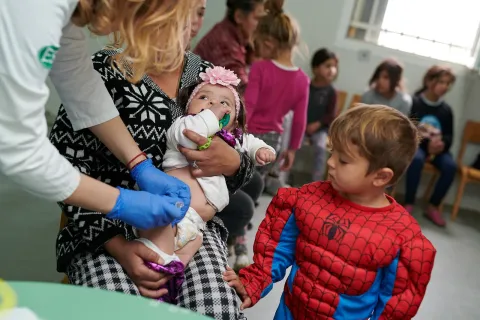
Together for children’s health: Science, parents, and doctors
Institute for Public Health, Center for Early Development of Clinical Centre of Montenegro, Parents Association, and UNICEF call for responsible parenting, trust in science, and timely vaccination
- Crnogorski
- English
- Shqip
PODGORICA, 29 April 2025 – National Institute for Public Health data indicates that almost only 22% of children born in 2023 in Montenegro have received the first dose of the MMR vaccine. This is by far the lowest in Europe. This means that more than three-quarters of babies remain unprotected from highly contagious diseases that can have serious consequences. Outbreaks such as measles have already returned to the European region – with over 127,000 cases reported in 2024, the highest number in the last three decades. During the same year 38 deaths from measles have been reported in Europe, based on preliminary data received as of beginning of March 2025.
Ahead of the European Immunization Week, the Institute for Public Health of Montenegro, Center for Early development of the Clinical Center of Montenegro, the Parents Association, and UNICEF are warning: Montenegro is still far from being in the safe zone form the large outbreaks in terms of vaccination coverage – it would at least need 95%. Vaccination coverage is declining, particularly among the youngest children, and infectious diseases do not wait.
Data from the Institute of Public Health reveals a clear and worrying trend: the younger the children, the lower the vaccination rate. Only 22% of children born in 2023 received their first dose of the MMR vaccine, compared to 48% of those born in 2022, 67% in 2021, 76% in 2020, while the best-protected cohort is that of 2019, with 82% vaccinated.
“Achieving better results in the field of immunization requires joint efforts from all sectors – health, education, local authorities, media, and everyone who can contribute to better awareness and vaccine accessibility. Parents play an irreplaceable role as key allies in making informed decisions about their children’s health. Strengthening primary healthcare, supporting healthcare workers, and building trust among parents is the only approach that leads to improved vaccination coverage, comparable to the most successful practices in Europe. The Institute of Public Health of Montenegro calls on parents and all citizens to seek information from reliable sources and contribute to protecting the health of the youngest and the entire community”, stated the Institute for Public Health of Montenegro.
European Immunization Week is a timely reminder that vaccines are among the greatest achievements of modern medicine. The MMR vaccine is safe, effective, and has no link to developmental disorders. This is also confirmed by the World Health Organization, the European Centre for Disease Prevention and Control, numerous universities, and independent scientific bodies. The scientific consensus is unequivocal: autism spectrum disorders are not caused by vaccination but are linked to genetic predispositions and prenatal risk factors.
“Parents want to make the right decisions, but they are often overwhelmed by inaccurate information, which can sometimes even come from healthcare professionals. We need to ensure they have access to facts and enable direct, open conversations with doctors so they can resolve their concerns and get answers to questions on this topic, which is important for their children's health”, say from the Parents Association.
Dr. Iva Ivanović, Director of the Center for Early Childhood Development, states: “Autism has strong genetic and prenatal causes. Vaccination does not contribute to its development – decades of serious research have proven this.”
Although most parents in Montenegro do vaccinate their children, they often do so with delays, leaving children unprotected during their most vulnerable age – when infectious diseases can have the most severe consequences. The greatest challenge lies in timely vaccination, which provides protection precisely when children need it most.
UNICEF in Montenegro, with support from international partners – primarily the Delegation of the European Union and the Government of the Republic of Korea – is implementing a range of activities aimed at strengthening the national immunization system. In cooperation with the Ministry of Health, the Institute of Public Health, health centers, and local authorities, UNICEF has supported improvements in communication between healthcare workers and parents, organized training for medical staff, provided equipment and infrastructure, and facilitated direct pediatrician-parent conversations in every municipality.
Still, results vary significantly from one municipality to another, highlighting the need for further efforts and ongoing support for parents in making informed decisions. The best preschool immunization rates (excluding children born in 2024) have been recorded in Žabljak (83.1%), Andrijevica (82.1%), Gusinje (80.4%), Plav (78.5%), Pljevlja (78.4%), Mojkovac (78.3%), and Kolašin (76.7%). The lowest rates were found in Plužine, Budva, Bar, and Ulcinj, where less than 50% of preschool-aged children are vaccinated.
“This alarmingly low rate of vaccination is not only a statistic anda decline in trust – but it represents a violation of a child’s fundamental right to health. Everybody needs to play a role: every pediatrician has the obligation to promote timely vaccination and not to advise for postponing; the healthcare system must scale up awareness; parents have a responsibility to be informed and protect their child”, said Michele Servadei, UNICEF Representative to Montenegro.
On the occasion of marking the European Immunization Week, joint message of the Association of Pediatricians of Montenegro, the Center for Early Intervention, the Parents Association, and UNICEF is:
“Children cannot choose – but we can. Their health depends on our choices. Vaccines protect children from dangerous diseases and allow them to grow up safely and healthily. For this reason, let’s vaccinate on time, as every child has the right to a healthy start.”