Supporting parents is key to give every child the best start in life
UNICEF and the Ministry of Health bring together experts and parents to strengthen support for families with young children

- Crnogorski
- English
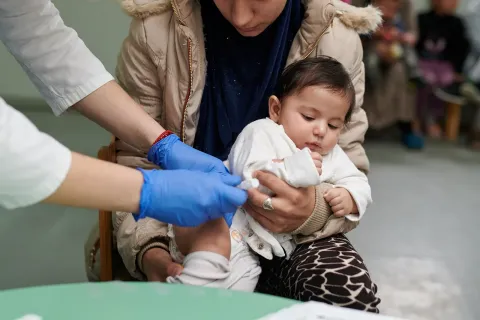
Podgorica, 3 November 2025 – The first years of life represent the most sensitive and important period in which the foundations of a child’s future health, skills, and emotional stability are built. During this period, parents play the most crucial role in their children’s lives and need timely, accessible, and high-quality support from the system to best respond to their child’s needs. This was the key message from the Conference on home visits and family support – The best start in life for every child in Montenegro, organized by UNICEF and the Ministry of Health.
During the first day of the two-day conference, which gathered more than a hundred representatives of state institutions, health, education and social welfare providers, academia, nongovernmental organizations, international organizations, association of municipalities, and parents, it was emphasized that investing in the early years of life brings the greatest returns – not only for the child and her/his family, but for the society as a whole. Current evidence show that investing in early childhood programmes pays off many times over. For every dollar invested in quality early childhood programs, yields a return of between $6 dollars and $17 dollars . This evidence is well summarized by James Heckman, a Nobel Laurate in Economics Every child, who is given the best start in life, has a greater chance to reach her/his full potential and contribute to the community in which they grow up.
“Montenegro has made an important step forward by placing children and families at the heart of its national development agenda. Home visits by primary health care nurses who visit pregnant women, and families of newborns and young children, are not just a health service – they are an opportunity for every family and every parent to receive the support they need. When we invest in parents and in the first years of a child’s life, we invest in the health, education, and resilience of the entire community. Through the cooperation between UNICEF, the Government of Montenegro, and our partners, we have already achieved significant results: the family-centred early childhood intervention (ECI) programme is being implemented in Bijelo Polje, Berane and Podgorica, , with three more municpalities – Cetinje, Tivat and Bar – in preparation. The Caring Families parenting programme has reached over 2,000 parents in 17 municipalities; and the online parenting platform, Bebbo app, has been downloaded nearly 16,000 times, with around 11,000 registered users receiving personalized parenting advice. Together, we continue to build a system where every child has equal opportunities to grow, learn, and thrive,” said Michele Servadei, UNICEF Representative in Montenegro.
Milena Cojić, State Secretary at the Ministry of Health, pointed out what she described as a clear goal:
“We want every child and every family, regardless of where they live or what challenges they face, to receive timely, quality, and continuous support. This means investing in the knowledge and capacities of our health professionals, strengthening intersectoral cooperation, and using innovations that can bring services closer to every home”, Cojić said.
Lidija Turusković shared her experience with patronage visits, which she considers one of the most important links in the chain of support for mothers and babies.
“When I became a mother, along with the immense joy that entered our home, we were also faced with many uncertainties. In those first days, when I felt unsure and somewhat discouraged, especially when it came to breastfeeding, it was the patronage nurse who gave me support and showed me that I could do it. With her help, we overcame the initial challenges, and later I continued to rely on her advice for everything else. She monitored my recovery, the baby’s growth and development, and taught me about hygiene, nutrition, and everything that caring for a child entails. A patronage nurse does not care only for physical health – she also recognizes the first signs of postpartum sadness, sees the real living conditions of the family, and provides both professional help and emotional strength. Her work is irreplaceable”, said Turusković.
A special segment of the conference was dedicated to the development of inclusive early intervention models that place the family at the centre of support. It was highlighted that investing in early childhood development is not only a matter of care but also of long-term vision – because a society that invests in its youngest invests in its progress, stability, and future.