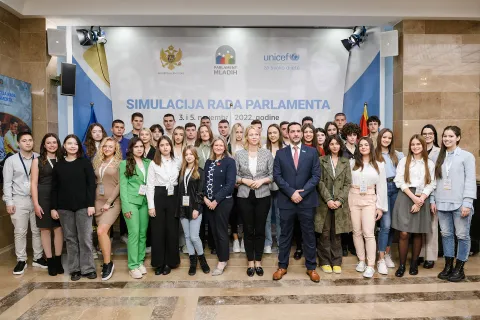
Parliamentary elections for every child in Montenegro
UNICEF is calling on all political actors and citizens to prioritize child rights issues

- Crnogorski
- English
- Shqip
PODGORICA, 28 MAY 2023 – Two weeks before the national parliamentary elections in Montenegro, UNICEF is calling upon all political actors, media, civil society and academia to focus the pre-election public debate on the best ways for Montenegro’s new government to decrease child poverty and all forms of violence, as well as to improve access to and the quality of education and health for every child.
“UNICEF is calling on all political actors and citizens to prioritize child rights issues. The ways that the next government decides to address these issues will influence every family and every boy and girl in this country, not just in the next four years, but in their long-term quality of life too".
For these reasons, UNICEF will be working with Montenegro’s girls and boys, their parents, teachers and other professionals to support them to have their voices heard in the run-up to the elections.
A series of media releases with their voices on key child rights issues will be published in the coming days to contribute to the public debate so that media and politicians may also focus on critical child rights issues in Montenegro.
“By focusing on proposals from different actors regarding the best solutions to real-life problems that families in this country face every day, we can contribute to a better quality of the public debate before the elections. We believe that an inclusive and participatory public debate on child rights issues will encourage voters to be driven by the responsibility to vote for whichever political list seems to them to be the best for building a Montenegro which provides equal rights and opportunities to every child,” UNICEF Montenegro Representative Juan Santander explained.
UNICEF Montenegro’s young reporters have invited representatives of all the political lists to a press conference in the UN Eco Building on 9 June, two days before the elections.
Through a social media and in-person campaign, they are already collecting questions for politicians from their peers from all over Montenegro.
They want to hear every candidate explain how a new government formed by the political bloc that they represent would improve the lives of children, adolescents and their families in Montenegro.
“Some of us will be voting for the first time at these elections. We want to make an informed decision on who to vote for by hearing about how the new government will deal with issues that affect us – girls and boys, with and without the right to vote".
“What affects us, also affects every family in Montenegro, today and tomorrow. We are the national priority of Montenegro. We want to know how the new government will respond to our needs".
According to the latest census, children aged up to 18 make up almost one quarter of Montenegro’s population. Together with their families, they make up the vast majority of Montenegro’s citizens.
Numerous UNICEF analyses and reports on children in Montenegro in recent years point to urgent problems related to child poverty, violence, education and health:
- One in four Montenegrin citizens and one in three children are already living at risk of poverty. Children living in rural areas and in the north are generally worse-off than their peers living in urban areas and in the south of the country. Children growing up in poverty face deprivations in all areas and especially in housing, health, nutrition and education; education is essential for ending poverty. These children attend kindergarten, primary and secondary school to a much smaller extent than their peers.
- Two-thirds of Montenegro’s children aged 1 to 14 years experienced some form of physical punishment and/or psychological aggression from adult household members in the last month.
- Two out of every three children in Montenegro attend elementary schools with insufficient infrastructure. On average there are 16 students per computer in primary and secondary schools.
- Approximately 7,000 children are born each year in Montenegro and, despite recent efforts in some maternity wards, none of the maternity wards is fully baby- and mother-friendly, which is the recommended international standard for providing quality care to mothers and the best start in life for newborn babies.
United Nations Children’s Fund, better known as UNICEF, was founded in 1946 and it is the world’s leading source of credible data and analysis on children, using evidence to advocate for children and for policies that improve their lives worldwide.
Since its foundation in 1946, UNICEF works with governments and communities in more than 190 countries and territories to support children worldwide to realize their rights and fulfil their potential, from early childhood through adolescence. UNICEF’s work for children is recognized by the UN Convention on the Rights of the Child.