Vaccines which save lives
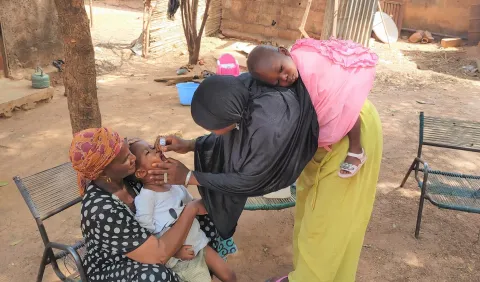
In Mali, vaccination in public places like markets is saving children’s lives

KAYES, Mali – “I lost my first child to a disease I didn’t know. My husband explained that it was related to her breathing,” says Aminata, her eyes brimming with tears.
It is 9:00 in the morning and the market in the Kayes plateau neighborhood is already crowded with women who have come to sell their goods. Most of them have their toddlers with them. Aminata Soumaré, sixteen, is a celery vendor. She is already a mother and her husband Abdoulaye Traoré, 45, is a security guard at one of the city’s private radio stations.
They had two children, including Mariam Traoré, ten months old, who has not yet been vaccinated. Their older daughter, Doussouba Traoré, died of pneumonia when she was forty-five days old.
Unfortunately, the painful experience of Aminata and Abdoulaye is not an isolated case. In Mali, one child in ten dies before celebrating its fifth birthday, mostly of avoidable causes. Only 45% of children between the ages of 12 and 23 months receive all basic vaccinations, and 14% receive no vaccinations at all.

In Kayes, the situation is even more troubling: only 41% of children have received all basic vaccinations. Difficulties accessing care for the most vulnerable families, and parents’ lack of information and awareness are the main barriers to the complete vaccination of children.
To respond to the issue, UNICEF in Mali and its partners have identified eleven districts with the highest number of children not receiving vaccinations. In these districts, UNICEF has – in close collaboration with the World Health Organization, Gavi, the Canadian government, USAID and other partners – implemented innovative approaches, such as providing vaccinations in places where people gather.
“To encourage a change in parents’ behavior, we first have to try to understand their reality.”
Organizing vaccination campaigns in places like markets is especially beneficial for people like Aminata, whose day starts at 6:00 in the morning, selling cakes at the bus station and ends well after the market closes. “I can’t find the time to go to the health center. My husband’s wages alone can’t feed us for more than a week,” confides Aminata.
“To encourage a change in the parents’ behavior, we first have to try to understand their reality, and the community relays play a primary role in raising awareness,” explains Fatoumata Diagouraga, a community relay for the Community Health Center in the Kayes plateau neighborhood.

“Last week, I was approached by Fatoumata. She asked me if Mariam had been vaccinated and I told her no,” states Aminata. “I told her what had happened to my older daughter and she explained that if she had been vaccinated, she could have been saved. So as soon as I saw the vaccination team today, I went to over to them so Mariam could receive her vaccinations.”
Abdoulaye, who had polio himself, understands the importance of vaccinations.
“If my parents had had access to this type of vaccination service, I don’t think I would have caught this disease. A drop of polio serum in the mouth would have prevented the handicap I have today,” he confides. “My wish is for Mariam to grow up in good health, complete her studies and become – maybe – a minister.”
In Mali, the rate of vaccination coverage has increased from 39% in 2013 to 45% in 2018 among children aged 12 and 23 months old, since the implementation of new and innovative approaches such as creating digital registers of vaccinated children, using mobile vaccination teams to reach people living in remote and hard-to-reach areas, using solar fridges to keep the vaccines at an optimal temperature, running vaccination sessions in public places (markets, schools, mosques, and major bus stations), and using mobile phones to remind parents of their children’s vaccination calendar.