My school, my responsibility: How 11‑year‑old Halimatou championed a green revolution.
President of the ECO club, Halimatou and her classmates no longer wait for change. They grow it — one tree, one action and one brave idea at a time.

- Français
- English
The cool air under the young trees is the first thing you feel when entering Kabara primary school, 7 kilometres from Timbuktu. Where the sun once burned the ground, a small green oasis now stretches across the courtyard. Leaves rustle, children sit in the shade to read, and the sand no longer blinds them with heat. It is hard to imagine that only months ago, sweat fell from brows onto exercise books faster than pencils could write.
In the middle of the garden, watering a shrub, stands the girl who dreamed it all into life. Halimatou, 11 years old, the president of the school’s ECO club, and the quiet architect of Kabara’s transformation.
Before the changes began, the school felt tired. The heat made it difficult to stay outside and when the rains came, it was impossible. Children recall the last big flood - the back wall of the school collapsed. “I remember being scared,” one girl confided. “You don’t know how fast the water will come.”

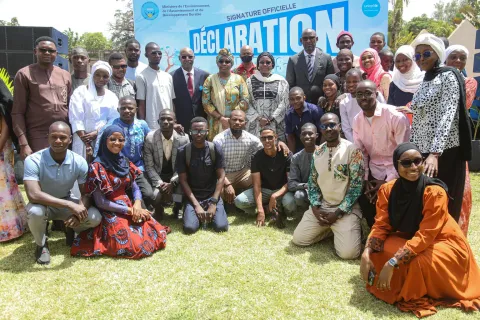
When the “My School, My Responsibility” project selected Kabara, Halimatou saw an opportunity. She gathered her fifteen classmates, officially members of the school's ECO club, supported by six young U‑Reporters and two teachers, and shared her idea - to turn the courtyard into a living garden that would cool the school, protect them from heat and make their environment beautiful again.
They started with their hands in the sand. Collecting waste. Softening soil. Planting the first twenty shrubs. Each class took turns tending to them, carrying water in small buckets, shading the most fragile plants with cloth or cardboard. Slowly, the school began to change. The heat felt less suffocating. One of the greatest successes of Halimatou and the ECO club is the creation of the school garden. Designed, maintained and protected by the students, with the active support of the management, it has become a space of shade, collaboration and learning. "Here, we plant, we learn and we see our efforts grow," says Arkia, 11 years old.


But for Halimatou, planting trees was just the first step. As she learned more about climate change and flood risks, memories of the last flood returned — the panic, the uncertainty, the feeling that children were unprepared. She wanted to do more than just plant a garden, she wanted to plant knowledge to help protect her community.
Halimatou took a leap that would intimidate many adults - she addressed the Timbuktu authorities directly. For the first time in her life, she advocated with decision makers, including those responsible for flood contingency plans and multiple risks. “My heart was beating fast,” she recalls. “I wondered if they would listen to a child.” They did.
She advocated that Timbuktu ECO club representatives, all primary school students, sit on the regional committee in charge of updating the flood and multi-risk contingency plans. The authorities are now committed to the involvement of ECO club members in decision-making processes related to climate resilience in Timbuktu.
"As a state structure that leads contingency plans at the regional level, we recognize the relevance of this advocacy," says Mr. Danseny Keita, Director of Civil Protection in Timbuktu. "Indeed, it now allows the integration of members of ECO clubs into the regional committee in charge of updating and disseminating Timbuktu's flood and multi-risk contingency plans, taking into account the realities of schools and students."

Halimatou’s leadership is a powerful reminder that children are not only impacted by climate change but they can lead the response. Across the three pilot schools in Timbuktu with ECO clubs more than 1,000 students are now trained in first aid and flood action, hundreds have learned proper waste management, and over sixty shrubs thrive where heat once spread.
"When children like Halimatou take the lead, they show that they are not only impacted by the effects of climate change, they know how to respond, mobilize and inspire an entire community," says Kadia Foune Adiawakoye, Adolescent and Youth Community Engagement Officer at UNICEF's Timbuktu office.
The "My school, my responsibility" project, is implemented by the Regional Directorate for Sanitation and Control of Pollution and Nuisances (DRACPN), the Teaching Academy, the Civil Protection and the association Action of Young Women from Timbuktu for the Preservation of the Environment (AJFTPE), with the support of UNICEF via funding from the Federal Republic of Germany (BMZ) as part of the Sahel Resilience Partnership.

GIZ, WFP and UNICEF are working together as part of the Sahel Resilience Partnership, alongside local authorities and implementing partners, with financial support from German Cooperation (BMZ).