Making schools more welcoming for girls
Like Coumba and Issa, Adolescents in Mali are becoming champions of menstrual hygiene through education and empowerment.

- Français
- English
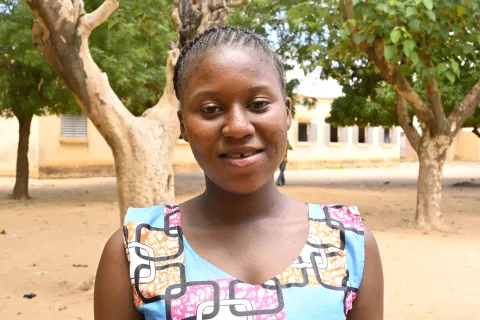
Coumba, a 16-year-old Grade 11 student, and Issa, a 17-year-old in Grade 9, proudly show their classmates the reusable sanitary pads they just made.
“The first period for many of us means anxiety, stress, and sometimes even dropping out of school,” said Coumba.
“I used to think that menstruation meant impurity, and that we shouldn't go near girls during their period,” said Issa.
Like several hundred students across the country, Coumba and Issa received training on menstrual health and hygiene management (MHM). The sessions dispelled their fears and misconceptions, inspiring them to become active advocates for menstrual hygiene.
A study conducted by UNICEF in 2019 in the municipalities of Kati and Bandiagara revealed that 91 per cent of girls do not change their sanitary pads throughout the school day. Up to 20 per cent of students reported missing at least one class, and 60 per cent of girls had never received any information about menstruation before their first period. This lack of information, compounded by inadequate school infrastructure, heightens the stress and anxiety many girls feel when experiencing menstruation for the first time.
Creating an open dialogue on a taboo subject


In 2023, UNICEF partnered with the Ministry of Education to organize training sessions on MHM in schools in Koulikoro, Bamako, Mopti, Kayes and Sikasso. The three-day training equipped students with both knowledge and practical skills, including how to make reusable sanitary pads.
“The active participation of mothers' associations, school management committees, and boys helped create a collaborative learning environment. This is essential for addressing a long-taboo subject and promoting a better understanding of menstrual hygiene issues,” said Aicha Walett Mohamed, WASH focal point at the National Directorate of Basic Education.
A total of 1,500 menstrual hygiene kits — including reusable pads, soap and underwear — were distributed to participating schools. Each school also received a grant of 100,000 FCFA (around USD 160) to implement an action plan developed jointly by students and teachers. Materials such as cotton, thread, needles and scissors were also provided so that trained students could continue making reusable pads at school.
The programme trained 510 individuals, including 264 girls (some with disabilities), 106 boys, 20 youth advocates affiliated with UNICEF, 72 teachers and facilitators, and 48 members of school management committees and mothers’ associations.
With increased financial support, UNICEF aims to scale up this initiative nationwide, transforming every school into a welcoming and supportive environment for girls’ education. More than 2.5 million students in Mali could benefit from such training.
Towards a barrier-free school


The training is based on two modules. The first explores fundamental concepts related to gender equity, including stereotypes, social roles, and human rights. the second focuses on menstrual hygiene. These modules not only help children understand their own bodies better but also encourage boys to support girls, by learning alongside them (and with parents) how to make reusable pads.
“These three days helped me understand my health better. I also realized that there are no jobs meant just for boys or just for girls — everyone can do the same work. In fact, some boys with us today learned how to make pads. Our parents can’t always afford to buy them, and now we can organize ourselves and keep a stock at school,” said Coumba.
Issa shared similar enthusiasm: “I now know that my beliefs about menstruation were wrong. I better understand how girls’ bodies work, and I’ve realized that menstruation is a natural and important part of a woman’s life.”