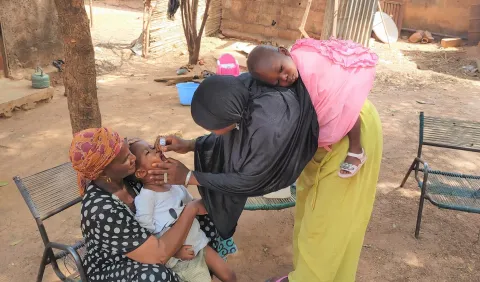
Aissata, a symbol of the fight against maternal and neonatal tetanus in Mali.
In 2023, Mali was declared to have eliminated maternal and neonatal tetanus.

- Français
- English
In 2023, Mali was declared to have eliminated maternal and neonatal tetanus. This status was confirmed following a detailed evaluation, which demonstrated that Mali meets the World Health Organization's standard of having less than one case of neonatal tetanus per 1,000 live births in each of its health districts.
The dawn was slowly rising over the neighborhood of Abaradjou in the health district of Sankoré in the Tombouctou region. Once flourishing, this region was struggling with maternal and neonatal tetanus, which is an insidious disease threatening the survival of mothers and their infants.
This scourge, caused by a bacterium from the soil and in animal droppings, results from the contamination of the umbilical stump during unhygienic cord care at childbirth. Symptoms usually occur from the third day in a newborn child who was normal and suddenly becomes rigid, presenting with uncontrollable convulsions and muscle spasms that can cause the death of child.
In this neighborhood, as elsewhere in Mali, deliveries were often performed by traditional midwives, using contaminated equipment. This practice, coupled with the adherence to ancient rituals, unfortunately made tetanus contamination all too common during deliveries.
Aissata, a 46 -year-old local woman, however, was determined to change her fate. Having already lost a baby to this disease, she resolved not to let history repeat itself. Aissata’s determination was steadfast: "I gave birth at home assisted by a grandmother, a few days later, the baby couldn’t breastfeed, and his condition was getting worse. So, I took him to the health center. They did everything they could, but the baby passed away. The doctor explained to me that it was tetanus and that if I had been vaccinated during pregnancy, it could have saved my baby. Losing a child is terrible and I wouldn't wish it to any parent," Aissata recounts with emotion.
Aware of the risks, Aissata sought out information and learned from a women's group in her village about a new initiative by the Malian government, supported by UNICEF and WHO, targeting the elimination of maternal and neonatal tetanus. Inspired by the possibility of a different ending for her story, Aissata decided to actively protect her next pregnancies this time — by getting the tetanus vaccine.


The very next day, as if in answer to her determination, an advanced strategy team arrived by motorcycle in Aissata’s village to administer the vaccine to all women of reproductive age (pregnant or not). Aissata was among the first to receive her dose and made the significant choice to travel to the Sankoré community health center for the remaining doses of the vaccine. The road was long and arduous, but the hope of a better future for her future pregnancies sustained her.
"Today I am talking about my story to the women in my village and I am telling them to get vaccinated against tetanus and to have check-ups during pregnancy. When I talk about my story, some tell me that they have also lost babies following home births." recounts Aissata, who has just finished an educational talk with other women from her village.
In 2023, WHO announced that Mali had defeated maternal and neonatal tetanus, a major advance for public health in a country where maternal and infant mortality rates are among the highest in the world.
Mali's significant milestone is a testament to the collective efforts of the country and its partners, including UNICEF. A comprehensive strategy to strengthen systematic vaccination played a pivotal role. Health centers across Mali were equipped with solar refrigerators to store vaccines efficiently, along with the provision of motorcycles and vehicles to facilitate the delivery of vaccination services. Vaccinations were administered through a well-organized approach: at health facilities for fixed strategies, by motorcycle for areas located between 5-15km away, and through mobile clinics for communities more than 15 km from a health facility.


From 2002, Mali embarked on several vaccination campaigns against tetanus, adopting fixed, advanced, and mobile strategies. These efforts were significantly supported by financial contributions from the United States, underscoring the global commitment to combating this health threat. The vaccination program proved to be a lifeline for thousands of women, including Aissata, enabling them to protect themselves against tetanus.
Additionally, childbirth practices in Mali saw remarkable improvements through the gradual introduction of qualified personnel, including gynecologist-obstetricians, midwives, and obstetric nurses, into health centers and district hospitals. This initiative was supported by the state and partners like the World Bank, enhancing the quality of maternal care.
Traditional midwives, integral to many communities, received training on essential hygiene practices to further reduce the risk of tetanus contamination. This training emphasized the importance of maintaining clean surfaces, hands, and clothes during childbirth, using a new blade for umbilical cord cutting, applying chlorhexidine for cord care, and avoiding the application of potentially harmful substances on the umbilical wound. Through these comprehensive measures, Mali has made significant strides in safeguarding the health of mothers and newborns against tetanus. “These practices have saved millions of women of childbearing age and newborns while protecting them against tetanus,” explains Dr Moumini GUINDO in Sankoré community health center.
Aissata determination and resilience are a symbol of the possibility of change and the power of taking proactive steps towards health and safety. In this region of Mali, her fight against maternal and neonatal tetanus, marked by courage and transformation, serves as an inspiration for many women A new dawn, for an era of health awareness and empowerment in the community.