Designing safer digital spaces where every girl can thrive
Statement by the UNICEF Representative to Maldives, Dr. Edward Addai on International Women’s Day

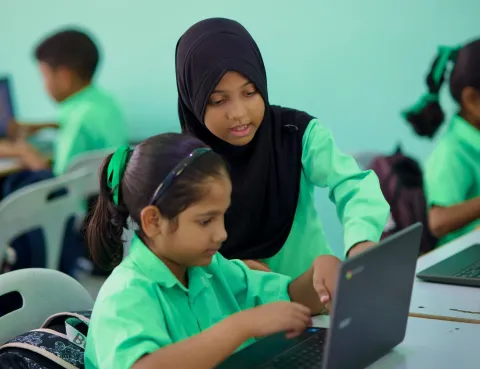
Today, on International Women’s Day, UNICEF reaffirms its commitment to advancing the rights of every girl – and ensuring that girls can thrive in an increasingly digital world.
Around the globe, progress toward gender equality remains uneven. Despite decades of advancement, harmful social norms and discriminatory practices continue to limit the opportunities of millions of girls. As societies become more connected through technology, these inequalities are not only reflected online – they are often amplified in digital spaces.
Maldives is among the most digitally connected societies in the South Asia region. With internet access reaching the vast majority of the population and social media widely used across islands and generations, digital platforms have become an integral part of daily life, shaping how young people learn, communicate, and participate in society.
For girls, these platforms offer powerful opportunities to learn new skills, access information, and raise their voices. Yet the same spaces can also expose girls to new and evolving forms of harm.
Digital violence can take many forms, including manipulation, blackmail, harassment, grooming, and the misuse of AI-generated or altered images. These violations can have profound and long-lasting consequences for a girl’s safety, dignity, mental health, and well-being.
Evidence highlights the scale of the concern. Data from the Family Protection Authority (FPA) shows that Technology-Facilitated Gender-Based Violence (TFGBV) is increasingly present in reported cases of abuse. In cases involving sexual abuse, 51.4 per cent were identified as involving technology-facilitated elements, with many victims being women and girls.
These findings underline the urgent need for coordinated, multi-sectoral action – bringing together government institutions, law enforcement, the justice sector, social services, educators, technology companies, civil society, and communities to prevent abuse, protect survivors, and ensure accountability.
This International Women’s Day, UNICEF Maldives is drawing attention to the importance of ensuring that digital spaces are safe for girls. The online world should expand girls’ horizons, not endanger them. Because when girls are safe, supported, and empowered online, their opportunities multiply and societies flourish.
In this regard, UNICEF Maldives renews its call to Government and partners to:
- Expand girls’ access to safe, inclusive digital learning and participation.
- Strengthen protections against online harassment, exploitation, and technology-facilitated gender-based violence.
- Invest in girls’ digital skills so they can shape their futures and contribute to the digital economy.
- Challenge harmful norms and dismantle discriminatory barriers that limit girls’ rights, both online and offline.
- Engage men and boys as active partners in creating safe, respectful digital environments.
The national ‘Udhuhilan’ campaign, led by the Family Protection Authority in partnership with UNICEF Maldives, reinforces this commitment by mobilizing families, communities, and institutions to prevent violence against children and create safe, nurturing environments both online and offline.
Through this campaign and beyond, UNICEF stands ready to continue working with Government, partners, and communities to strengthen prevention efforts, support survivors, and ensure that every child can grow up safe and protected.
As we mark this day, we also remember the millions of girls living through conflict and crisis around the world. On this International Women’s Day, UNICEF continues to call for sustained action to protect girls everywhere and reaffirms its commitment to safeguarding their rights, safety, and dignity.
Together, we must build a world where every girl can learn and thrive – free from violence, free from fear, and full of possibilities.
Media contacts
About UNICEF
UNICEF promotes the rights and wellbeing of every child, in everything we do. Together with our partners, we work in 190 countries and territories to translate that commitment into practical action, focusing special effort on reaching the most vulnerable and excluded children, to the benefit of all children, everywhere.
For more information about UNICEF and the work it supports in the Maldives, visit www.unicef.org/maldives