Beating Plastic Pollution for a Healthier Future for Every Child
Joint Statement by the Minister of Tourism and Environment, Hon. Thoriq Ibrahim, and UNICEF Representative to the Maldives, Dr. Edward Addai, on World Environment Day 2025

Malé, Maldives – 5 June 2025 – As we commemorate World Environment Day 2025, we are reminded that the climate crisis is no longer a distant threat. It is a lived reality, especially for children and young people in Maldives. It affects every aspect of their lives from health and nutrition to education and safety.
This year’s theme, “Ending Plastic Pollution,” is particularly urgent for Small Island Developing States like Maldives, where the ocean is both our lifeline and our frontline. In Maldives, plastic pollution is not only an environmental concern, but also an issue that affects the well-being of children and young people.
Plastic Pollution: A Hidden Threat to Children
Plastic has permeated every corner of our environment and society. It’s in the food we eat, the water we drink, and even the air we breathe. Microplastics have been found in human breast milk and placental tissue, exposing children to harmful chemicals even before birth.
The consequences are profound:
- Health risks: Exposure to plastic-related toxins can harm brain development, disrupt endocrine systems, and weaken children’s immunity.
- Environmental impacts: Plastic pollution adversely impacts ecosystems and its production drives greenhouse gas emissions, accelerating climate change. In a nation spread across many geographically dispersed islands, rising sea levels and extreme weather already threaten homes, schools, and essential services, whilst plastic pollution threatens our fragile marine ecosystems.
- Unsafe environments: Poor waste management leads health impacts, and disease outbreaks, disrupting education and endangering lives.
These are not future risks. They are current realities for too many children across our island communities.
Maldives' Commitment to a Plastic-Free Future
The Government of Maldives has made significant strides toward eliminating plastic pollution and building climate resilience:
- Island-level waste management: By the end of 2025, waste and resource management centers will be operational on every inhabited island.
- Nationwide ban on single-use plastics: A progressive phase-out is underway, including bans on plastic bags, straws, and other disposables.
- Plastic-free schools: All schools have been plastic-free since 2020, providing healthier learning environments.
- Recycling innovation: Civil society and social entrepreneurs are doing incredible work to enhance awareness and reduce and recycle plastics.
- Community engagement: Initiatives like Fen Veshi reduce bottled water use through water filtration systems and refill stations in public spaces.
These efforts are about more than cleaning our environment. They are about protecting children’s health, their futures, and their rights.
Empowering Young People to Lead
Despite the scale of the challenge, we are inspired by the growing movement of young climate leaders across Maldives. We must equip them with the knowledge, skills, and platforms to act and listen to their views and ideas.
Through the UNICEF Climate Guardians initiative, young people are gaining a seat at the table. Since 2017, the Ministry of Environment and Tourism and UNICEF Maldives have trained young people in advocacy and negotiation skills, enabling them to represent their voices at global forums like UNFCCC COP. During the latest update to the Maldives’ Nationally Determined Contributions (NDCs), their inputs brought a child- and youth- sensitive lens to shape policies that affect all.
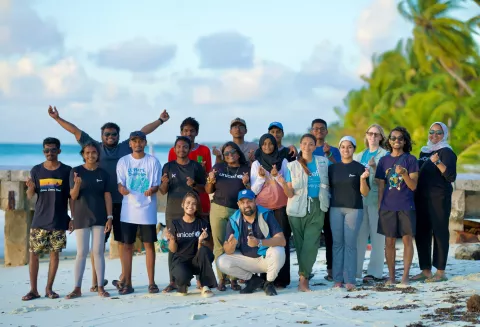
Young people are also leading local clean-up campaigns, raising awareness, and modeling sustainable lifestyles. They are not just inheriting this crisis; they are transforming it.
A Call to Collective Action
The Government of Maldives remains committed to progressively phase out single-use plastics, invest in circular economy solutions, and embed sustainability into education and policy. But no single entity can solve this alone.
On World Environment Day and beyond, the Government and UNICEF are joining hands to call on all sectors of society to act:
- Communities: Reduce plastic use, support clean-up drives, and adopt sustainable practices.
- Businesses: Adapt innovative sustainable practices such as eco-friendly packaging and circular models.
- Young People: Keep leading. Your courage, energy, and vision are reshaping our future.
- Policymakers: Prioritize child-centered, climate-resilient policies in national development strategies.
World Environment Day is not just a day of awareness, it is a call to urgent and united action. The decisions we make today will determine the health of our planet and the well-being of every child tomorrow.
Let us act now. For every child. For every island. For our shared future.
Media contacts
About UNICEF
UNICEF promotes the rights and wellbeing of every child, in everything we do. Together with our partners, we work in 190 countries and territories to translate that commitment into practical action, focusing special effort on reaching the most vulnerable and excluded children, to the benefit of all children, everywhere.
For more information about UNICEF and the work it supports in the Maldives, visit www.unicef.org/maldives
Follow UNICEF Maldives on Twitter, Facebook and Instagram.
About the Ministry of Tourism and Environment
“Towards a Cleaner, Greener and Safer Maldives”
The Ministry of Tourism and Environment is responsible for implementing government policies, regulations, programmes and projects related to the provision of clean water and appropriate sewerage services, provision of clean and affordable energy services, provision of clean and healthy environment free from pollution, protection of the islands from coastal erosion, advocate for the rights of small islands states in the fight against climate change, mobilize finance to adapt and mitigate the negative impacts of climate change, coordinating sustainable development goals within the government, and protection and preservation of natural environment – Ministry of Tourism and Environment