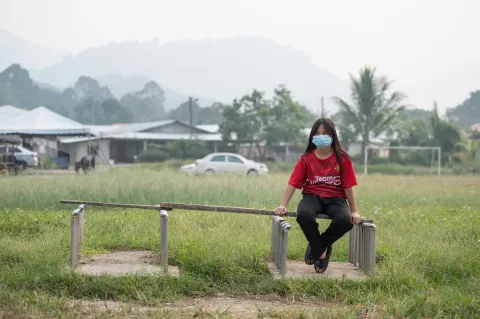
Surrounded by Water, Yet None to Drink
How climate change shapes childhood in Rantau Panjang.

Salidah Ramli is a mother of four, expecting her fifth child. She lives in Rantau Panjang with her husband, who takes on house-building jobs and sources wedding items like bunga telur and hantaran goods. To support the family, Salidah helps by selling susu selasih.
Originally from Golok, just across the border, she married into this flood-prone life. Her mother, who runs a small food stall in Kuala Lumpur, rarely visits. The annual trip to see her mother has become one of the few constants in a life increasingly defined by uncertainty.
Rantau Panjang sits at the crossroad of geography and climate vulnerability. This border town, perched between Malaysia and Thailand, has always known floods. But residents like Salidah have noticed the changes: waters that rise more suddenly, retreat, then surge again without warning. Floods have affected over 70,000 people across five states in Malaysia during the 2021-2022 monsoon season alone, with Kelantan bearing much of the impact. Children, who make up nearly 40% of those displaced during major flood events, face particular risks—from interrupted education to waterborne diseases.
For Salidah's family, these statistics translate into painful memories. The image of her youngest slipping and falling during an evacuation still haunts her. "That's what I worry about most—the safety of my kids," she says, her hand unconsciously moving to her growing belly. The mathematics of evacuation become exponentially complex with each child: four sets of clothes to grab, four pairs of feet to guide through rising waters, soon to be five.
In the event of an emergency

When the evacuation orders come, usually in the dead of night as waters creep steadily higher, the family makes their way to the local school that serves as a temporary shelter. "It's hot, uncomfortable. The kids cry. There's no water, no electricity at the school where we stay," Salidah recounts. The irony is not lost on her—surrounded by water, yet with none to drink. "
"The floods are becoming more frequent now—they rise suddenly, and after they subside, they rise again. Sometimes people send help, but when the water is deep, they can't get through to us. But at least we have shelter."
These emergency shelters, while providing crucial refuge, often lack basic amenities. During flood emergencies in Malaysia, access to clean water and sanitation facilities in temporary shelters remains a critical challenge, with children being particularly vulnerable to water-related diseases that can spread rapidly in crowded conditions.
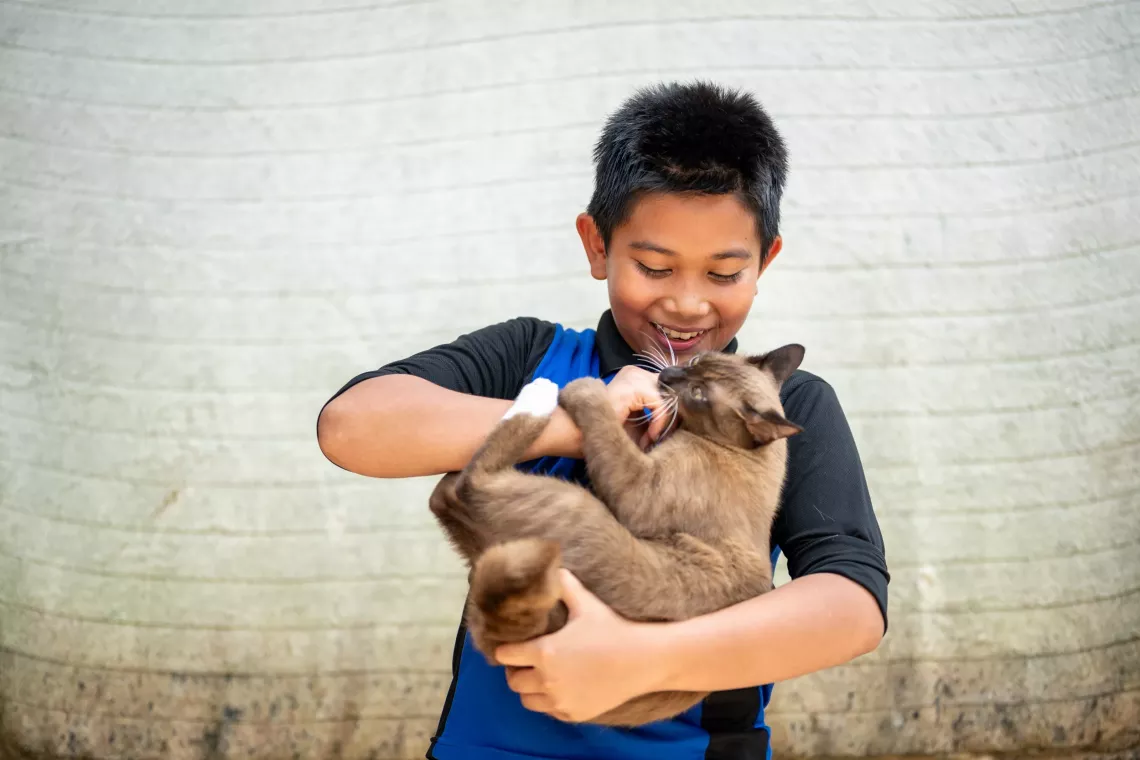
Salidah's eldest son, Haris, has developed his own flood protocol. "He's always ready," Salidah says. "When there's a flood, he's already prepared—he puts all his school books and school things on the high shelf."
Education disruption remains one of the most significant long-term impacts of flooding on children. Our data indicates that repeated floods can cause children to miss weeks of school annually, with cascading effects on their learning outcomes and future opportunities. For Haris, protecting his books has become as second nature as seeking higher ground.
When asked to choose between drought and flood, both increasingly common in Rantau Panjang, Haris gives a child's practical view of which is worse. "Floods trouble my mother and family because we have to evacuate and stay at the school with no facilities, no comfort for my mother with the younger siblings, especially when electricity and water get cut off," he explains. His preference for drought: "At least with drought, he can still play outside when it's not too hot", Salidah speaks to the immediate, tangible hardships that floods bring to their family.

Salidah's story reflects what's happening to families worldwide due to climate change. Across Southeast Asia, climate-related disasters increasingly force families from their homes, with children bearing disproportionate impacts. In Rantau Panjang, these projections carry names—Akmal and his siblings, the baby yet to be born who will know floods as surely as lullabies.
Here, climate change has a mother's face, weathered by worry but softened by love. It has a child's resilience, demonstrated in school books carefully preserved and younger siblings tenderly protected. It has the solid feel of wooden planks raised in defiance of rising waters, and the bitter taste of hope mixed with exhaustion in makeshift shelters.