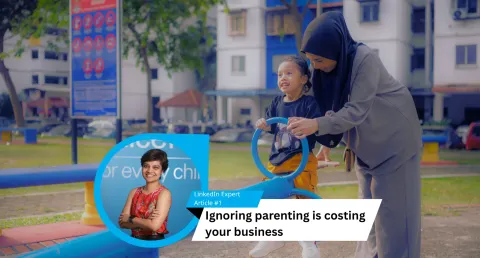
It’s time to put parenting on the balance sheet
Part 2 of 2

If you caught part one, we described the trade-offs that many parents in Kuala Lumpur face on a daily basis – balancing performing at work with responsibilities at home. When companies do not support this reality, the impact is visible through lower productivity, higher absenteeism, and rising attrition which in turn erode profitability.
Malaysia’s policy makers are responding quickly, recognizing that social factors are central to economic growth. Sustainability disclosures are expanding beyond climate to include how companies treat their workforce. Through the National Sustainability Reporting Framework (NSRF), public-listed companies are now expected to report on labour practices and employee well-being. At the same time, proposed amendments to the Companies Act 2017 signal a clear direction. Using a phased approach and beginning with large private firms, companies will increasingly need to identify and disclose material social risks, including those linked to workforce conditions.
National policy is also aligning Environment, Social and Governance (ESG) priorities with business and human rights. The National Action Plan for Business and Human Rights 2025 – 2030 reinforces that supporting workers, including parents and caregivers, is not only the right thing to do, it strengthens business performance. It sets out practical steps for government, led byespecially the Ministry of Human Resources, and companies to expand access to family-friendly policies across workplaces.
Investors are reinforcing this shift. Large Malaysian asset owners such as Employees Provident Fund (EPF) and KWAP are increasingly integrating workforce well-being and human rights into their ESG frameworks. Investor expectations are also evolving. Companies are being asked to disclose labour policies as well as how they manage labour risks and support their workforce in practice.
The opportunity now is to connect these efforts across the ecosystem. One practical way forward is for companies to apply a clearer “social lens” to their sustainability and board governance. This starts with recognising employees, especially workers that are parents and caregivers, as a core stakeholder group. When companies do this well, they are better able to identify risks early, improve workforce stability, and strengthen long-term performance.
Leading companies are already moving in this direction. By designing family-friendly policies that reflect the realities of their workforce, and reporting transparently on progress, they build trust with investors and policymakers, while setting the pace for their industry.
Investors, in turn, can go further by engaging companies on how workforce policies affect employees with caregiving responsibilities, and by integrating these considerations into stewardship and investment decisions.
Family-friendly policies are no longer peripheral, they are central to human capital strategy. In tight labour markets, they strengthen employer brand, improve retention, and create a clear competitive advantage.
Malaysia has made strong progress in building its ESG infrastructure. The next step is to ensure that what is measured and reported reflects what truly drives value.
Parenting may begin at home, but its effects are visible in company performance, supply chains, and the wider economy.