Children of the Dam
Displaced by the Bakun Hydroelectric Dam, families in Sungai Asap continue to rebuild life, with children carrying the weight of both struggle and hope.

At dawn in Sungai Asap, the air hums with the sounds of roosters and the laughter of children darting between longhouse corridors. Nestled deep in Sarawak’s interior, this resettlement area is home to thousands of families—each carrying stories of resilience, challenge, and quiet hope. Originally established in the 1990s for communities displaced by the Bakun Hydroelectric Dam, Sungai Asap has become both a place of rooted tradition and persistent struggle. For children here, every day is shaped by resilience in the face of poverty, remoteness, and limited opportunities.
Children travel in all sorts of vehicles, including 4x4 trucks, cars and motorbikes to attend one of three primary schools or the only secondary school in the area, SMK Bakun, which also provides hostel facilities. Education is valued by families, yet quality and access can be limited by remoteness and infrastructure gaps.
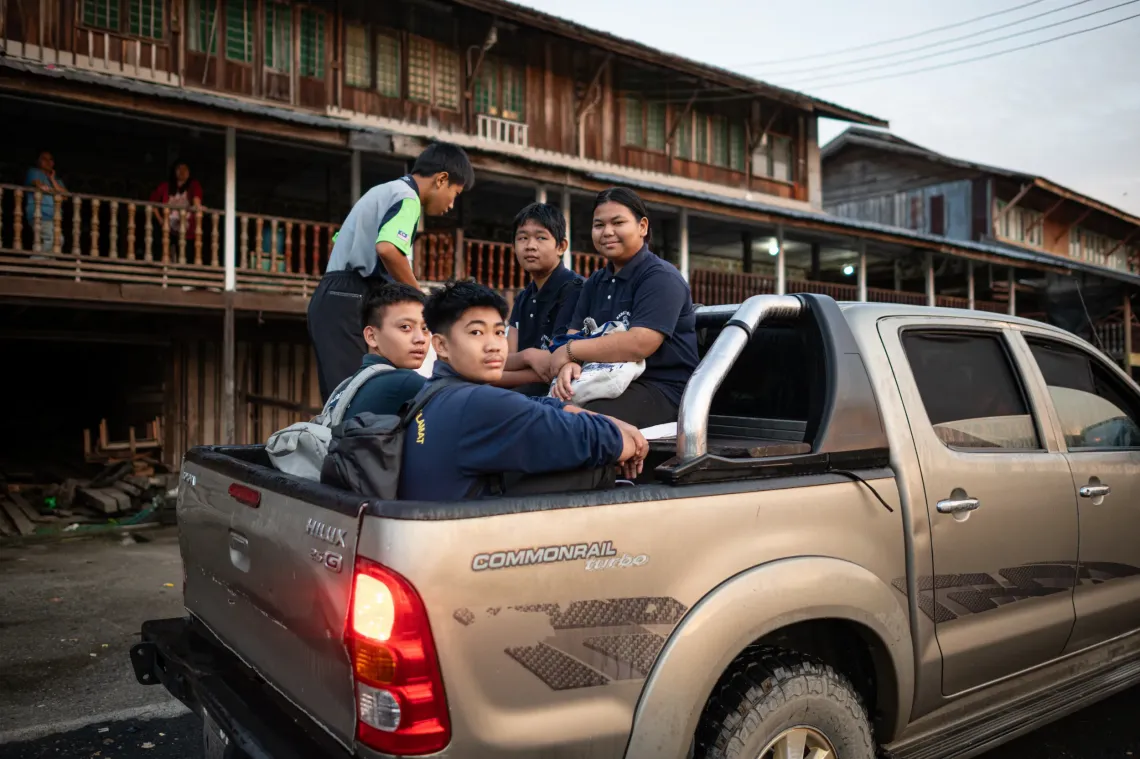
Many children in Sungai Asap begin their school day with a bumpy ride on the back of a 4x4 truck, clinging to the sides as the vehicle winds along uneven gravel roads. Aileen and Adrian are among them too.
The trucks are often the only reliable transport option in rural Sarawak, where poor road conditions make ordinary cars impractical. Families usually pool resources to pay the driver a monthly fee, treating the journey as a necessary investment in their children’s education. To make the ride more bearable, some drivers bolt stools or wooden benches onto the truck bed, though the children often end up squeezed shoulder-to-shoulder, their school bags stacked high in the corner.

The sight of children hopping into these trucks at dawn is a familiar routine in the longhouse communities. It is not just the young who rely on them—on weekends, adults also crowd onto the same vehicles to reach nearby towns or pasar tamu (weekly community market) for groceries, fresh produce, or household essentials. The trucks double as community lifelines, ferrying people for medical appointments, festive gatherings, and even funerals.
The Cost of Progress
In the late 1990s, the Bakun Hydroelectric Dam promised progress but forced over 10,000 indigenous people from tribes like the Kayan, Kenyah, and Penan to leave their ancestral homes. Villages and sacred lands were submerged. Families were moved to Sungai Asap, 30KM away, with promises of a better life, promises that quickly faded.
Relocation fractured communal life and weakened cultural ties. While some families found stability, many still struggle. Today, Sungai Asap houses over 3,000 families across 15 longhouses. Schools and clinics are running, and community efforts aim to restore livelihoods and identity.
Most men now earn their living in distant plantations in Long Murum or Bakun, or through small, irregular jobs that bring in little stability. For women, crafting once held promise as both an economic and cultural lifeline, but today it has become a livelihood that offers only little returns, no longer enough to sustain families in the way it once did.
“There are already too many crafts in the market, the prices are low, and it’s hard to compete. Logistics is another issue because we live in such a remote area,” said Celicia, a mother of five.

For many women in Sungai Asap, the struggle to make ends meet has reshaped daily life. The weight of survival often falls on mothers, who juggle multiple roles as breadwinners, caregivers, and keepers of the household.
Agnes is one of them. As a single mother, she carries the full responsibility of raising her children in the longhouse. Every morning, she drives them to school before heading to her job as a customer service officer, and every afternoon she returns briefly to prepare lunch before rushing back to work. “I wish I could sit longer and just rest my feet,” she says with a tired smile.
“But I have to get back to work. As a single mother, I am the sole provider for my family, if I don’t work, we have nothing to eat”.
It is within this rhythm of sacrifice and resilience that her children—Aileen, 12, and Adrian, 15—are growing up. While Agnes shoulders the responsibility of providing for the family, Aileen and Adrian are learning to navigate their own challenges in school, at home, and on the futsal court.
The Goalkeeper of Sungai Asap
At just 12 years old, Aileen walks with the quiet confidence of someone who already knows who she is—even if others are not yet ready to see it. Her favourite subject is Sejarah (History). “I like knowing what happened before, how people lived and what they went through,” she says, her voice steady. In school, she fits in easily, well-liked by her classmates, but her biggest challenges are not in the classroom.
Aileen’s real battles unfold on the futsal court.

“Mereka tidak mahu terima kenyataan sememangnya saya adalah goalkeeper yang bagus (They didn’t want to admit that I am, in fact, a good goalkeeper).”
For many of the boys, the issue has never been about skill; it has been about gender. To them, Aileen is fine as a friend, a fellow gamer, even part of the longhouse. But not here, not as a goalkeeper. In the past, they even tried to convince Adrian to ask her to leave. But he refused. “She’s a good goalkeeper,” he told them. “I don’t see anything wrong with her playing.”

Adrian shines both in the classroom and on the futsal court, where he plays as a striker. Every evening, he trains and plays with his friends, often with his sister guarding the goalpost. He is always quick to defend her ability. “She’s good,” he says with pride. “She even represents the school in bola baling (handball), and the catching technique is the same.” For him, her place on the field is undeniable.
As the eldest of three siblings, Adrian takes his role seriously, whether at home, at school, or on the futsal court. He shares a close bond with his sisters, Annice and Aileen, and often sees himself as their protector. His dream is to become a police officer one day. “Police are brave and strong, I want to be like that,” he says.
That sense of responsibility is rooted in personal loss. Adrian still remembers the pain of losing his grandmother in 2020. “I want my mother to be happy. And I want to take care of Annice and Aileen, always,” he shares quietly.

At home, Aileen shares the longhouse with her brother Adrian and their cousin Hannah, while her older sister Annice stays at the school hostel and comes back every Friday. Aileen looks up to her mother. “She’s so strong,” Aileen says. “I want to make her proud one day.” Watching her mother juggle everything with grace has deeply shaped how Aileen views courage and drives her even more to succeed.
In a community where opportunities are scarce and gender expectations still linger, Aileen is charting her own path. She dreams of forming an all-girls futsal team in her longhouse. There are two other girls in her longhouse who love futsal as much as she does. “I just need two more,” she says quietly. “Then I can form my own girls’ team.” Supported by her family, especially her brother Adrian, and inspired by her mother’s strength, she is not waiting for permission to take her place on the field, in this world.
Aileen takes charge of her life.
Sarawak Child Well-Being Index (SCWI)
It is stories like Aileen’s and Adrian’s that highlight the importance of the Sarawak Child Well-Being Index (SCWI). Launched in May 2025 by UNICEF and the Sarawak Ministry of Women, Early Childhood and Community Wellbeing Development, the SCWI is designed to capture these lived experiences. It looks beyond numbers and averages, bringing together data on education, health, protection, and participation, while paying special attention to children in remote and underserved communities.
Sungai Asap was chosen as one of 150 communities to be part of this effort. Here, community members themselves help collect information, ensuring that local voices—like Aileen’s and Adrian’s—are part of the bigger picture. The findings will guide policies and services so that children, no matter where they live, are not left behind.
For Aileen, it is about being seen not only as a student, but also as a goalkeeper who refuses to give up her place on the field. For Adrian, it is about standing beside his sister and believing in her talent. For Agnes, it is about working tirelessly so her children can have opportunities she never had.
Their story is one of the thousands in Sungai Asap. Together, they remind us that child well-being cannot be measured by statistics alone. And through the SCWI, these stories will finally be counted, shaping a Sarawak where every child is seen, heard, and given the chance to thrive.