Sabah Child Wellbeing Index provides a comprehensive picture of children’s lived realities
New findings will guide planning and investment decisions for children in Sabah
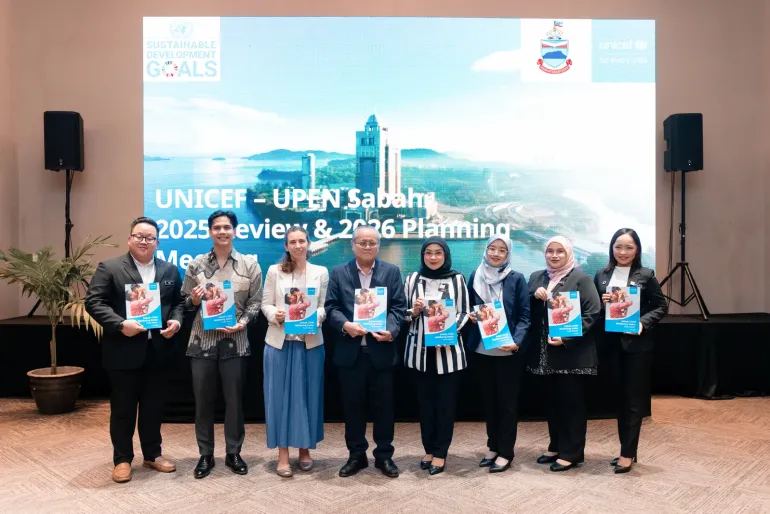
Kota Kinabalu, Sabah, 5 June 2026 – New research by UNICEF and the Sabah State Government’s Unit Perancangan Ekonomi Negeri (UPEN) provides a comprehensive picture of how children in Sabah are growing, learning and living.
The Sabah Child Wellbeing Index (SCWI) looks beyond household income to examine children’s lives across six areas: health, nutrition, learning, play and rest, safety and protection, and participation.
The study highlights important strengths, including strong family and community support and access to basic services for many children in Sabah. It also identifies areas where more investment is needed, particularly in ensuring safe homes and communities, access to nutritious food, improving adolescent health, and reliable internet
The study also found that children’s wellbeing tends to decline as they grow older, particularly during adolescence. Children with disabilities, as well as undocumented and stateless children, face some of the greatest barriers to wellbeing.
“This study paints a picture of how children in Sabah experience their daily lives across different aspects of wellbeing. By helping us understand these interconnected experiences, this index can support more inclusive responses, especially for those most at risk of being left behind,” said Robert Gass, UNICEF Representative in Malaysia.
Key findings highlight progress and persistent challenges
The study found that:
- Nearly 80 per cent of children have a strong sense of belonging to their school and community.
- Almost 1 in 4 children are not fully immunized.
- Fewer than one-third of adolescents aged 15–17 meet benchmarks for sexual and reproductive health, including access to information, services and trusted support.
- Fewer than one in three children meet growth and development thresholds, and many consume limited amounts of fruits and vegetables.
- Under 35 per cent of children have sufficient access to digital devices and reliable internet, which limits their ability to learn and participate online.
In addition, children reported that they lack opportunities for inclusive play, feel unable to freely express their opinions, or live in environments that do not meet adequate housing standards.
“Behind every data point is a child growing up in Sabah — a child who may feel supported by family and community, but who may also face challenges in getting nutritious food, accessing reliable internet, feeling safe or having their voice heard. These findings remind us that support must be shaped around children’s lived realities, with a focus on those facing the greatest barriers,” added Robert Gass, UNICEF Representative in Malaysia.
The findings also reveal disparities across districts. Deprivations tend to be higher in hard‑to‑reach areas such as Kudat, particularly in digital access and nutritious food consumption, and in Tawau, where vaccination gaps are more prominent.
Undocumented and stateless children experience some of the widest gaps in wellbeing, reflecting persistent barriers to accessing essential services such as healthcare and education.
The study engaged 4,441 children and caregivers across all five administrative divisions of Sabah, including children from underserved communities, such as children with disabilities and children who are undocumented or stateless.
The Sabah Child Wellbeing Index is intended to guide planning and decision-making by identifying where children need the most support and highlighting the need for stronger, more inclusive systems that reach every child, regardless of legal status or location.
Media contacts
Additional note:
Refer to the report here.
The SCWI adopts a participatory approach to understanding child wellbeing. Children, caregivers, government agencies and key civil society organizations took part in focus group discussions to define what wellbeing means in the Sabah context. The process informed the identification of six wellbeing domains and 37 indicators, ensuring that the index reflects the lived realities of children across the state.
Building on this framework, children across Sabah were surveyed across six domains: health, nutrition, education, play and rest, opportunities for participation as well as safe and enabling environments.
About UNICEF
UNICEF promotes the rights and wellbeing of every child, in everything we do. Together with our partners, we work in 190 countries and territories to translate that commitment into practical action, focusing special effort on reaching the most vulnerable and excluded children, to the benefit of all children, everywhere.
For more information about UNICEF and its work for children, visit www.unicef.org.
Follow UNICEF on X (Twitter), Facebook, Instagram, LinkedIn, YouTube, TikTok, & Threads.