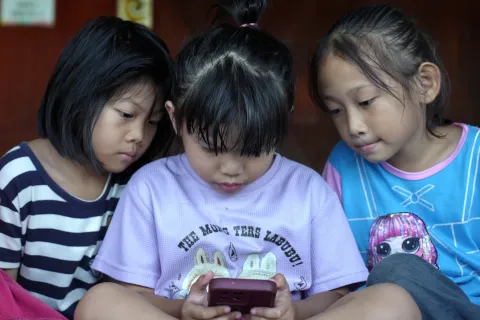
Age restrictions alone won’t keep children safe online, says UNICEF

KUALA LUMPUR, 12 December 2025 – UNICEF today reaffirmed that while governments are right to take online child sexual exploitation and abuse seriously, social media age bans on their own will not keep children safe online and may have unintended consequences.
Recent enforcement operations against child sexual abuse material (CSAM) in Malaysia highlight the scale and urgency of the threat facing children in digital spaces. UNICEF welcomes the strong commitment by Malaysian authorities to tackle CSAM and strengthen online safety, including through the Online Safety Act 2025 and efforts to hold digital platforms accountable.
At the same time, UNICEF cautions that age restrictions and bans must be part of a broader approach, not a standalone solution.
“Families are overwhelmed. Children are encountering bullying, grooming and sexual exploitation online, and the status quo is clearly failing them,” said Sanja Saranovic, Deputy Representative, UNICEF Malaysia. “But simply banning younger users from social media will not solve the problem. Many children will still find ways to go online, often through less regulated platforms, where it is harder to protect them and they will be less likely to seek help when something goes wrong.”
UNICEF emphasizes that social media is not a luxury for many children, especially those who are isolated, marginalized, or living with disabilities. Digital platforms can provide vital opportunities for learning, connection, play and self-expression. Any measure to protect children must therefore balance safety with their rights to participation, information and privacy.
UNICEF calls for a comprehensive, child-rights-based approach to online safety in Malaysia, which includes:
- Stronger platform responsibility
- Requiring social media and tech companies to redesign products with child safety and well-being at the centre;
- Implement systems and procedures to detect and block access to known CSAM;
- Investing in safer platform design, and effective content moderation;
- Providing child-friendly reporting channels and meaningful remedies when harm occurs.
- Rights-respecting age-appropriate designs and tools
- Using age-appropriate designs to offer safer, developmentally appropriate experiences for younger users rather than relying solely on bans;
- Developing rights-respecting age-assurance tools that are evidence based, proportionate to risks and privacy-preserving.
- Stronger regulation and enforcement
- Ensuring regulators have the powers and resources to require systemic risk assessments, independent audits and meaningful transparency from platforms.
- Support for parents, caregivers and schools
- Investing in social-emotional and digital literacy and parenting support, so adults are not left to “police algorithms they cannot see” or monitor dozens of apps alone.
“Online safety cannot rely on enforcement alone. Platforms, regulators, families, schools and communities must work together to create digital environments that are safe, inclusive and rights-respecting for every child,” said Sanja Saranovic, Deputy Representative, UNICEF Malaysia.
UNICEF stands ready to work with the Government of Malaysia, regulators, industry partners, civil society, parents and young people themselves to ensure that every child can safely learn, connect and thrive in the digital age.
Media contacts
About UNICEF
UNICEF promotes the rights and wellbeing of every child, in everything we do. Together with our partners, we work in 190 countries and territories to translate that commitment into practical action, focusing special effort on reaching the most vulnerable and excluded children, to the benefit of all children, everywhere.
For more information about UNICEF and its work for children, visit www.unicef.org.
Follow UNICEF on Twitter, Facebook, Instagram, YouTube, TikTok, & Threads.