Religious Leaders Support Polio Vaccination
Engaging influencers to end polio

When the Zomba District Health Office airlifted 500 polio vaccine doses in July, Phillip Katombosola could not wait for the drone to land at Magomero health centre.
The teacher, who sits on Magomero Catholic parish's church committee, considers the vaccine a reliable tool to prevent the global resurgence of wild poliovirus.
“As church leaders, we are keepers of our brothers and sisters, including children,” he says. “To ensure that everyone is safe, we urge adults to make sure that every child is vaccinated against the return of polio.”
Katombosola spoke at the Christian Health Association of Malawi (CHAM) facility at St Pius Catholic Parish, a 90-minute drive from Malawi’s old capital city, Zomba.
The parish priest nominated him for an orientation of leaders of different religious denominations on the importance of the mass polio vaccination.
He encourages religious leaders to share accurate information so that every child is sidestepped during the polio vaccination campaign launched by the Ministry of Health in July 2023.
"All God-fearing people have a moral duty to protect the vulnerable, not to endanger lives through false teachings that fuel vaccine hesitancy," he says.
Vaccine hesitancy surged during the three-year-old Covid-19 pandemic, which compelled people to stay home and avoid public gatherings. Then prayer houses had to shut down or convene fewer people per session.
During the public health emergency, Katombosola encouraged people to receive Covid-19 vaccines, wear masks, wash hands with soap, and observe social distancing.
While the faithful found it easy to mask up, wash hands at the doorstep and sit far apart, some religious leaders discredited the vital vaccines as evil and slow killers.
Looking back, Katombosola says religious leaders needed not to demonise and resist the vaccines that partly accelerated a return to normal.
“The disruptive disease remains a global threat, but I was filled with joy when I heard of an end to Covid-19 as a public health emergency. This confirms that vaccines work. They helped Malawi kick polio in the early 1990s, allowing generations that were at risk of permanent paralysis to enjoy healthy lives and learn without hardship."
The tale of overcoming energises Katombosola to publicly promote the polio vaccination campaign supported by UNICEF, World Health Organization, and the United States Centre for Disease Control and Prevention (CDC).
"As religious leaders, we should support public health staff to do their life-saving work instead of sowing unfounded fear and doubts. Let people decide," he says.
A week before the polio vaccination campaign, Katombosola took to the pulpit at St Pius parish to share tips from the polio vaccination orientation supported by UNICEF through the District Health Office (DHO). As the director of ceremonies, he implored the congregation to allow all eligible children to receive the vaccine.
"A huge crowd, even from the outstations, gathered at the parish to witness the confirmation ceremony usually led by our bishop. Surely I couldn't leave the microphone without talking about the disease that threatens the future of our children, church, and world unless every child is fully vaccinated," he says.
The teacher also discusses the benefits of the polio vaccine with children at his school, where over 500 children received the vaccine during the campaign. He tells them that the vaccine is a free and safe tool to protect their lives and futures, says the teacher.
“We're it for old people, I would have been the first to get vaccinated, but the campaign targets children under 15. My three children–15-year-old Fetina, seven-year-old Oscar, and 12-year-old Catherine–were among the first to receive the oral shots because I have to lead by example," he narrates.
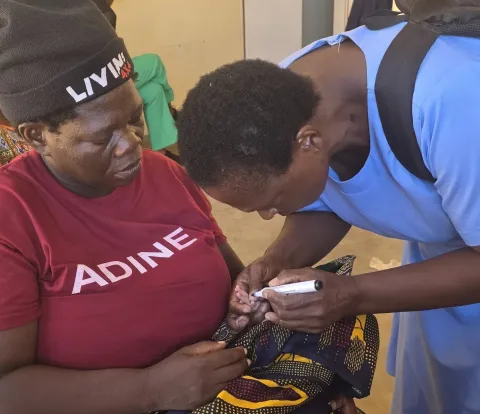
Following the arrival of the vaccine doses on a drone, Katombosola accompanied vaccination teams on a door-to-door walk to trace children not vaccinated at school.
Gracious Sitolo, a Standard Six boy who dreams of becoming a nurse, was vaccinated at his home by Health Surveillance Assistant Benson Wyson.
"I received the vaccine because our teacher talks about the dangers of polio both in class and at church. He tells us that the vaccine helps prepare our bodies to fight against the disease," the learner explains.
Wyson hailed religious and traditional leaders for making vaccination teams' work simple.
He stated: "Magomero health centre has 26 HSAs and 28 teams tasked to vaccinate at least 16 231 children during the campaign. We cannot meet the daily target of 4 058 without community support.
"But I'm certain that we will meet or even beat the target because everywhere we go, people are aware of the campaign and the importance of the vaccine because their village heads and religious leaders talk about it.