Nursery schools become health hubs as Under-5s get Vitamin A supplements in childcare centres
UNICEF supports Ministry of Health to promote child survival in Malawi

On a cool, misty morning in Chakhaza, Dowa, as tiny feet splashed through puddles on the way to school, four-year-old Natasha Chirwa sat giggling with her friends at Mbalasheka Community-Based Childcare Centre (CBCC). The rain drizzled softly on the thatched roof as Health Surveillance Assistant (HSA) Sarah Kunjunjunju stepped into the classroom with a small cooler box in her hand.
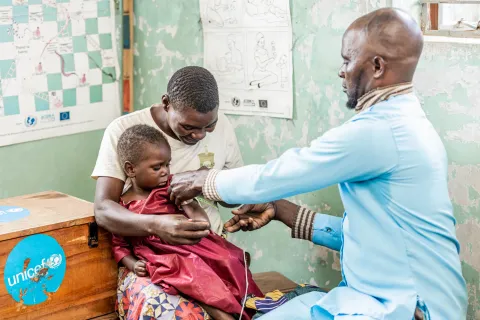
This wasn’t just another day of songs and play—it was a day for Natasha and her classmates to receive a crucial dose of Vitamin A and Albendazole, right in their familiar learning setting.
For years, Natasha’s mother, Christina Chirwa, had braved long walks to the under-5 clinic at Chakhaza Health Centre to ensure her daughter got the supplements. But now, thanks to an innovative approach, HSAs like Kanjunjunju are bringing these essential medicines directly to community nursery schools, making it easier for children to receive life-saving supplements in the company of their friends – no more long waits at the health centre, no more costly trips for parents, and less pressure on already overwhelmed clinics.
Alongside the bright red Vitamin A capsules, the children also receive Albendazole, medication given in tablet form that helps eliminate intestinal worms, ensuring the children stay healthy and thrive.

UNICEF, with funding from the Government of Canada, supports the Malawi Government in ensuring that every child who needs Vitamin A supplementation receives it.
The supplement is essential for enhancing immunity, growth, and development in children. It strengthens their vision, reduces the risk of blindness, and helps prevent childhood infections.
Christina Chirwa, who is not only Natasha’s mother but also a teacher at Mbalasheka CBCC, has noticed a remarkable improvement in the children’s health over the past six months since the school-based administration of Vitamin A and Albendazole began.
“The children are healthier, and we see fewer cases of sickness among them. As a parent, this also reduces my transport costs because I no longer need to take Natasha to the Under-5 clinic for these supplements,” she says.
For other parents, the initiative is a welcome relief. Chikondi Phiri, whose five-year-old son Francis received his second dose at Chakhaza CBCC, describes it as “killing two birds with one stone.”
“Under-5 clinics happen during weekdays, which meant taking children out of class to go to the clinic. They missed lessons. Now, they receive the supplements without any disruption to their learning,” says Phiri.
Loyce Macloud, whose three-year-old daughter Emily also learns at Chakhaza CBCC, agrees. She notes that many parents tend to neglect taking their children to the under-5 clinics once they stop breastfeeding.
“Most of us are busy with farming, and sometimes we feel taking the kids to the clinic is too much work. This initiative makes life easier because the supplements come to them,” says Macloud.

Kunjunjunju says the response from the community has been overwhelmingly positive.
“Parents have been very cooperative. They even ensure their children bring their health passports on the days we administer the doses,” she says.
She has also observed a significant reduction in cases of diarrhea and skin infections, which she attributes to the increased uptake of Vitamin A and Albendazole.
“The children are now healthier and more energetic,” says the health worker.
The initiative, which covers multiple CBCCs in the area, is being overseen by Chrissy Chinoko, the Senior Disease Control Surveillance Assistant for Chakhaza. She manages 17 HSAs tasked with administering the supplements across 18 CBCCs, reaching over 1,800 preschool learners in 60 villages.
“This initiative has been really helpful because we are now able to reach children whose parents do not bring them to the under-5 clinics,” Chinoko explains. “Secondly, we find the children in one place, which makes it easier for us to administer the doses. It is also more efficient.”
As little Natasha sucked from the Vitamin A capsule and chewed her Albendazole tablet under Kanjunjunju’s watchful eye, she was unaware of the profound impact these tiny medicines would have on her future. For her, it was just another school day, filled with friends and fun. But for her mother and thousands of other parents in Dowa, this simple yet powerful initiative is changing lives—one bright, healthy child at a time.