Keeping girls in school through UNICEF scholarships
Grace's story

It is every Malawian child’s dream to be selected for secondary school. Passing examinations is a mark of approval that all the hard work has paid off.
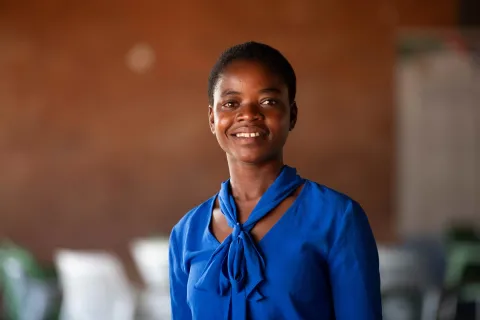
So when Grace Kalimo, 17, of Mtawa Village in Salima, received the news she’d passed her primary school exams, she was ecstatic.
However, her joy was short lived. Her parents earn a living from subsistence farming and found it too difficult to raise the money to pay for her school fees.
As a result, Grace was force to stay home instead of starting secondary school, and with no help in sight, her dream of gaining a secondary education seemed lost.
“I saw my friends going to school while I stayed home,” the form 3 student says, “I was so sad and thought that was going to be it for me.”
Then one day her uncle offered to go and talk to school authorities about Grace’s predicament. It was during the discussion her uncle was told about UNICEF scholarships.
“The teachers told my uncle I should apply. I did. Then I waited to know if I’d been approved. When the news finally came I was very excited.”
About 50% of girls in Malawi complete primary school, but only a third of these make it to secondary school and only one in five graduates. Most students fail to access secondary education because of the associated costs of secondary education. To address this, UNICEF through the KIND Fund has been supporting scholarships in Malawi since 2013. The scholarship helps with other school related costs, accommodation costs, learning materials, school bags, uniforms, sanitary pads and school shoes.
The scholarship has also eased the pressure on Grace’s parents. Instead of worrying, Grace now concentrates on her studies.
“I am very grateful. It was tough before. Without this scholarship, I am not sure what would have happened to me.”
“I will do everything in my powers to achieve my dream of becoming a nurse.”
Grace now hopes UNICEF extends the scholarship to as many girls as possible who come from under-privileged backgrounds like hers.
“I want to encourage girls who are in the same situation as I was in not to give up. They should work hard and focus on their education.”
COVID-19 impact on school
But despite the good news, UNICEF scholarship recipients have not been spared from the COVID-19 pandemic.
Grace’s school is now closed and because she lives in a rural area, she doesn’t have access to the internet or technology to boost her home learning. To address this, UNICEF is currently working with the Malawi Government and other partners to finalize self-study materials for form 3 and 4 secondary students.
However, Grace and her classmates also take part in group discussions.
“Every day, since the closure of schools, each one of us presents on topics that we are struggling with, so we help each other during group discussions.”
“Where we are stuck and need clarification, we go to the science teacher who lives nearby to help us.”
Grace says teachers advised her and her friends to continue studying and prepare for school to reopen.
“The teachers told us to frequently wash our hands and observe social distancing.”