Liffa’s rise: Small cash, big change
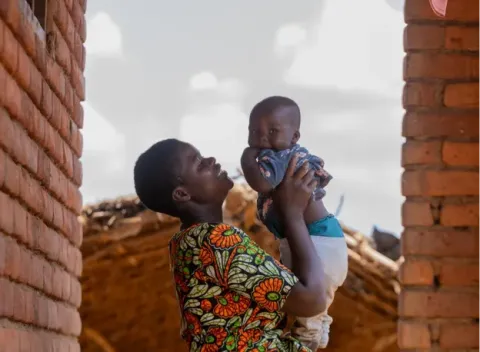
"I was able to pay school fees, buy books and ensure Liffa stayed in school through the SCTP.” Liffa's mother

When Liffa William’s name echoed through the graduation hall at the Malawi University of Science and Technology (MUST) on 24 July 2025, the moment was drowned in the ceremonial drumroll and muted by the vuvuzelas outside. Yet, for one woman sitting beneath the arched roof, it was the loudest, proudest moment of her life.
“I am very overjoyed from the bottom of my heart,” says an exuberant Modester Laja, Liffa’s mother. “I had nowhere to go with him. But God created a way where there was none.”
Liffa, 25, graduated in July 2025 with a Bachelor’s degree in Biomedical Engineering. His academic journey began in Mkamwana Village, Traditional Authority Kalembo, in Balaka, a place where children dream of education but often drop out before reaching secondary school.
“I struggled to find fees, textbooks and materials in both primary and part of my secondary school,” Liffa explains. “Before my mother was enrolled in the Social Cash Transfer Programme, we didn’t even have enough for proper meals, let alone books.”
Liffa's turning point came when his mother was enrolled in the Social Cash Transfer Programme (SCTP) in 2017. This is Malawi’s flagship social assistance programme implemented by the Malawi government across all the 28 districts with support from the World Bank, the European Union, the German government and the Government of Ireland.

The programme, to which UNICEF provides technical support, provides unconditional monthly cash transfers to ultra-poor, labour-constrained households. At the time she was enrolled into the programme, Laja was raising four children alone with no stable source of income.
She used the modest MK3,500 monthly stipend to launch a small business selling tomatoes, fish and bananas.
“It wasn’t much,” she says, “but I was able to pay school fees, buy books and ensure Liffa stayed in school.”
Her sacrifice paid off: Liffa earned 10 points, a top grade, in the exams for completion of secondary education – the Malawi School Certificate of Education exams – in 2018 and proceeded to the university.
But his acceptance into MUST introduced a new crisis — who would pay the university fees and other expenses?
UNICEF Malawi Social Protection Specialist George Juwawo recalls how routine field monitoring brought Liffa’s story to their attention.
“His household was doing better because of the SCTP. But when we learnt he had been selected to the university, we knew the programme had to evolve into something more transformative,” he explains.
That evolution came in the form of ‘Cash Plus’ interventions — where households are not just given cash but also linked to opportunities that amplify impact.
UNICEF and the Ministry of Gender, Community Development and Social Welfare approached First Capital Bank (FCB), already a disbursement partner for SCTP, with a request to sponsor Liffa’s studies.
FCB listened — and acted.
“The bank committed MK8 million (about US$ 4,600) to cover costs for William’s five-year university education. This included tuition fees, on-campus accommodation, meals, stationery, other academic requirements and a modest out-of-pocket allowance to ensure his well-being throughout his studies,” explains Twikale Chirwa, FCB’s Head of Marketing and Communication.
The bank’s motivation went beyond philanthropy.
“William’s story perfectly embodies the transformative potential of financial inclusion and social protection. His mother’s wise use of SCTP funds to support her child’s education resonates deeply with our core belief at FCB — that when you empower households with the right resources, they can break the cycle of poverty,” Chirwa adds.
Laurent Kansinjiro, Deputy Director for Social Welfare in the Gender Ministry, sees Liffa’s graduation as validation of what SCTP was designed to do.
“People say cash transfers breed dependency. But stories like Liffa’s show the opposite. With the right support, poor households can transform and build strong human capital,” he explained.
He notes that while SCTP’s immediate goal is to meet basic needs — food, education and shelter — it also aims for long-term human capital development. “We are talking about generational change here.”
Indeed, Liffa is already influencing his younger siblings and extended family.
“When I go back home, I want to encourage my other children and my relatives’ children to scale the same heights,” said Laja.

UNICEF continues to support Malawi government to align social protection with the country’s 2063 development goals. That includes generating evidence, supporting policy design and linking vulnerable households with education, nutrition and climate-smart interventions.
And while Liffa’s journey is personal, its implications are national. Kansinjiro sees Liffa’s graduation as more than a personal milestone.
He sees Liffa’s story as a path toward sustainable graduation from poverty.
For Liffa William, the impact of his journey speaks loudly, powerfully and with the promise that more stories like his are possible when the right hands come together to lift.