How Malawi is tackling public health emergencies
“UNICEF played a vital role in building the capacity of our clinicians and nurses,” Allan Chilima

In recent years, Malawi’s health sector has faced an increasing number of disease outbreaks, stretching already limited resources. From cholera to measles and COVID-19, the need for coordinated and collaborative emergency responses has become more critical than ever.
In Kasungu District, in the central region of Malawi this need is being addressed through strengthened public health emergency coordination structures, made possible with the support of UNICEF. Working in partnership with district councils and other stakeholders, UNICEF with support from Foreign, Commonwealth & Development Office (FCDO) has enhanced the district's capacity to respond swiftly to health crises by supporting the Public Health Emergency Management Committee and Rapid Response Team (RRT) meetings.
Chrispin Thom, Environmental Health Officer and Integrated Disease Surveillance and Response (IDSR) Coordinator at Kasungu District Hospital, explains that the Public Health Emergency Management Committee brings together a range of actors. “Our team includes officers from the Ministry of Health, the water department, security agencies including the police, NGOs, and the animal health/veterinary department,” he says.
This collaborative approach follows the Ministry of Health’s One Health strategy, which recognises that human health is closely linked to the health of animals and the environment. Thanks to this strategy, the Kasungu Public Health Emergency Management Committee has achieved notable successes. District WASH Officer Charles Kumwenda attributes the early containment of cholera in the district to the team’s coordinated response. “We recorded our last case of cholera in April 2023,” he says. “The unity and collaboration within the team have enabled us to respond promptly to outbreaks and other emergencies.”

Cecilia Trinity Kamiza, Nursing and Midwifery Officer and Infection Prevention and Control Coordinator, emphasises that planning and coordination are essential during emergencies. “We work with all departments at the District Health Office and the Council. The clinical and nursing departments support us in case management, while the laboratory team helps identify diseases through sample analysis,” she explains.
Kamiza also highlights the crucial role of the surveillance team, which conducts community investigations and monitors health indicators. “Our health promotion officers assist with awareness campaigns, especially in communities where most outbreaks begin. We work together to develop and share health messages,” she adds. The animal health department also plays a key role in guiding responses to zoonotic diseases.
The inclusion of the Malawi Police Service in the Public Health Emergency Management Committee activities illustrates the broad scope of collaboration. Deputy Commissioner of Police for Kasungu, Aubrey Johns Nyirenda, explains that the police help regulate population movement during emergencies to prevent the spread of disease.
Clinical Officer Edwin Jumbo reflects on the support received during the 2022–2023 cholera outbreak. “UNICEF played a vital role in building the capacity of our clinicians and nurses. They also helped raise community awareness and facilitated training for Health Surveillance Assistants, Health Management Committees, and their sub-committees,” he says.
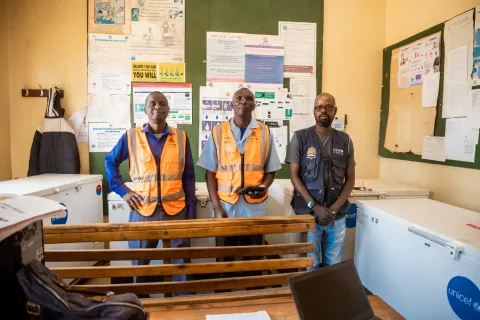
Moses Chavula, District Implementation Plan Coordinator, further notes that UNICEF supplied Personal Protective Equipment, medications, and other essential supplies needed to combat the outbreaks.
The broader collaboration has extended to developing hazard-specific response plans, conducting regular meetings, and creating district-level response mechanisms. These efforts are not only helping Kasungu respond to current emergencies but also building resilience for future challenges.
As Malawi continues to navigate public health threats, Kasungu stands out as an example of how strong coordination and multisectoral partnerships can safeguard communities. The district’s experience shows that, when health systems, communities, and partners work together, timely and effective responses to emergencies are possible.